Night Desert Safari Abu Dhabi: Stars, Fire & the Desert After Dark
Dune bashing at golden hour, BBQ under the stars, fire and Tanoura shows, then real darkness for stargazing — at our own private Al Khatim camp, from AED 35 per person.
The Short Answer
In Abu Dhabi, the night desert safari is the evening safari at full length: pickup 3:00–3:30 PM (3 in the afternoon, never 3 AM), dune bashing and sunset in daylight, then the whole camp programme — BBQ dinner, fire show, Tanoura, belly dance, shisha, stargazing — after dark until departure at about 9:30 PM. Shared places cost AED 35 self-drive, AED 50 by bus or AED 100 with hotel pickup. If you would rather sleep out and wake to sunrise, book the overnight safari at the same camp.
| Key fact | Detail |
|---|---|
| Pickup | 3:00–3:30 PM — afternoon, never 3 AM |
| Darkness falls | Around 6–7 PM by season; the programme continues in full darkness |
| Return | Back in Abu Dhabi about 10:00–10:30 PM the same night |
| Price from | AED 35 self-drive · AED 50 shared bus · AED 100 hotel pickup · VIP majlis +AED 50 |
| Where | Our private camp at Al Khatim, ~80 km east on the E22 — 50–60 minutes |
| Booking | WhatsApp +971 58 228 2683 · pay on arrival · free cancellation up to 12 h before |
What Is a Night Desert Safari in Abu Dhabi?
A night desert safari in Abu Dhabi is the standard evening safari run to its natural conclusion: the drive out and dune bashing happen in daylight, sunset is watched from the dunes, and everything at camp — dinner, live shows, shisha, stargazing — happens after dark. You return the same night, around 10:00–10:30 PM. There is no separate “night-only” departure.
Booking sites list “evening safari”, “sunset safari”, “night safari” and “Arabian nights desert safari” as if they were four products; here they are one experience with four names. Darkness arrives partway through — and the after-dark half is the better half: dunes cool, lamps on, the fire show finally making sense.
The one genuinely different product is the sleepover: if you searched “desert safari night stay”, you want the overnight safari, compared below — choosing wrongly is the most common night-safari mistake we see.
Is Pickup at 3 AM or 3 PM? Night Safari Timings, Cleared Up
Pickup is at 3:00–3:30 in the afternoon — 3 PM, never 3 AM. Nothing in the Abu Dhabi desert departs at three in the morning; at that hour the only people in the dunes are overnight guests asleep at camp. The “night” in night safari refers to when the experience ends, not when it begins.
We answer this on WhatsApp almost daily, and travellers ask it on review forums, because listings print “3:00” with no AM or PM. In practice: mid-afternoon collection, golden hour on the dunes, full darkness at camp, drop-off around 10:00–10:30 PM.
Everything is pegged to sunset, which swings between roughly 6 and 7 PM, so winter evenings give more darkness at camp. The full schedule sits on our desert safari timings page.
Evening-Night Safari vs Overnight Safari: Which Do You Need?
The evening-night safari returns you to the city the same night at 10:00–10:30 PM; the overnight safari keeps you at camp to sleep, adds the late-night sky, dawn and breakfast, and returns you next morning. Same camp, same shows, same dinner — the difference is purely whether you go home or stay.
Here is the comparison nobody else publishes — the last row is the decision in one line.
| Question | Evening-night safari | Overnight safari |
|---|---|---|
| Pickup time | 3:00–3:30 PM (afternoon) | 3:00–3:30 PM — identical |
| Return | Same night, 10:00–10:30 PM drop-off | Next morning, after sunrise and breakfast |
| Time in darkness | Sunset (~6–7 PM) to the ~9:30 PM departure | The entire night, plus the pre-dawn sky |
| Do you sleep in the desert? | No — dinner, shows, stars, then home | Yes — beds at our private camp |
| Stargazing | After-dinner session away from the lamps | The deepest skies come late, after the camp dims |
| Sunrise and animal tracks | Not included | Dawn light and the night’s fresh animal tracks |
| Dinner and live shows | Full programme: BBQ buffet, fire show, Tanoura, belly dance | Same programme, then the quiet night |
| Price | From AED 35 self-drive · AED 50 bus · AED 100 hotel pickup | Listed on the overnight safari page |
| Book it if… | You want the desert after dark but your own bed | You want the whole night sky and the dawn |
A useful shorthand: the evening-night safari is a night out; the overnight is a night away. Stargazers timing a new moon should stay over — the late sky and the sunrise hour reward it. Anyone with an early flight, or allergic to camping, should go home to air conditioning.
How Much Does a Night Desert Safari in Abu Dhabi Cost?
The night desert safari costs from AED 35 per person if you drive yourself to our Al Khatim camp, AED 50 with shared bus pickup from Al Wahda Mall or Mazyad Mall, and AED 100 with shared hotel or home pickup. Private options: AED 599 for a 7-seater car, AED 800 for a Land Cruiser.
There is no “night premium” — after-dark is simply part of the evening safari price. Every tier gets the same camp experience; you choose transport and seating.
| Option | Price (AED) | Good to know |
|---|---|---|
| Self-drive — meet at our camp | 35 per person | Cheapest route in; navigate to our pin off the E22 |
| Shared bus — Al Wahda Mall or Mazyad Mall | 50 per person | Handy for the city centre and Mussafah side |
| Shared safari with hotel/home pickup | 100 per person | Door-to-door; back at your hotel around 10:00–10:30 PM |
| VIP majlis upgrade | +50 per person | Reserved low-seating majlis with the best view of the shows |
| Private 7-seater car | 599 per car | Your own vehicle and driver all evening and night |
| Private Land Cruiser | 800 per car | The full dune experience, privately, for your group |
Every ticket includes dune bashing, sandboarding, a short camel ride, the sunset stop, falcon photo opportunity, henna, Arabic coffee and dates, unlimited soft drinks and tea, the live shows and the veg and non-veg BBQ buffet. Pay on arrival, cash or card — no deposit, free cancellation up to 12 hours.
Book Your Night in the Dunes
From AED 35 per person · pickup 3:00–3:30 PM · back by 10:30 PM · pay on arrival.
Hour by Hour: The After-Dark Programme at Our Camp
After sunset the camp changes character: lamps on, coals down, the programme running show by show until vehicles load at about 9:30 PM. The timeline flexes with the season — everything follows the sun.
| Time | What happens |
|---|---|
| 3:00–3:30 PM | Hotel/home pickup, bus from Al Wahda or Mazyad Mall, or self-drive |
| Late afternoon | Arrive Al Khatim; tyres deflated, then dune bashing while the light is good |
| Golden hour | Sunset photo stop on a high dune; sandboarding and the short camel ride |
| ~6–7 PM (seasonal) | Sunset. Lamps on; Arabic coffee and dates as the sky deepens |
| Early evening | Falcon photos, henna, and a wander up the nearest dune as stars appear |
| ~7:30–8:00 PM | BBQ buffet opens — grills and a full vegetarian line, salads, breads, dessert |
| After dinner | Fire show, spinning Tanoura, then belly dance — the Arabian-nights tableau under a black sky |
| Later | Shisha, sweet tea and stargazing away from the lamps |
| ~9:30 PM | Vehicles load for the drive back to the tarmac |
| 10:00–10:30 PM | Drop-off at your hotel or pickup point in Abu Dhabi |
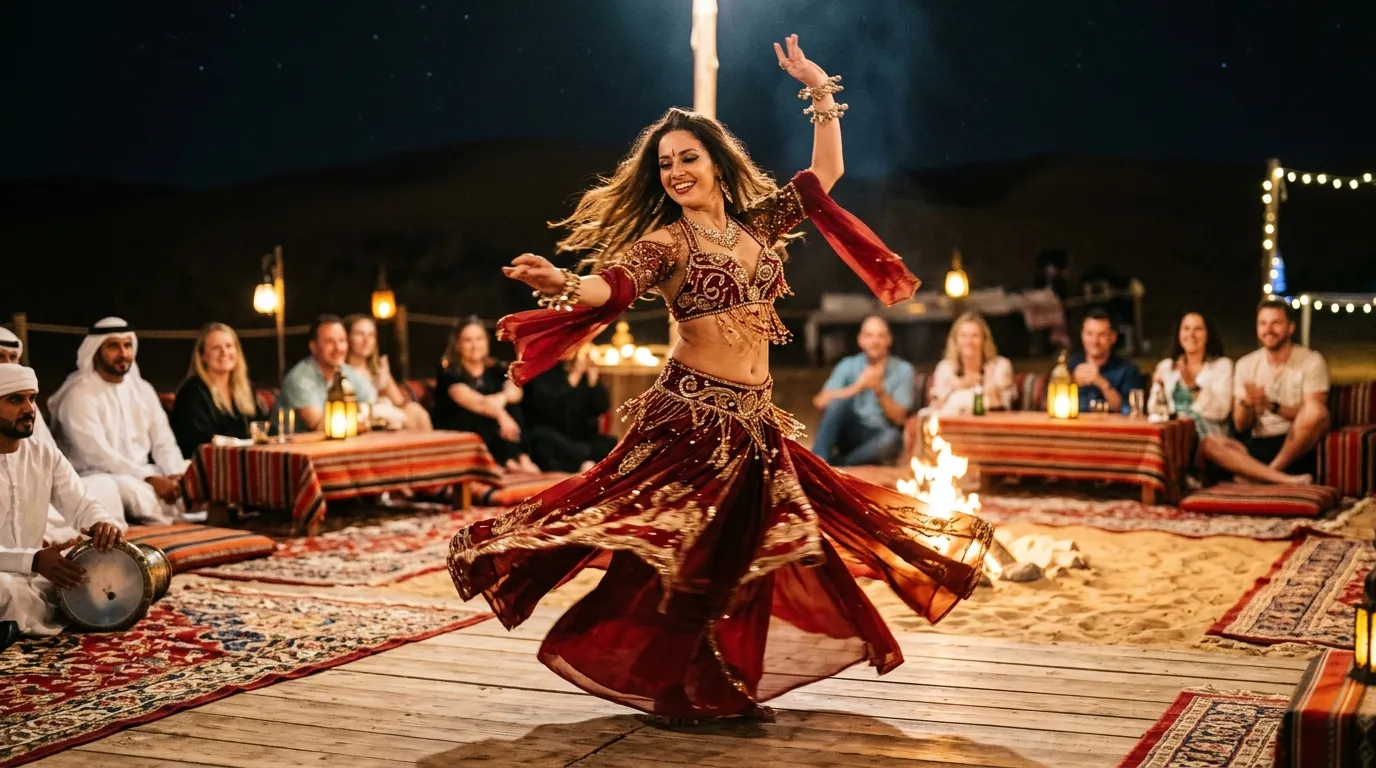
One detail guests rarely expect: the shows are sequenced for darkness — fire first, dance last — and the gap between sunset and dinner is left free for climbing the dune behind camp. Asked to start the fire show early, we refuse; against a half-lit sky it loses everything.
Why Dune Bashing Happens Before Dark (and Why That Is a Good Thing)
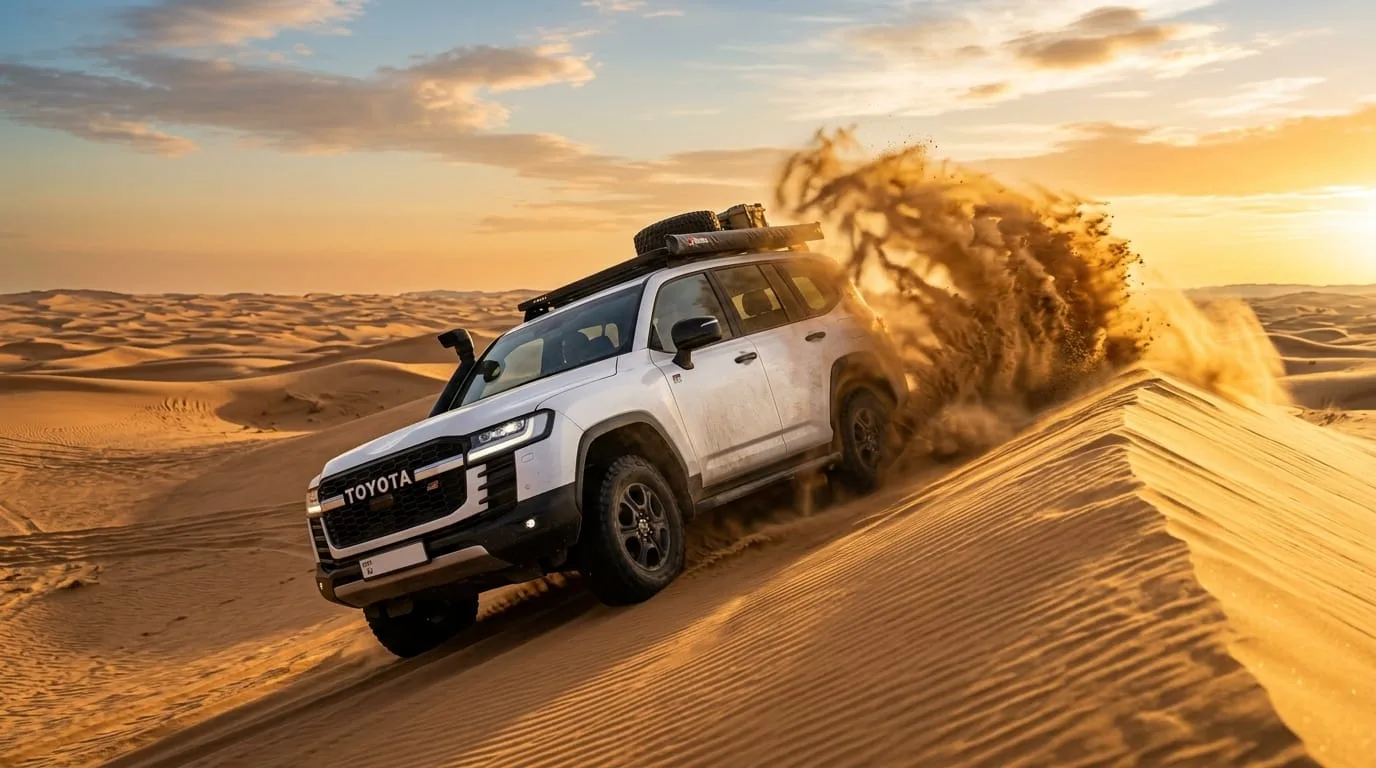
Dune bashing runs in daylight and ends around sunset — no operator in Abu Dhabi drives the big dunes in darkness, and none should. Our drivers read the sand by sight: the ripple patterns, the shadow on a slip face, the crust that says a crest will hold. Headlights flatten all of that into guesswork.
Sand changes daily with wind and humidity; a ridge crossed at speed yesterday can be scooped hollow today, and the warning is visual. So the driving takes the bright, low-angle light of late afternoon, and the after-dark return follows a known flat track, gently.
The honesty carries a bonus: the dunes come before dinner — roller-coaster driving on a full stomach is a combination nobody enjoys. If driving is your main event, read our dune bashing guide and ask about an extra daylight run.
How Dark Does the Desert Really Get at Al Khatim?
Dark enough for serious stargazing. Our camp sits roughly 80 km east of Abu Dhabi’s light dome, and on a clear, moonless night the Milky Way shows to the naked eye once your eyes adjust. You will still notice a faint western glow — the city — but overhead the sky is genuinely black.
We would rather tell the truth than sell a planetarium. The UAE’s certified darkest spot is Al Qua’a, about 125 km and roughly 90 minutes southeast; astronomers go there for a reason. Al Khatim is the practical compromise: 50–60 minutes from town, dunes over 100 metres blocking stray ground light, and skies that reward eyes and cameras without becoming an expedition.
What surprises guests most is the darkness underfoot. Step past the last lamp and night vision opens within minutes: crests appear against the sky, and on a moonless night starlight is enough to walk by. Our Al Khatim desert guide covers the area in daylight.
Stargazing on a Night Safari: What You Can Actually See
On a clear, moonless night expect the Milky Way overhead, the brighter planets when they are up, shooting stars if a shower is running, and more stars than most city dwellers have ever seen. On a full-moon night expect the reverse: few stars, but silver dunes bright enough to walk without a torch.
Three things decide your sky: moon, dust, season. The moon matters most — it gets its own section below. Haze softens the hotter months, while crisp winter evenings produce the sharpest skies: one more reason the cool season is peak desert time, as our best time to visit guide explains.
After the shows, take your tea beyond the lamps and give the sky a few patient minutes; our crew will point you to the darkest edge of camp. For the full deep-sky version, we run dedicated stargazing safaris.
Moon-Phase Planning: Choose the Night Sky You Want
Book within about five days of a new moon for the darkest sky and a naked-eye Milky Way; book near the full moon for silver dunes and easy walking. Both are superb, different nights — and nobody else tells you to check the moon before picking a date.
| Moon phase | The sky | The dunes | Book it for |
|---|---|---|---|
| New moon (within ~5 days) | Fully dark; naked-eye Milky Way on clear nights | Black shapes against a starfield | Serious stargazing and astrophotography |
| Young crescent | Hangs low after sunset, then sets — dark sky afterwards | Briefly silvered, then dark | The best of both, plus a photogenic moonset |
| Quarter moon | About one-sixth of full-moon brightness — brighter stars still show | Ridgelines softly lit | A balanced night if your dates are fixed |
| Full moon | Washes out all but the brightest stars and planets | Glowing silver, crisp shadows — walk without a torch | Moonlit dune walks and landscape photography |
If your dates are flexible, decide what you want first: photographers chasing the galactic core need the new-moon window; couples usually love the full moon, when the desert becomes a black-and-white photograph you can walk into. Check a moon-phase app — or send your dates on WhatsApp and we will check the moon for you. More detail lives in our Abu Dhabi desert stargazing guide.
Nocturnal Wildlife: What Moves in the Dunes After Dark
Once the sand surface cools after sunset, the desert’s night shift clocks on: Arabian red foxes, gerbils, geckos and — if you are very lucky — the Pharaoh eagle-owl. Straight truth: sightings are a bonus, never a promise; any operator who guarantees wild animals is selling something.
The first hours of darkness are the busiest — exactly your hours at camp. The most reliable show is written, not performed: by morning the sand is stitched with neat fox lines and tiny gerbil hop-prints, the whole story readable at dawn.
| Species | When it is active | What you might actually notice |
|---|---|---|
| Arabian red fox | Most nights, once the sand cools | Eye-shine at the lamplight’s edge; tidy paw lines by morning |
| Rüppell’s fox | Night; deeper and shyer | Smaller tracks; a big-eared silhouette if fortunate |
| Desert hedgehog | The first hours of darkness | A rustle under a shrub near camp |
| Cheesman’s gerbil | After dark | Paired hop-prints and fresh diggings by dawn |
| Wonder gecko & short-fingered gecko | Warm nights | A second of torchlight on firm sand |
| Pharaoh eagle-owl (“Buma”) | Night; a silent hunter monitored by Abu Dhabi’s environment agency | A low call across the dunes if you are lucky |
| Sand boa | Occasional night mover | S-shaped drag marks on the slip faces |
| Dhub (spiny-tailed lizard) | Day-active — asleep after dark | Its burrows; the lizard itself only in daylight |
Keep torches low and voices lower on the dune walk to raise your odds. Full profiles are in our guide to the animals of the Abu Dhabi desert.
A Night Photography Mini-Guide for the Dunes
One piece of kit brings home genuinely good night photographs: something to hold the camera still — a small tripod, a bean bag, a jacket on a cool bonnet. After that it is settings, and they are simple.
| Shot | Support | Settings that work |
|---|---|---|
| Milky Way over the dunes | Tripod, wide-angle lens | Manual mode: f/2–2.8, ISO 1600–6400, 10–30 second exposure |
| Pin-sharp stars (no trails) | Any | The 500 rule: 500 ÷ focal length = maximum seconds before stars streak |
| Full moon close-up | Tripod, your longest lens | ISO 100, f/11, around 1/125 second — the moon is sunlit rock |
| Phone shots | Small tripod or a propped bag | Night mode, lens wiped clean, hands off during the exposure |
| Fire show | Handheld is fine | Let the flames light the frame; shoot bursts, keep the sharpest |
Fieldcraft matters as much as settings: walk beyond the camp lights — our drivers know the dark ridges — and focus manually on a bright star, not autofocus’s guess.
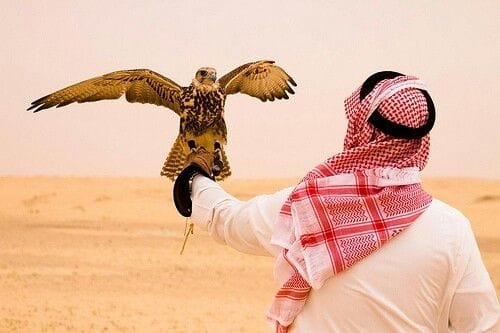
How Cold Does the Desert Get at Night — and What Should You Wear?
The desert cools fast after sunset — dry sand sheds its heat quickly — so even summer evenings turn pleasant late in the programme. In winter, bring a proper jacket: Abu Dhabi city sees January lows around 14°C, and the open desert reads noticeably colder, especially with a breeze over the dunes.
This catches out more guests than anything else: people pack for the 3 PM pickup and forget they will be sitting outdoors at 9 PM. At night even the sand turns cold to the touch.
On your feet, anything that slips off easily wins — the camp carpets are a barefoot zone. The season-by-season packing list is in our what to wear guide.
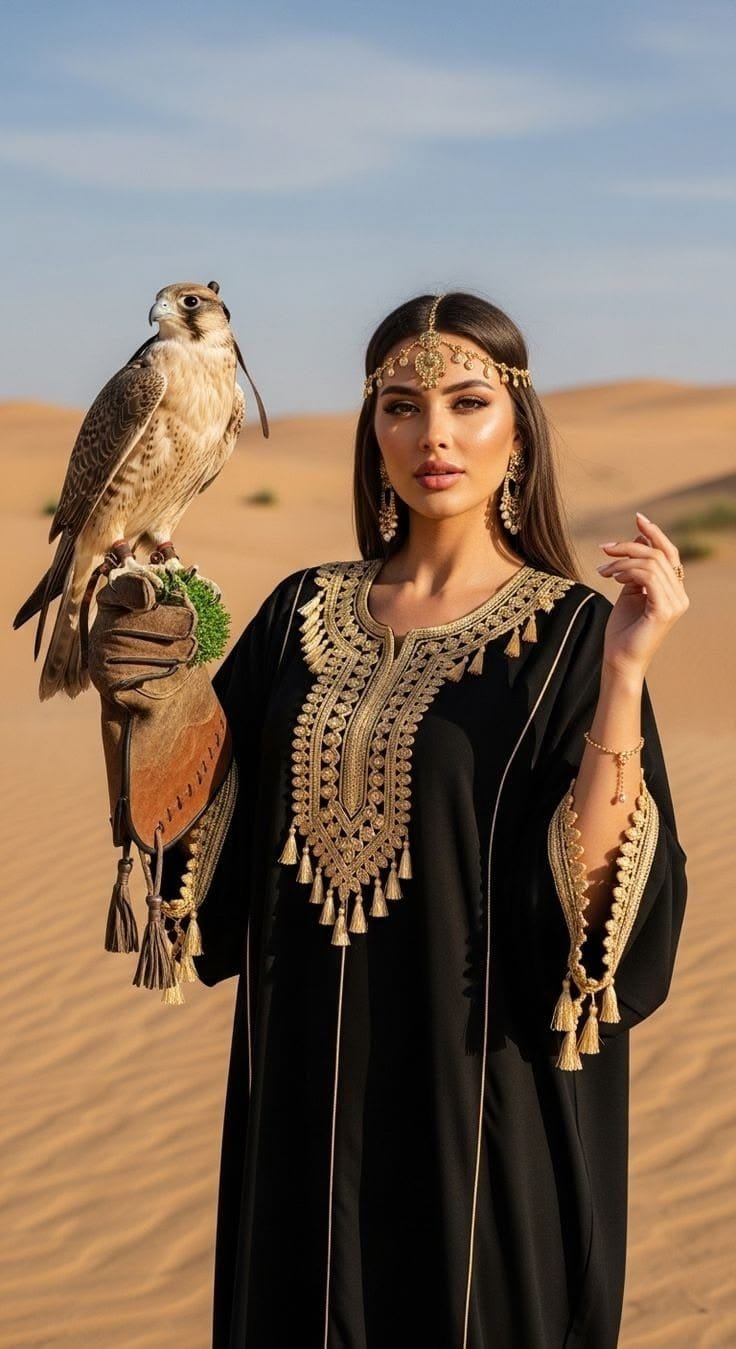
Who Should Book a Night Safari — and Who Shouldn’t
We would rather match you to the right trip than win the wrong booking.
Still torn? Tell us on WhatsApp who is coming, what you want to see, and your dates — we will say plainly which trip fits, even when it is the cheaper one.
VIP Majlis and Private Night Safaris
Two upgrades change the night. The VIP majlis, +AED 50 per person, reserves cushioned low seating with the clearest view of the fire show and stage — worth it on busy winter evenings. Details on the VIP safari page.
Going private changes the rhythm rather than the seats. A private 7-seater is AED 599 per car and a private Land Cruiser AED 800; your group rides alone, the driver paces the dunes to your nerves, and the sunset stop lasts as long as your camera needs. It is the format we recommend for proposals — the dark dune behind camp has hosted a few.
Your own vehicle also means the stargazing stop happens where the sky is best, not where the convoy parks. Comparisons on our private desert safari page.
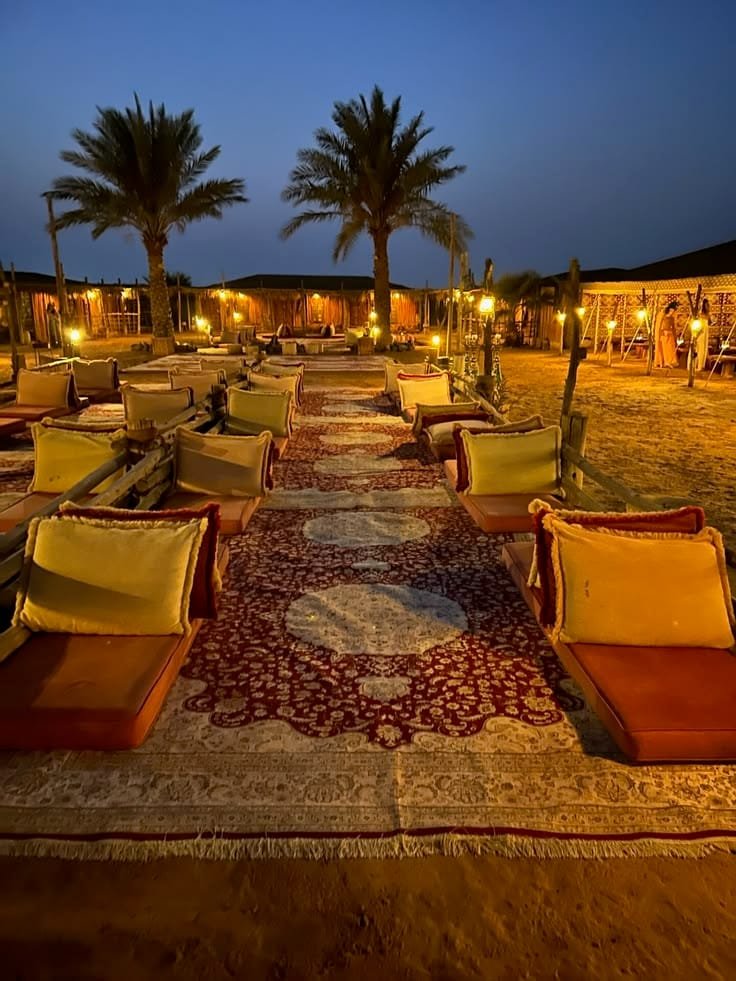
Why Book the Night Safari With Us
Because the camp is actually ours. Most “night safari” listings resell seats at shared camps they have never operated; we built and run our own in the Al Khatim dunes — which is why we can tell you where the dark ridges are and what the moon will do on your date.
It is built the traditional way — carpets, low seats, coals, lamplight — closer to a true Bedouin majlis than a floodlit arena. You notice the moment the shows end and the silence takes over.
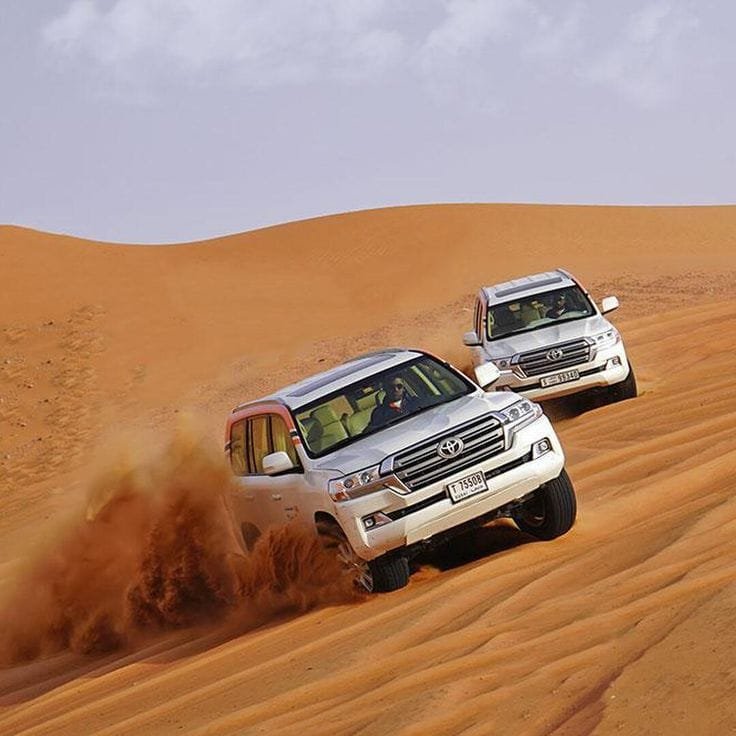
A Licensed Operator, Not a Reseller
Royal Arabian Safari Tourism LLC is a DCT Abu Dhabi licensed tour operator — office at Al Sila Tower, Al Maryah Island — with its own private camp in the Al Khatim desert. More than a decade of desert nights, over 5,000 guests hosted, and a 4.9★ Google rating. Pay on arrival — cash or card — no deposit, no booking fee, free cancellation up to 12 hours before.
The Desert Is Better After Dark
From AED 35 per person shared · AED 599 private 7-seater · AED 800 private Land Cruiser. Tell us your date; we will tell you the moon phase.
Night Desert Safari Abu Dhabi — Frequently Asked Questions
Quick factual answer:
Desert safari Abu Dhabi night temperature by season at Al Khatim Desert (GPS 24.1302, 54.6136): December-February evenings run 12-18°C by the 10:30 PM safari return, occasionally dipping lower on clear still nights — a light jacket or hoodie is genuinely needed; March and November run 18-23°C (light layer advised); April and October 22-27°C (optional layer); May-September evenings stay 28-33°C after sunset cooling from 40°C+ afternoons — no layer needed, the night breeze is the season’s relief. The desert cools 12-18°C from its daytime peak within hours of sunset because dry air and clear skies allow rapid radiative heat loss — far faster than coastal Abu Dhabi city, which stays several degrees warmer overnight due to humidity and urban heat. The evening safari (pickup 3:00-3:30 PM, return ~10:30 PM) ends before the night’s true minimum, which arrives pre-dawn. The camp provides warmth via fire, hot drinks (unlimited tea and coffee), and sheltered majlis seating. Every package from AED 35 includes the same camp; book via WhatsApp +971582282683.
Last verified: June. The table reflects standing climate patterns for the camp’s coordinates; for an unusual forecast on your specific date (rare rain or wind events), the booking thread gives same-day guidance — and our rain-policy page covers what weather can and cannot change.
Why Desert Safari Abu Dhabi Night Temperature Drops So Fast
The desert’s famous evening plunge is straightforward physics, and knowing it makes the packing advice stick. Sand is a poor heat bank: it absorbs the day’s energy in a shallow surface layer and surrenders it within hours of sunset. Dry air compounds the surrender — humidity is the atmosphere’s blanket, trapping outgoing warmth, and Al Khatim’s interior air is dramatically drier than coastal Abu Dhabi’s, so the desert radiates its heat straight up into a cloudless sky with nothing to catch it. The result is a routine 12-18°C swing between afternoon peak and late evening that coastal cities never experience: the city’s humid marine air and concrete hold warmth all night, while 80km inland the same evening sheds it by dinner. This is also why the desert’s winter stars blaze so hard — the same dry transparent air that releases the heat admits the Milky Way (Bortle 3 skies, the stargazing page has the full astronomy) — and why Bedouin culture wrapped itself in layers and fire pits for millennia. The swing is not a flaw in the desert evening; it is the desert evening, the reason January dinner happens beside a fire under impossible stars, and the entire phenomenon is defeated by one item: the layer you almost left at the hotel.
For the curious, the same mechanism explains the desert’s morning chill that surprises sunrise-safari guests, the legendary clarity of desert astronomy worldwide, and why every desert culture on Earth independently invented the same answers — fire, layers, hot drinks, and gathering. Physics wrote the desert’s social calendar long before anyone scheduled a show on it.
What to Wear for Each Desert Safari Abu Dhabi Night Temperature Band
Deep winter (Dec-Feb): the two-layer evening
T-shirt under a real jacket, hoodie or fleece — not a decorative shrug. Long trousers, closed shoes, and for the cold-sensitive a light scarf that doubles for dune photos. You will shed the layer during active dune time and live in it from dinner onward; the fire and unlimited hot drinks handle the rest. Children need the same logic one notch warmer.
Shoulder months (Mar, Apr, Oct, Nov): the tied-around-the-waist season
One light layer — overshirt, light hoodie — carried, not worn, until roughly 8 PM decides for you. The classic shoulder-season error is trusting the warm afternoon pickup; pack for the table’s evening column, not the 3 PM window you booked in.
Summer (May-Sep): dress for the day, enjoy the night
Breathable light clothing start to finish — the evening’s 28-33°C with a desert breeze is the day’s reward, not a problem to dress against. The summer packing list is sun-side: cap, sunglasses, sunscreen for the daylight hour, then nothing but comfort after dark.
The universal kit, every month
Closed comfortable shoes (sand goes cold before air does — winter toes notice), sunglasses for the drive and dunes, and the first-time guide’s five-item list. The camp covers blankets-level warmth needs around the fire; your job is only the personal layer. The what-to-wear guide carries the full wardrobe logic, fabric choices and the ladies-specific notes this card compresses.
How the Camp Handles the Desert Safari Abu Dhabi Night Temperature
The camp was designed by people who have sat through every one of the table’s twelve rows, and its thermal engineering shows. Winter’s toolkit: the fire — the camp’s literal and social centre from November to February, around which seating naturally migrates; unlimited hot tea, coffee and kahwa flowing all evening (the desert’s original central heating); sheltered majlis seating that blocks the night breeze that makes 14°C feel like 10°C; and a show programme whose fire performance lands, not coincidentally, in the evening’s coldest stretch. Summer’s toolkit inverts: open-sided seating engineered to catch and channel the night breeze, cold-drink stations doing constant duty, the late seasonal sunset pushing the whole programme into the cooled hours, and the camp’s interior layout shading every transition of the daylight hour. The 3:00-3:30 pickup and ~10:30 return are themselves thermal engineering — the schedule occupies the desert’s most habitable daily window in every season, skipping summer’s brutal early afternoon and winter’s pre-dawn freeze alike. Guests sometimes ask whether the camp has heaters or air conditioning; the honest answer is that the desert evening, correctly scheduled and correctly dressed, needs neither — four thousand years of Bedouin practice and twelve thousand recent guests agree on fire, layers, hot drinks and timing, and the camp simply industrialised the formula.
How the Desert Safari Abu Dhabi Night Temperature Moves Through One Evening
You board at or near the daily maximum (the table’s first column), but in air conditioning — the hot hour is a window view, not an experience. Summer guests feel this engineering most: 43°C exists, briefly, on the other side of the glass.
Open-desert air starts shedding within an hour of the sun’s decline. Dune-time temperatures run 3-6°C below the daily peak and falling — active, adrenalised bodies notice it less than thermometers do.
The moment the disc drops, radiative cooling takes over entirely and the desert loses 1-2°C per hour, fastest in winter’s driest air. The golden-hour warmth on your photos is the day’s last; the layer’s hour approaches.
Winter guests reach for the jacket here; shoulder-season guests untie it from the waist; summer guests register only that the evening has become pleasant. The hot kahwa’s timing is not an accident.
Dinner and the shows run in the month’s listed range — winter’s 12-17°C beside the fire, summer’s 28-32°C in the breeze — the stable heart of the evening’s thermal story.
The desert keeps cooling toward a pre-dawn minimum several degrees below anything you experienced — winter’s open desert can approach single digits by 5 AM — but that chapter belongs to the overnight-safari guests and their heavier kit. The evening format exits at intermission, by design.
Why Your Abu Dhabi Weather App Misleads You About the Desert
The single most common temperature error guests make is packing from the city forecast, so the correction deserves its own section. Coastal Abu Dhabi and inland Al Khatim are different climates wearing the same emirate: the city sits on humid Gulf air that blankets its heat overnight, surrounded by concrete and asphalt re-radiating the day, so a January city night holds 17-19°C while the open desert 80km east sits at 12-14°C. Summer flips the comparison’s comfort, not its direction — the desert’s 30°C dry evening feels markedly better than the city’s 33°C at 80% humidity, which is why residents flee TO the desert on summer nights, not from it. The practical rules: take any city forecast’s overnight low and subtract 2-4°C for the camp; trust dry-air comfort to outperform the raw number in summer (dry 31°C wears like humid 27°C); and distrust “feels like” indices calibrated for urban humidity entirely. Or skip the meteorology and use this page’s table, which already did the correcting — it describes the camp, not the Corniche, and the camp is where your jacket will or will not be needed.
Temperature Planning for the Guests Who Feel It Most
Small children: the under-5s run cold at the evening’s edges — December-January nights want a real jacket plus a beanie, and the fire-adjacent majlis seats are the family’s winter home base. The 10:30 return matters here too: children are home before the desert’s serious cold, asleep before it peaks. Babies on laps: the free under-3 riders need the same one-notch-warmer rule plus a blanket from the changing bag — desert-cooled air moves faster over a stationary lap than parents expect, and the wrapped-up winter baby at the fire show is among the camp’s most contented guests. Older guests: the seniors guide covers mobility, but thermally the advice is one layer more than the table’s verdict and a seat in the wind-sheltered majlis — at which point winter evenings become exactly the fire-and-kahwa romance the brochures promise, and frequently the older generation’s favourite chapter of the whole UAE visit. Guests from genuinely cold countries: our Russian, Scandinavian and Canadian guests reliably find January’s 14°C “a pleasant summer evening” and the jacket advice adorable — calibrate the table to your own baseline and enjoy the consistent annual amusement of watching Gulf residents bundle up dramatically beside you at the fire. Guests from the tropics: the reverse calibration applies — Southeast Asian and South Indian visitors quite often feel winter desert nights as properly cold, and should treat the table’s “jacket essential” months as “warm jacket essential.” Pregnant guests: thermal comfort joins the gentler-evening planning the pregnancy page details fully — shoulder months are the clear sweet spot, and the camp’s free drink stations handle the extra hydration needs in all of them. The universal principle: the table gives the objective number; your body’s history gives the subjective one; pack for the conversation between them, and remember the camp’s fire, drinks and shelter are subsidising your answer all evening.
Using Desert Safari Abu Dhabi Night Temperature to Choose Your Month
If the table is your menu, here is the sommelier’s reading of it. Choose December-February if atmosphere outranks comfort on your scorecard: the cold is the price of the year’s sharpest stars, the fire at its most magnetic, kahwa at its most necessary, and the dense, huddled, glowing version of the camp that photographs like a film set — bring the jacket and the desert safari Abu Dhabi night temperature becomes the evening’s co-star rather than its villain. Choose March-April or October-November if you want the desert with no thermal opinions at all: shirtsleeve dinners, optional layers, the camp at its most effortless — the objectively correct answer for first-timers, seniors, and anyone packing light. Choose May-September if your trip lands then anyway (the evening genuinely works, per the summer defence above) or if you are a resident chasing thin crowds and the breeze-cooled late-sunset version of the camp that tourists never meet — summer weeknights are the connoisseur’s quiet secret, and the deals page prices the arbitrage. Avoid nothing: twelve thousand guests are distributed across all twelve rows of the table, and the camp’s thermal engineering plus one correct layer flattens every month into comfort. The desert safari Abu Dhabi night temperature is a packing input, not a booking veto — the only month that ruins an evening is the one you dressed for incorrectly, and you are now incapable of that.
Evening vs Overnight: Two Different Temperature Stories
A clarification that prevents the internet’s scariest desert-cold anecdotes from mis-calibrating your packing: the dramatic figures — single-digit desert nights, frost on tent canvas, “I froze in the Arabian desert” — belong to the hours AFTER the evening safari ends. The desert’s cooling curve keeps falling past the 10:30 departure toward a pre-dawn minimum that can sit 5-8°C below anything the evening guest experiences; January’s open desert can approach 6-8°C by 5 AM while the same evening’s camp dinner ran a manageable 14°C. This is precisely why the overnight safari is a different product with different kit — proper bedding, heavier layers, the full cold-night briefing our overnight page provides — and why evening guests reading overnight reviews should not import the alarm. The evening format was scheduled, deliberately, to occupy the warm side of the desert’s nightly curve: you arrive after the day’s peak, dine on the gentle slope, and leave before the plunge. The table on this page describes YOUR hours; the horror stories describe hours you booked yourself safely out of. (And if the deeper night tempts rather than warns you — those pre-dawn temperatures come with the year’s most outrageous stars — the overnight page is where that decision lives, jacket requirements and all.)
Twelve Thousand Guests of Temperature Lessons, Compressed
The camp’s accumulated thermal folklore, offered as the shortcuts it is. The waist-tie rule: in any month with a layer verdict, bring it even if the pickup feels warm — the universal shoulder-season regret is the hoodie left in the hotel at a balmy 3 PM that was desperately missed at a 19°C 9 PM. Carrying costs nothing; lacking costs the evening’s second half. The dune-bashing exception: active dune time runs warm regardless of season — adrenaline, bracing and the vehicle’s interior all generate heat — so the layer belongs in your day bag during the driving and on your shoulders from sunset; dressing for the bashing instead of the camp is the second most common calibration error after trusting the city forecast. The sand-temperature surprise: sand sheds heat faster than air, so winter dune-sitting for stargazing or photos chills from below before the air explains why — the scarf-as-sitting-mat trick is the regulars’ answer. The hot-drink cadence: winter veterans hit the kahwa station on arrival, with dinner, and before the fire show — three warm waypoints that carry a marginally-dressed guest through the coldest stretch in comfort. The photographic bonus of cold months: winter’s crisp air is the year’s clearest — the same dryness that drops the temperature sharpens the stars and the sunset both, which is why the table’s coldest rows produce the gallery’s best frames. And the golden meta-rule: every temperature problem at the camp has a free solution within fifty metres — fire, drinks, shelter, motion — so the correctly-packed guest’s actual exposure to discomfort rounds to zero. The desert safari Abu Dhabi night temperature, in the end, is the most solvable challenge on the whole itinerary: it is published, predictable, and defeated by one garment. Few things in travel are so generously beatable.
How the Desert’s People Solved This Temperature Before Thermometers
The closing perspective that turns a packing question into the evening’s richest context. Everything the camp deploys against the night — the fire as social architecture, the cardamom-spiked kahwa served scalding, the layered loose clothing, the wind-walled majlis, even the timing of gatherings to the desert’s habitable hours — is Bedouin thermal engineering, refined across centuries in this exact landscape before a single weather station existed. The traditional bisht and shemagh are layering systems; the majlis orientation reads prevailing winds; the coffee ritual is hospitality and core-temperature management in one pour; and the desert’s famous night sociability — stories, music, gathering at the fire — exists partly because the fire was simply where everyone needed to be from November to February. When you pull your hoodie closer at the fire show with a hot kahwa in hand, you are not working around the desert evening’s design; you are participating in its oldest one, and the camp’s whole winter atmosphere is this heritage running live. The desert safari Abu Dhabi night temperature, read this way, is less a logistics line than an admission ticket: the cold is what convenes the fire, the fire is what convenes the people, and the people around a desert fire is the original show — running nightly here a few thousand years before we added the Tanoura. Pack the jacket; inherit the evening.
Temperature Reviews From Both Ends of the Year
Went in January and almost ignored the jacket advice because Abu Dhabi was 24 degrees at lunch. By dinner at the camp it was maybe 13 and I have never been so grateful for a hoodie in my life. But honestly – the cold MADE the night. Fire, hot kahwa, blankets of stars, everyone huddled close at the shows. My wife called it the most atmospheric evening of the trip and she is right.
Everyone warned us against a July safari and the afternoon was indeed properly hot. But nobody mentions what happens after sunset – the desert cooled fast, a breeze arrived from somewhere, and dinner at maybe 30 degrees in dry air felt better than the humid city had at midnight. Summer evening desert is a genuinely underrated experience if you respect the daylight hour.
What is a night desert safari in Abu Dhabi?
It is the evening safari experienced through to full darkness: afternoon pickup, dune bashing and sunset in daylight, then dinner, fire show, Tanoura, belly dance, shisha and stargazing after dark, returning about 10:00–10:30 PM. There is no separate night-only departure — darkness is the safari’s second half.
Is the night safari the same as the evening desert safari?
Yes — same product, same price, same camp. “Evening”, “sunset”, “night” and “Arabian nights” safari are marketing names for one trip whose second half runs after dark. The only genuinely different product is the overnight safari, where you sleep at camp and return next morning.
Does the night desert safari start at 3 AM or 3 PM?
3 PM — mid-afternoon, never 3 AM. Pickup runs 3:00–3:30 PM, sunset is watched from the dunes, the after-dark programme follows at camp, and drop-off is about 10:00–10:30 PM the same night. Listings printing “3:00” without AM or PM cause the confusion.
What is the difference between a night safari and an overnight safari?
The night (evening) safari returns you to Abu Dhabi at 10:00–10:30 PM. The overnight includes everything the evening does, then you sleep at our camp, catch the late sky and sunrise, and return after breakfast. If you searched “desert safari night stay”, you want the overnight.
How much does the night desert safari cost?
From AED 35 per person self-drive, AED 50 with mall bus pickup, and AED 100 with hotel pickup. VIP majlis is +AED 50 per person; a private 7-seater is AED 599 and a private Land Cruiser AED 800. All tiers include dinner, shows and activities; pay on arrival.
Can you see the Milky Way on a night safari?
Yes — on a clear night within about five days of the new moon, the Milky Way shows to the naked eye from the dark sand beyond our lamps. Near full moon it vanishes into moonlight, so time your date to the lunar calendar.
What is the best moon phase to book?
For stars, book within roughly five days of a new moon, when the sky is fully dark. For silver, walkable dunes, book near the full moon. A quarter moon — about one-sixth of full brightness — is a fair compromise. Send your dates on WhatsApp and we will check the moon.
Which animals come out in the desert at night?
Once the sand cools: Arabian red foxes, Rüppell’s foxes, desert hedgehogs, Cheesman’s gerbils, geckos and occasionally a sand boa, with the Pharaoh eagle-owl hunting silently overhead. Sightings are a bonus, not a promise — the reliable evidence is the fresh tracks covering the sand by morning.
Is dune bashing done in the dark?
No. Drivers read dune shape and shadow by eye, which headlights cannot replace, so driving runs in late-afternoon light and ends around sunset; after dark, vehicles use a known flat track. It also puts the dunes before dinner — your stomach will approve.
Is the desert cold at night?
It cools quickly once the sun sets, because dry sand sheds heat fast. Summer evenings turn pleasantly mild by the time the shows end; winter nights need a jacket — the city sees January lows around 14°C and the open desert feels colder. One warm layer covers every month.
What should I wear for a night desert safari?
Light, loose clothing for the hot afternoon start, shoes you can shake sand from, and one warm layer for after sunset — a jumper in warm months, a proper jacket and scarf in winter. Nothing you would mourn losing to sand. The seasonal packing list is on our what-to-wear guide.
Is the desert safe at night?
Yes. You are at a private, staffed camp with our own team, vehicles and lighting — not wandering open desert. Dune driving stops at sunset, the return follows a known track, and you stay within sight of the lamps unless a guide walks with you.
What is for dinner — and are there vegetarian options?
A BBQ buffet from about 7:30–8:00 PM with a full vegetarian line alongside the grills — salads, breads, dessert — plus unlimited soft drinks, water and tea, and Arabic coffee with dates at sunset. Tell us about allergies or vegan and Jain needs when booking; the kitchen prepares accordingly.
Can children join the night safari?
Yes — evenings are the desert’s most family-friendly hours: cool sand to run on, shows children adore, and a return by 10:00–10:30 PM that suits school-age kids. For very young children we can soften the dune driving, or take the private car so the pace bends to you.
Can I stay in the desert for the whole night?
Yes — that is the overnight desert safari. You keep the entire evening programme, sleep at our private Al Khatim camp, wake to fresh tracks and dawn light, and return after breakfast. It suits deep-sky stargazers and anyone who wants to hear the desert truly quiet.
Do the live shows run during Ramadan?
Live music and dance performances pause during Ramadan across Abu Dhabi’s desert camps, ours included. Everything else runs — dune bashing, sandboarding, camel rides, sunset, the buffet, shisha and stargazing — and many guests find the quieter Ramadan camp especially atmospheric.
Any tips for photographing the stars at camp?
Bring something to hold the camera still — a small tripod or bean bag. For the Milky Way use manual mode around f/2–2.8, ISO 1600–6400 and a 10–30 second exposure; the 500 rule (500 ÷ focal length = maximum seconds) keeps stars sharp. Walk beyond the camp lights first.
Is there a private night safari option?
Yes — a private 7-seater car is AED 599 and a private Land Cruiser AED 800, each for your group alone with its own driver. Same programme, flexible rhythm: longer sunset stops, driving paced to your group, and a stargazing stop where the sky is best.
How do I book a night desert safari?
Message WhatsApp +971 58 228 2683 with your date, group size and pickup preference — self-drive, mall bus, hotel pickup or private car — and we confirm in minutes. No deposit, no booking fee; pay on arrival by cash or card, with free cancellation up to 12 hours before.
The Desert Doesn’t End at Sunset
Every desert safari watches the sunset; our Abu Dhabi night desert safari stays for what comes after — coals and lamplight, fire against a black sky, a silence you can hear between the shows. Pickup 3:00–3:30 PM, home by 10:30 PM, from AED 35 per person at our own private camp. Time your night to the moon and it will outshine everything else on your itinerary.
Keep planning with our first-time desert safari guide and the complete price guide — then send your date on WhatsApp and we will hold your evening.
Continue Planning Your Trip
- Camping in Abu Dhabi — Spots, Rules & Overnight Options
- Fossil Dunes Abu Dhabi — Al Wathba Visitor Guide & Closure Update
- Abu Dhabi Sand Dunes — Where to Find Them & How Tall They Get
- UAE Desert Guide — Dunes, Wildlife & Where to Go
- Liwa Overnight Desert Safari — A Night in the Empty Quarter
- Desert Safari Abu Dhabi Night Temperature
- Abu Dhabi Desert Safari Prices
- What to Wear on a Desert Safari in Abu Dhabi
- Best Time for a Desert Safari in Abu Dhabi
- Desert Safari Packages Abu Dhabi
- Abu Dhabi Desert Safari Booking — Confirmed in Minutes
- Morning Desert Safari Abu Dhabi
Book this tour
No deposit and no card details. Message us and we confirm the plan and the exact price before you commit — answered at any hour.
- Send your date and guest countYour date, how many of you, and where we collect from. That is all we need.
- We send the plan and the pricePer car, not per person. You see the route, the timings and the exact figure first.
- Pay the driver on the dayCash or card, after the run. Free cancellation up to 12 hours before pickup.
Answered 24 hours · No deposit · No booking fee · Licensed operator
If we have to cancel, what happens?
A cancellation policy that covers your obligations but not ours is only half a document. Here is our side of it, in writing.
If we have to cancel your booking — for weather, a vehicle issue, or driver illness — we will contact you as soon as we know and rebook you at no charge on the next date that works for you. You pay nothing for the cancelled booking.
If we need to send a different vehicle than the one you booked, we will ask you first rather than turning up in something you did not book.
This is separate from your own cancellation rights, which are unchanged: you can cancel free up to 12 hours before pickup. Because we take no deposit and no booking fee, there is no money of yours sitting with us either way — nothing to chase, and nothing to wait for.