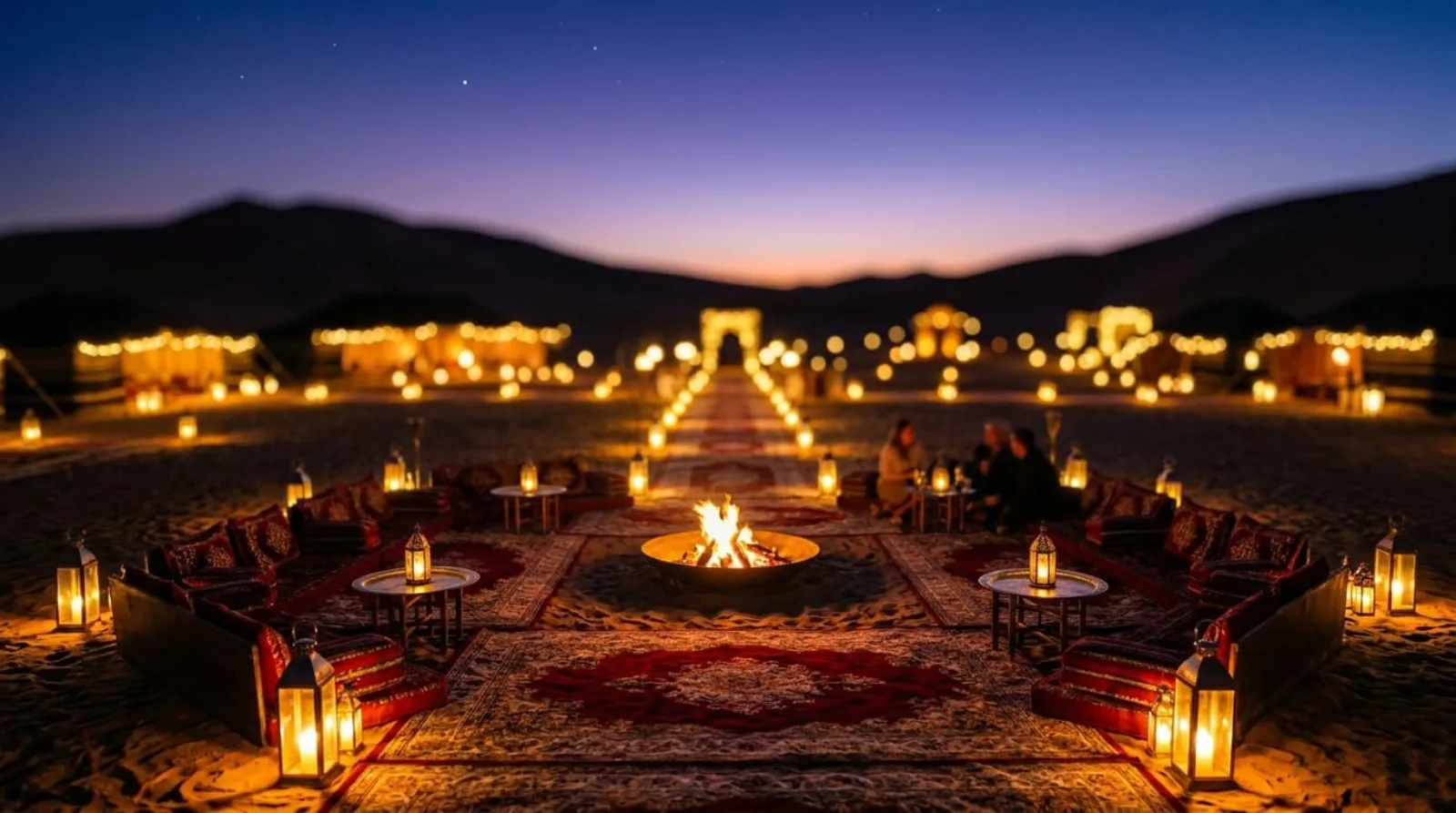
Stargazing Desert Safari Abu Dhabi — See the Milky Way from the World’s Darkest Deserts
⭐ 4.9★ · 5,000+ guests · DCT Abu Dhabi Licensed · Direct booking, no markup
There is a moment on every overnight desert safari that catches people completely off guard. The BBQ dinner is finished. The live entertainment has wound down. The fire has burned to embers and the camp has gone quiet. And then someone looks up.
What they see stops them mid-sentence. The sky above the Abu Dhabi desert, once you are far enough from the city lights, is not the sky they know from home. It is not even the sky they saw from their hotel balcony an hour before sunset. It is a sky so dense with stars that the Milky Way — the actual band of our own galaxy — stretches from horizon to horizon in a luminous arc so bright it casts faint shadows on the sand. Thousands of stars become visible that are invisible from any city on earth. The silence of the desert and the depth of the sky combine into something that most people describe as the most peaceful, most awe-inspiring moment of their trip.
This is not poetry. This is literally what happens when you take a desert safari into the dark zones beyond Abu Dhabi’s light pollution. And it is available to you, tonight, on any of our overnight safaris.
4.9★ · 5,000+ guests
Stargazing Desert Safari Abu Dhabi — See the Milky Way from the World’s Darkest Deserts: The Short Answer
There is a moment on every overnight desert safari that catches people completely off guard.
- How much does a desert safari in Abu Dhabi cost?: Booking direct with us: AED 35 self-drive, AED 50 shared bus from Al Wahda or Mazyad Mall, AED 100 shared hotel pickup, AED 599 for a private 7-seater car and AED 800 for a private Land Cruiser.
- How long is the dune bashing?: Around 40 to 45 minutes with short breaks. Tyres are deflated to roughly 15 psi first so they float on the sand.
- What time does the desert safari start and finish?: Pickup is usually 3:00 to 3:30 PM and you are back in the city around 10:00 to 10:30 PM. Timings follow sunset, so in December pickup moves earlier and in June it moves later.
- Where does the desert safari take place?: At our own DCT-licensed camp in the Al Khatim desert, roughly 80 km east of Abu Dhabi city along the E22 Abu Dhabi to Al Ain highway, about a 50 to 60 minute drive.
- What is included in the Abu Dhabi desert safari?: Every evening package includes 4×4 dune bashing, a short camel ride, sandboarding, a sunset photo stop, Arabic costume for photos, henna for ladies, a full BBQ buffet dinner with vegetarian and non-vegetarian options, unlimited soft drinks, water, Arabic coffee and tea, a shisha corner, separate washrooms and around eight live shows including tanoura, belly dance and a fire show.
- How do I book?: Message us on WhatsApp with your date and group size. We reply with the exact total, no deposit and no booking fee, and you pay at the camp on the day.
Why Abu Dhabi’s Desert Is One of the Best Stargazing Locations in the World
Most visitors do not realise that the UAE sits on some of the darkest skies accessible from a major city. Abu Dhabi itself is a modern metropolis — bright, busy, and thoroughly light-polluted. But drive just 45 to 75 minutes south-east into the Al Khatim Desert, where our safari camps are located, and you cross into a dramatically different world. The Bortle scale — the standard measurement of sky darkness, running from 1 (pristine black) to 9 (city centre) — drops from 8 or 9 in downtown Abu Dhabi to roughly Bortle 3 to 4 in the Al Khatim desert. At Bortle 3, the Milky Way is clearly visible with the naked eye, dozens of constellations become apparent, and on the best nights you can see the Andromeda Galaxy — the most distant object visible without a telescope — as a faint smudge of light two and a half million light-years away.
Go further south into the Liwa region and the Al Quaa desert (Bortle 2), and the sky becomes genuinely pristine — among the darkest accessible skies in the entire Middle East. Our Liwa desert safari overnight option places you in this extraordinary darkness.
The combination of desert latitude (low humidity much of the year, high percentage of clear nights), minimal light pollution once outside the city corridor, and flat terrain giving unobstructed horizon-to-horizon views makes Abu Dhabi’s desert one of the genuinely great stargazing locations on the planet.
What You Can Actually See — A Night Sky Guide for the Abu Dhabi Desert
The desert night sky is not a vague “lots of stars” experience. Specific, identifiable objects become visible that are impossible to see from any built-up area, and knowing what you are looking at transforms the experience from beautiful to genuinely educational.
The Milky Way
The single most dramatic sight. From the Abu Dhabi desert between roughly September and April, the core of our galaxy is visible as a luminous band arching across the sky. In the darkest spots (Al Quaa, deep Liwa), it is bright enough to notice its dust lanes — dark patches within the bright band where interstellar dust blocks the light of the stars behind it. Many guests mistake it at first for a thin cloud.
Planets
Depending on the time of year, Jupiter, Saturn, Mars, and Venus can all be visible — and from the desert, they are strikingly bright and steady compared to the twinkling of stars. Saturn’s rings are visible through even a modest telescope, and Jupiter’s four largest moons can be seen with good binoculars.
Constellations
Orion (the Hunter), Scorpius (visible in summer), the Big Dipper and Polaris (the North Star), Cassiopeia, and dozens of others become clearly defined when the background sky is dark enough for all their component stars to appear. In the desert, constellations that look like abstract connect-the-dots puzzles from a city garden suddenly make sense — you can see why ancient people saw a hunter, a scorpion, a bear.
Meteor Showers
The Abu Dhabi desert is spectacular for meteor showers because the dark sky makes even faint meteors visible. The major showers — the Perseids (August), the Geminids (December), and the Quadrantids (January) — produce dozens of visible shooting stars per hour from a dark-sky site. On the peak night of the Geminids, we have counted over a hundred meteors in a single hour from our desert camp.
Deep Sky Objects
For the dedicated stargazer, the Abu Dhabi desert reveals objects that most people only see in photographs: the Orion Nebula (a stellar nursery where new stars are being born), the Pleiades star cluster (a tight group of bright blue stars), and the Andromeda Galaxy (our nearest large galactic neighbour, 2.5 million light-years away, visible as a faint elongated smudge). These are naked-eye objects from a Bortle 3 site — no telescope required, though one certainly enhances them.
How Stargazing Fits Into Your Desert Safari
The stargazing experience is not a separate booking or an extra charge. It is a natural part of every overnight desert safari and every evening desert safari we run — because the stars are there whether we plan for them or not. The difference is that on our safaris, we make sure you are ready for them.
A typical evening safari already gives you a taste. After the dune bashing, the camel ride, the falconry display, and the BBQ dinner, the sky opens up as the camp lights dim. On clear nights (which are the majority of nights in Abu Dhabi from October to April), the Milky Way becomes visible within about 20 minutes of your eyes adjusting to the darkness.
For the full stargazing experience, our overnight safari is the way to go. After the last guest has finished dinner and the camp settles, the desert becomes yours. Lie on a blanket on the sand, look straight up, and let your eyes adapt fully — it takes about 20 to 30 minutes for your eyes to reach peak night sensitivity, and the sky deepens and fills with more stars every minute of that process. It is the slowest, most rewarding show you will ever watch.
We can arrange telescope viewing on overnight safaris for guests who want to see Saturn’s rings, Jupiter’s moons, or the Orion Nebula up close. Let us know when you book and we will prepare the equipment.
Best Times for Desert Stargazing in Abu Dhabi
Not all nights are equal. Here is what makes the difference:
Moon Phase
This is the single biggest factor. A full moon washes out the sky almost as effectively as city lights. The best stargazing happens within about five days either side of a new moon (when the moon is not in the sky at night). Check a lunar calendar when planning your safari — or simply ask us and we will recommend the best dates.
Season
October through April is stargazing season in the Abu Dhabi desert. Skies are clearer, humidity is lower, and the most spectacular section of the Milky Way (the galactic core) is visible from roughly September through November. Winter months (December to February) offer the longest dark hours and the coldest, clearest conditions — bring warm layers, because desert nights in January can drop to 10–12°C.
May through September has the advantage of warmer evening temperatures but often higher humidity and haze, which reduce star visibility. The galactic core is not visible in the evening sky during these months either.
Weather
Clear skies are essential. Abu Dhabi averages over 300 clear or mostly clear nights per year, so the odds are in your favour. Rare sandstorm or overcast conditions will reduce visibility — if conditions look poor for your booked date, we will always be honest with you.
Stargazing Photography Tips from the Desert
The Abu Dhabi desert is an extraordinary location for astrophotography — flat horizons, dark skies, and photogenic foreground elements (dunes, camels, the camp itself) make for stunning compositions.
For smartphone users: modern phones (iPhone 15 Pro and later, Samsung Galaxy S24 and later, Google Pixel) have excellent night modes. Place your phone on a stable surface (a small beanbag or even a shoe works), set the longest exposure your phone offers, and aim at the Milky Way. You will be surprised by what your phone captures.
For camera users: a wide-angle lens (14–24mm), manual mode, ISO 1600–3200, aperture as wide as possible (f/2.8 or wider), and a 15–25 second exposure will give you a sharp Milky Way image. Use a tripod. Focus on a bright star or distant light using live view zoom, then switch to manual focus so it does not shift.
For everyone: turn off your phone’s flashlight and screen brightness. Use a red-filtered light if you need to see — white light destroys your night vision for 20+ minutes.
Our Al Khatim Safaris — Stargazing Included from AED 35
Every Royal Arabian Safari safari gives you access to dark desert skies. Here are the packages, all departing from Abu Dhabi:
| Package | Price | Duration | Stargazing window |
|---|---|---|---|
| Self-Drive Safari | AED 35/person | 6–7 hrs | Evening stars after BBQ |
| Shared Bus Transfer | AED 50/person | 6–7 hrs | Evening stars after BBQ |
| Home Pickup (Shared 4×4) | AED 100/person | 6–7 hrs | Evening stars after BBQ |
| Morning Safari | AED 799/group | 4–5 hrs | Pre-dawn stars on winter mornings |
| Private Car Safari | AED 599/car (up to 6) | 6–7 hrs | Evening stars, flexible timing |
| Overnight Safari | On request | Full night | Full night — best option |
For dedicated stargazing: the overnight safari is the clear choice. You get the full dark-adapted experience from sunset to sunrise, with no rush to return to the city.
Check all options: desert safari packages or start with our self-drive safari from just AED 35.
Instant confirmation
Frequently Asked Questions
Can I see the Milky Way from the Abu Dhabi desert?
Yes. From our Al Khatim desert camp (45–75 minutes from the city, approximately Bortle 3–4), the Milky Way is clearly visible to the naked eye on clear, moonless nights between roughly September and April. From the deeper Liwa/Al Quaa desert (Bortle 2), it is spectacular.
Do I need special equipment for stargazing?
No. The naked eye is all you need to see the Milky Way, constellations, planets, and meteors. We can arrange telescope viewing on overnight safaris for guests who want to see planets and deep-sky objects up close — just mention it when you book.
Is stargazing included in the desert safari price?
Yes. The desert sky is there for everyone on every safari. There is no extra charge for stargazing. Overnight safaris give the longest and best dark-sky window.
What is the best time of year for stargazing in the Abu Dhabi desert?
October through April offers the clearest skies, lowest humidity, and longest dark hours. Within that range, plan around the new moon (when the moon is absent from the night sky) for the darkest conditions.
When is the best time of night to see stars?
After about 20–30 minutes of allowing your eyes to fully adjust to the darkness. Midnight to 3 AM typically offers the darkest window, but even 9–10 PM delivers excellent views on moonless desert nights.
Can children enjoy the stargazing experience?
Absolutely. Children are often the most enthusiastic stargazers — spotting shooting stars, identifying constellations, and asking questions about what they see. It is one of the most memorable educational experiences of a family desert safari.
What should I bring for stargazing?
Warm layers (desert nights can drop to 10–12°C in winter), a blanket or mat to lie on (or we provide), and your phone or camera if you want to try astrophotography. Leave the flashlight off — or use a red filter. We handle everything else.
How dark does the desert actually get?
Our Al Khatim camp sits at approximately Bortle 3–4 on the sky darkness scale (where 1 is pristine and 9 is city centre). At this level, the Milky Way is clearly visible, thousands of stars appear, and the sky feels dramatically different from any urban environment. The deeper desert (Liwa, Al Quaa) reaches Bortle 2.
The Desert Sky Is Waiting
You do not need to be an astronomer. You do not need a telescope. You do not even need to know the names of the constellations — though you will learn some by the time the night is over. All you need is a clear night, a patch of desert far enough from the city, and the willingness to look up.
The stars have been there above the Arabian desert for as long as the Bedouin have navigated by them — thousands of years of the same sky, the same Milky Way, the same silence. On your safari, you get to be part of that for one night. It is, without exaggeration, one of the most extraordinary things you can do in Abu Dhabi.
4.9★ · 5,000+ guests · DCT Abu Dhabi Licensed · Direct booking, no markup
Frequently Asked Questions
What is included in the Abu Dhabi desert safari?
Every evening package includes 4×4 dune bashing, a short camel ride, sandboarding, a sunset photo stop, Arabic costume for photos, henna for ladies, a full BBQ buffet dinner with vegetarian and non-vegetarian options, unlimited soft drinks, water, Arabic coffee and tea, a shisha corner, separate washrooms and around eight live shows including tanoura, belly dance and a fire show.
How much does a desert safari in Abu Dhabi cost?
Booking direct with us: AED 35 self-drive, AED 50 shared bus from Al Wahda or Mazyad Mall, AED 100 shared hotel pickup, AED 599 for a private 7-seater car and AED 800 for a private Land Cruiser. Agencies and hotel desks typically charge AED 180 to 250 per person for the same evening because they add commission on top of an operator price.
What time does the desert safari start and finish?
Pickup is usually 3:00 to 3:30 PM and you are back in the city around 10:00 to 10:30 PM. Timings follow sunset, so in December pickup moves earlier and in June it moves later.
Where does the desert safari take place?
At our own DCT-licensed camp in the Al Khatim desert, roughly 80 km east of Abu Dhabi city along the E22 Abu Dhabi to Al Ain highway, about a 50 to 60 minute drive. The Al Khatim ridges rise over 100 metres, which is considerably taller than the roadside dunes some operators use, and there is far less traffic on the sand.
How do I book?
Message us on WhatsApp with your date and group size. We reply with the exact total, no deposit and no booking fee, and you pay at the camp on the day. Free cancellation applies up to 12 hours before.
Is hotel pickup included?
Yes on the AED 100 shared pickup, the AED 599 private car and the AED 800 Land Cruiser, covering the whole city including the Corniche, Al Maryah, Al Reem, Downtown, Khalifa City, Mussafah, Yas Island, Saadiyat, Shabiya and the airport. The AED 50 package departs from Al Wahda Mall or Mazyad Mall, and AED 35 is self-drive using a GPS pin we send you.
Do I need a 4×4 for the self-drive option?
No. You drive on tarmac to a meeting point, so any standard car or rental reaches it comfortably. Our team takes over there in a proper 4×4 for the dune bashing.
How long is the dune bashing?
Around 40 to 45 minutes with short breaks. Tyres are deflated to roughly 15 psi first so they float on the sand. Intensity is adjustable at any point — tell your driver you want it gentle and it becomes a scenic drive.
Is dune bashing safe?
Yes with a licensed operator. Every passenger wears a seatbelt, vehicles are maintained and insured, drivers are trained specifically for dune driving, and vehicles travel in convoy so recovery is immediate. You can ask to stop at any time.
Can I do the safari without dune bashing?
Yes. Book the self-drive package and come straight to the camp, or ask for a direct transfer on a private car. You still get the sunset, camel ride, sandboarding, dinner and every show. This is the right choice for pregnant guests and anyone with back, neck or heart conditions.
What food is served at the camp?
A full BBQ buffet: salads and mezze including fattoush, hummus and Arabic bread; rice dishes, dal, pasta and mixed vegetable sabzi; chicken tikka, shish taouk, lamb seekh kebab and fish from the grill; Om Ali and fresh fruit for dessert. All 100% halal, with unlimited soft drinks, water, Arabic coffee and tea.
Are vegetarian and special diets catered for?
Vegetarian options are always available as standard, and the whole buffet is halal. Vegan, Jain, gluten-free and allergy requirements can be accommodated with advance notice — tell us when you book and we will confirm what will be on the table.
Is alcohol available?
No. Alcohol is not served or permitted at our camp and guests should not bring their own. Unlimited soft drinks, water, Arabic coffee and tea are included, and shisha is available at the camp.
What should I wear?
Loose, light-coloured clothing that covers shoulders and knees, and closed shoes such as trainers you do not mind filling with sand. From October to April bring a jacket — camp temperatures drop to 13 to 22 degrees after sunset. Avoid flip-flops, heels and skinny jeans.
Is the safari suitable for children?
Yes, from about age three. Ask for gentle dune bashing when you book, bring closed shoes and a spare set of clothes because sandboarding puts sand into everything, and pack a warm layer from November to March.
Can I add quad biking or a buggy?
Yes. Quad bikes are AED 100 single seater and AED 150 double, the Can-Am buggy is from AED 800 for 30 minutes, VIP majlis seating is +AED 50 per person, the falcon photo is AED 10–30 and professional photography starts at AED 50. Nothing is required and nothing is upsold under pressure at the camp.
What is the best time of year for a desert safari?
November to March gives the most comfortable conditions. October and April are excellent value with near-peak evenings and far fewer people. From May to September the morning safari is more comfortable than the evening one.
Is there a morning safari option?
Yes. The morning safari is a private premium product at AED 799 per car for up to 7 guests and does not include dinner or the live shows. It suits summer travel, photographers, families with young children and anyone with an evening flight.
What happens if it rains?
Abu Dhabi averages fewer than ten rainy days a year, almost all December to March. Light rain does not stop the safari and the desert afterwards is spectacular. If heavy rain or a strong wind would genuinely spoil the experience we move your date at no cost.
Are there toilets at the camp?
Yes. The camp has clean, separate washrooms for men and women, plus a prayer space, lighting and seating for every guest.
Can I see the Milky Way from the Abu Dhabi desert?
Yes. From our Al Khatim camp (Bortle 3-4), the Milky Way is clearly visible on clear moonless nights September-April. From deeper desert (Liwa/Al Quaa, Bortle 2), it is spectacular.
Do I need special equipment for stargazing?
No. The naked eye is sufficient for the Milky Way, constellations, and meteors. Telescope viewing available on overnight safaris on request.
Is stargazing included in the safari price?
Yes, included in every safari at no extra charge. Overnight safaris give the longest dark-sky window.
Best time of year for stargazing in Abu Dhabi?
October-April. Plan around the new moon for darkest conditions. Clear skies on 300+ nights per year.
How dark does the desert actually get?
Al Khatim camp: Bortle 3-4. Deeper desert (Liwa, Al Quaa): Bortle 2. City centre Abu Dhabi is Bortle 8-9 for comparison.
Can children enjoy stargazing?
Absolutely. Children love spotting shooting stars and learning constellations. One of the most memorable educational experiences on a family safari.
What should I bring?
Warm layers (desert nights drop to 10-12C in winter), phone/camera for astrophotography, no flashlight (use red filter). We provide blankets, mats, and refreshments.
Book this tour
No deposit and no card details. Message us and we confirm the plan and the exact price before you commit — answered at any hour.
- Send your date and guest countYour date, how many of you, and where we collect from. That is all we need.
- We send the plan and the pricePer car, not per person. You see the route, the timings and the exact figure first.
- Pay the driver on the dayCash or card, after the run. Free cancellation up to 12 hours before pickup.
Answered 24 hours · No deposit · No booking fee · Licensed operator
If we have to cancel, what happens?
A cancellation policy that covers your obligations but not ours is only half a document. Here is our side of it, in writing.
If we have to cancel your booking — for weather, a vehicle issue, or driver illness — we will contact you as soon as we know and rebook you at no charge on the next date that works for you. You pay nothing for the cancelled booking.
If we need to send a different vehicle than the one you booked, we will ask you first rather than turning up in something you did not book.
This is separate from your own cancellation rights, which are unchanged: you can cancel free up to 12 hours before pickup. Because we take no deposit and no booking fee, there is no money of yours sitting with us either way — nothing to chase, and nothing to wait for.
Desert safari Abu Dhabi: the timeline, hour by hour
This is how the evening actually runs, from pickup to drop-off. The sunset stop moves with the season; everything around it holds.
| Time | Stage | What happens |
|---|---|---|
| 3:00 – 3:30 PM | Pickup | Hotel, residence or an agreed pickup point in Abu Dhabi — or drive yourself to the camp using the GPS pin we send. |
| 3:30 – 4:10 PM | Drive to Al Khatim | About forty minutes from the city to the Al Khatim dunes. |
| 4:10 – 5:00 PM | Dune bashing | Tyres are deflated, then a 4×4 run across the dunes. Tell your driver if you want it gentle or lively — you set the intensity. |
| 5:00 – 6:30 PM | Camp activities | Camel ride, sandboarding, falcon photos, henna and Arabic costumes. |
| ~5:30 – 6:00 PM | Sunset stop | The photo stop on a high dune. This one moves with the sunset rather than the clock, so it shifts through the year. |
| 6:30 PM | Starters served | Arabic coffee, dates and welcome starters as the lamps come on. |
| 7:00 – 9:30 PM | Dinner and 8 live shows | BBQ buffet with separate vegetarian and halal non-vegetarian lines, plus unlimited soft drinks, water, tea and coffee — alongside eight live performances including belly dance, the LED Tanoura, and a fire show. Shisha in the designated area. |
| 9:30 – 10:00 PM | Wind-down | Stargazing away from the lamps, then the vehicles load for the drive back. |
| 10:00 – 10:30 PM | Drop-off | Back at your Abu Dhabi hotel or pickup point. |
Times are the standard evening run and shift a little with traffic and the sunset. Your confirmed pickup time is the one we send on WhatsApp the day before.