Liwa Desert Safari Abu Dhabi — A Night in the Empty Quarter
Drive deep into the Rub’ al Khali, watch the sun drop behind the UAE’s tallest dune, eat by a campfire, sleep under a Milky Way sky and wake for a dune-top sunrise — a private expedition planned by the team that runs its own desert camp night after night.
The Short Answer
A Liwa overnight desert safari is a private 4×4 expedition from Abu Dhabi into the Rub’ al Khali — the Empty Quarter, the largest uninterrupted sand sea on Earth. You get an afternoon of big-dune driving, sunset near the roughly 300 m Moreeb Dune, a campfire BBQ, a night in expedition tents under some of the UAE’s darkest skies, and sunrise over the sands before a midday return. Door to door it takes 20–24 hours, over roughly 220–250 km each way. It runs as a private expedition — pricing depends on vehicle count and season; message us on WhatsApp for a same-day quote.
| Key fact | Detail |
|---|---|
| Drive from Abu Dhabi | ~220–250 km by road, 2.5–3.5 hours via the E11 and E45 |
| Total commitment | 20–24 hours door to door, early-afternoon pickup to midday return |
| Headline sight | Moreeb Dune — roughly 300 m high, the tallest dune in the UAE |
| Where you sleep | Expedition tents at a private camp deep in the dunes |
| Best nights | Clear, moonless nights for naked-eye Milky Way viewing |
| Price | Private expedition — WhatsApp quote, no deposit, pay on arrival |
What Exactly Is a Liwa Overnight Desert Safari?
A Liwa overnight desert safari is a roughly 24-hour private expedition that swaps the usual few dune hours for the desert’s full cycle: afternoon light, sunset, true darkness, dawn. You travel by 4×4 from Abu Dhabi to the Liwa Oasis on the Empty Quarter’s northern rim, drive the big sands, and sleep in tents far from any road.
Staying the night is the point: it is the only way to hear the Empty Quarter with the engines off, watch the sky move from dusk to Milky Way to dawn, and stand on a cold crest as the sun rises over sand running unbroken towards Saudi Arabia.
Liwa itself is a 100 km arc of some fifty villages along the sand sea’s edge — the UAE’s date-farming heartland and the ancestral home of its ruling families. The dunes south of it are of a different order to anything nearer the city.
This is the deep-desert option, not the easy one: if you want the overnight feeling without the long drive, our Al Khatim overnight desert safari delivers tents, campfire and stars fifty minutes from the city. Liwa is for travellers who want scale.
How Far Is Liwa from Abu Dhabi — and What Is the Drive Like?
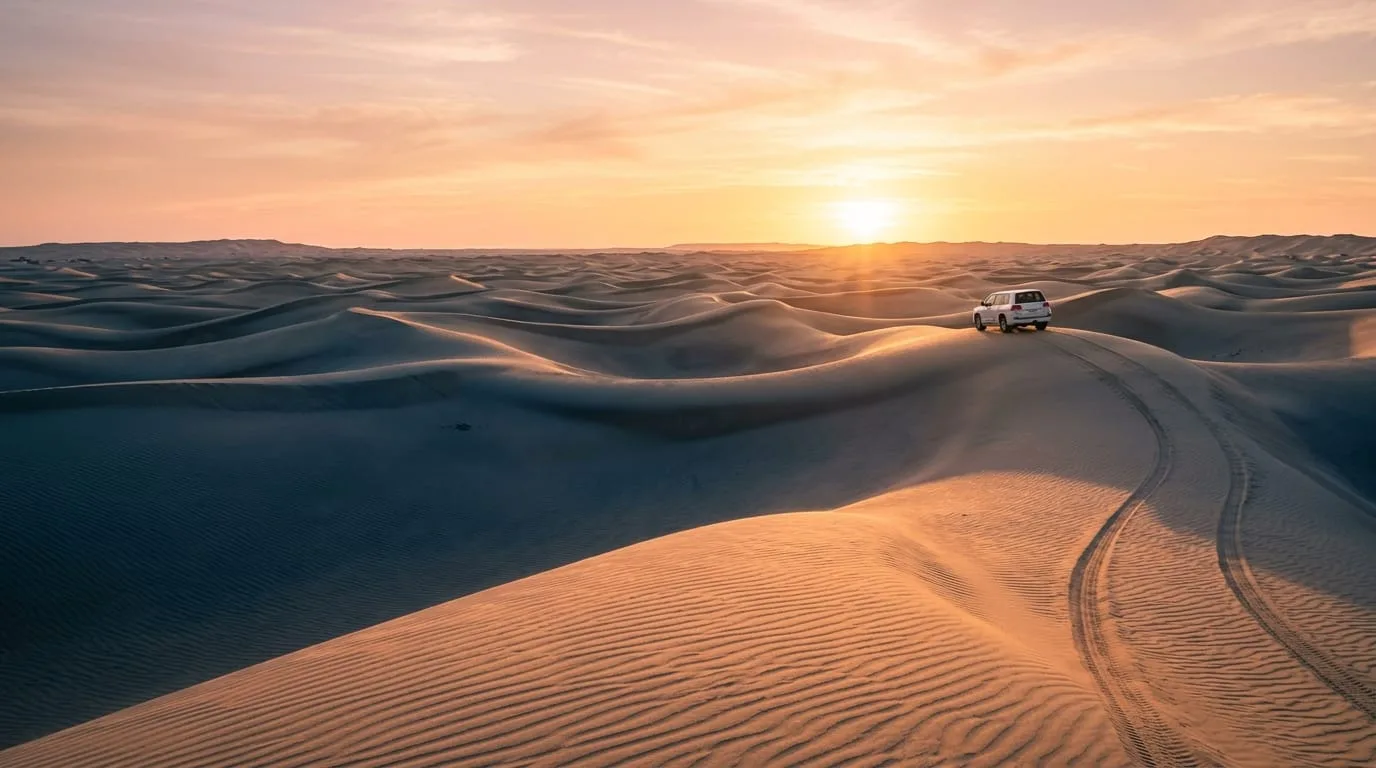
Liwa Oasis sits roughly 150 km south-west of Abu Dhabi in a straight line, but the road route is longer: about 220–250 km, taking 2.5–3.5 hours via the E11 and then the E45 south. It is a genuine journey — which is why this trip is an overnight, not a day dash.
You leave the towers, cross the coastal plain, and watch the land empty until date plantations appear — the oasis arc announcing itself. The hub town is Mezaira’a, where every sensible convoy makes its final stop: fuel, tyre deflation, water and the last reliably strong signal.
| Leg | Distance and time | What to know |
|---|---|---|
| Abu Dhabi → E45 turn-off | First long motorway stretch on the E11 | Flat coastal plain; dunes build as you swing south |
| E45 south → Mezaira’a | ~220–250 km total from the city, 2.5–3.5 h with a comfort stop | Liwa’s hub town and the last full services before the sands |
| Mezaira’a → Moreeb Dune area | ~25 km south of Liwa; the access spur is 22 km of tarmac | Fully paved but often sand-drifted at the edges — respect it |
| Dune corridors → camp | Off-road, at the drivers’ judgement | Mobile signal fades between the dune corridors; offline maps only |
Guests joining from Dubai can do this trip — we schedule an earlier start and quote the longer transfer honestly, as with all our desert safari pickups from Dubai. Tell us your hotel and we will build the timings around it.
The Liwa Overnight Itinerary, Minute by Minute
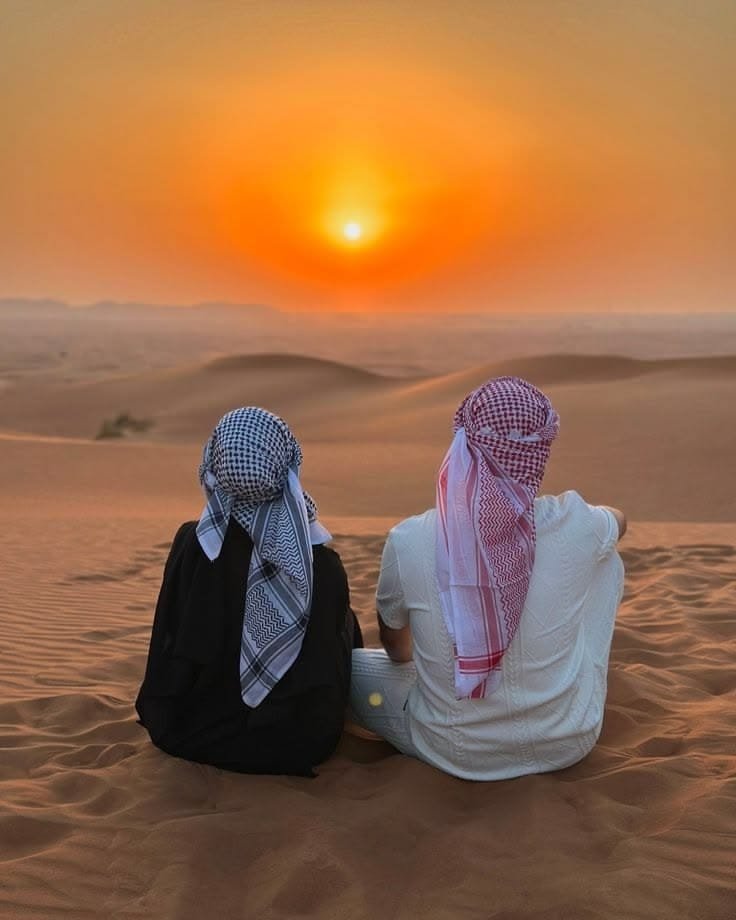
Every overnight follows the same proven skeleton — early-afternoon pickup, big-sand afternoon, Moreeb Dune at golden hour, a private camp night, sunrise, breakfast, midday return. Here it is in full, with the operator notes most itineraries leave out.
| Time (indicative) | What happens | Operator notes |
|---|---|---|
| Day one — the drive in, the dune afternoon, the night | ||
| 12:45–1:15 PM | Pickup across Abu Dhabi — hotels, residences or cruise terminal | Dubai pickups start earlier — confirm your zone with us |
| 1:15–3:30 PM | Motorway leg south-west, E11 then E45, with one comfort stop | Eat a light lunch beforehand — the dune driving comes later |
| 3:30–4:00 PM | Mezaira’a: fuel top-up, tyres aired down, water and snacks loaded | Last strong signal and last shops — buy what you need here |
| 4:00–5:00 PM | First dune corridors — cresting, side-sloping and bowl runs in the big sands | Queasy travellers should ask for the front seat and a gentler line |
| 5:00–5:30 PM | Moreeb Dune viewpoint (Tal Mireb) | Stand under the ~300 m slipface before the light turns gold |
| 5:30–6:15 PM | Sunset from a high ridge, cold drinks from the cool box | Shifts with season — winter departures run roughly an hour earlier throughout |
| 6:15–6:45 PM | Arrive at the private camp; tents allocated; Arabic coffee and dates | Light sleepers: claim a tent away from the fire |
| 7:00–8:30 PM | Campfire lit, BBQ dinner served, shisha for those who want it | Vegetarian and other diets catered — tell us when you book |
| 8:30–10:30 PM | Stargazing away from the firelight; the Milky Way on clear moonless nights | Red-mode head torches protect night vision |
| 10:30 PM | Lights out — a silence you can actually hear | Extra layers ready — the small hours are coldest |
| Day two — dawn, breakfast and the run home | ||
| 5:45–6:30 AM | Wake before first light; short dune walk to an east-facing crest | The one alarm nobody regrets |
| 6:30–7:15 AM | Sunrise over the Empty Quarter; mist over the sabkha flats on cool mornings | The trip’s best photography half-hour |
| 7:15–8:00 AM | Arabic breakfast back at camp | Coffee first, then a barefoot dune scramble |
| 8:00–8:45 AM | Camp pack-down and final photos | Shake out your shoes — sand hides everywhere overnight |
| 8:45–10:15 AM | Liwa photo stops — date farms and fort viewpoints, season depending | The oasis arc looks its best in low morning light |
| 10:15 AM–1:00 PM | Return drive to Abu Dhabi with a comfort stop | Most guests sleep most of it — that is normal |
| ~1:00 PM | Drop-off at your hotel or residence | 20–24 hours door to door, depending on zone and season |
Treat the clock times as an indicative cool-season pattern: we re-time every departure to the day’s actual sunset and sunrise, because reaching the ridge twenty minutes late is a mistake you cannot apologise your way out of.
Moreeb Dune at Sunset: Standing Under the Tallest Dune in the UAE
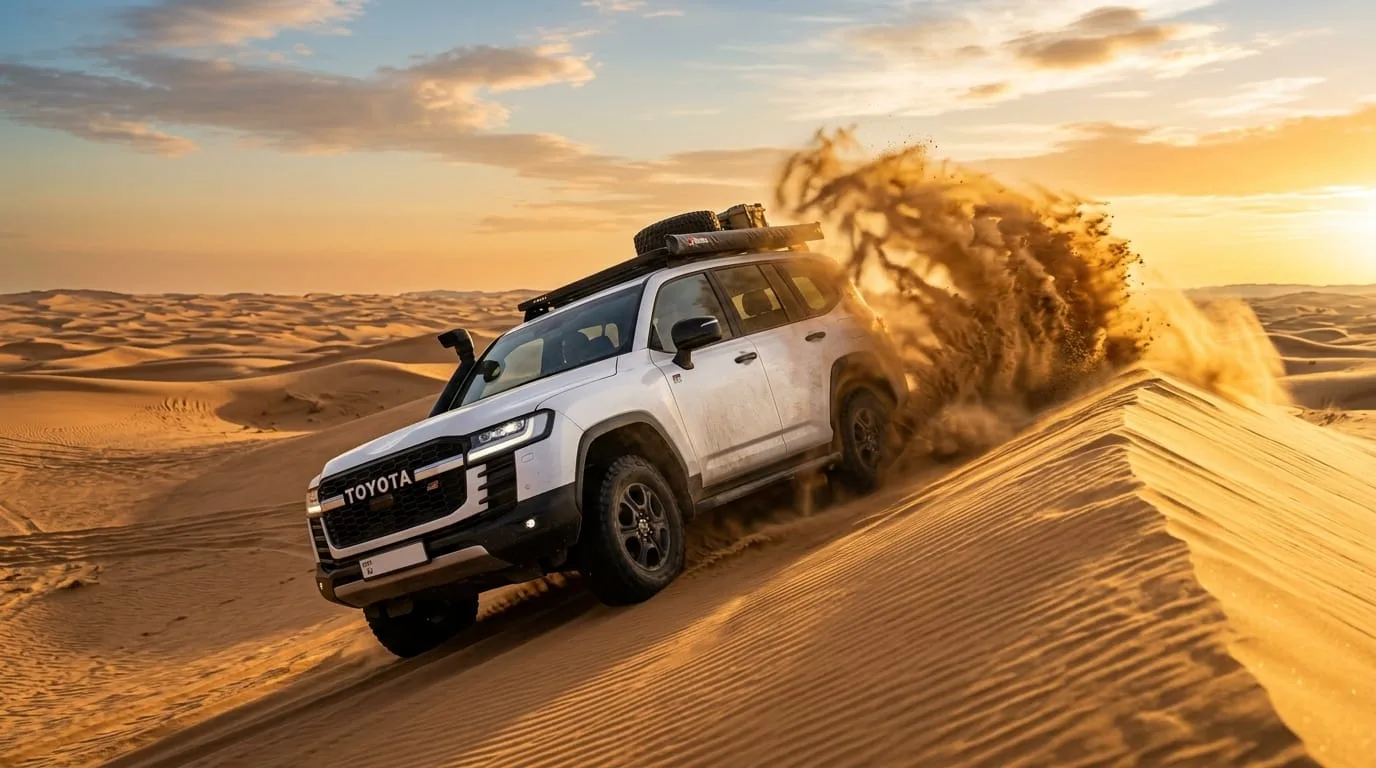
Moreeb Dune — Tal Mireb — is the centrepiece of any Liwa overnight: roughly 300 m tall with a slipface of about 50 degrees and a ridge line stretching around 1,600 m. It is the UAE’s tallest dune, about 25 km south of the Liwa arc at the end of a fully paved 22 km access road — and its name translates to something close to “terrifying”.
Numbers only half prepare you. The Rub’ al Khali’s dunes commonly reach 250 m; Moreeb exceeds even that. The dunes around our own Al Khatim camp top 100 m and feel enormous — Moreeb is three times taller. At its base in late afternoon, the crest still holds light your side lost half an hour ago.
Can you climb it? Partway, honestly — the slipface turns every step into two half-steps back, and most guests finish thoroughly winded well below the crest. We allow time at the viewpoint, then move to a quieter ridge for sunset itself. For the dune’s full story and motorsport history, our Moreeb Dune page goes deeper.
The Night: Campfire, Dinner and Sleeping in the Rub’ al Khali
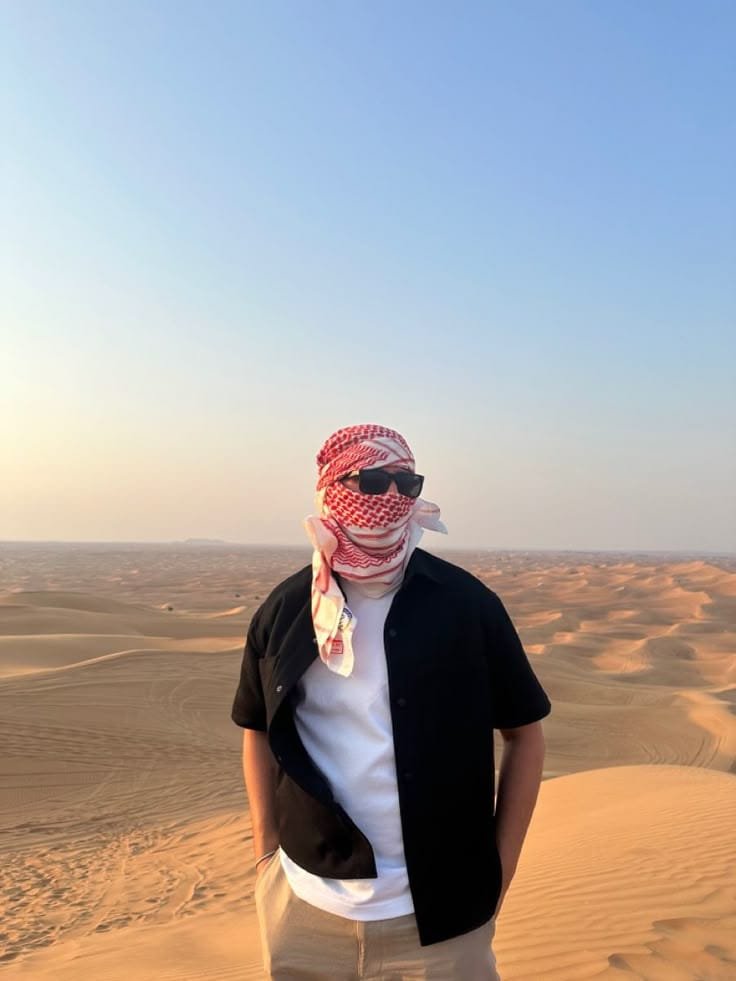
The night is the product. Once the sun goes down, a Liwa overnight becomes a private camp in open desert: firelight, dinner over coals, coffee poured the Bedouin way, then hours of dark sky with nothing between you and it. No stage, no show schedule, no queues.
Dinner around the fire
Dinner is a barbecue served by the fire — grilled meats and vegetarian dishes, salads, Arabic coffee and dates, with shisha for those who want it. Because the expedition is private, the evening runs at your pace: some groups talk until late, some go quiet the moment the Milky Way appears.
The tents, honestly described
You sleep in proper expedition tents at a camp set among the dunes, with bedding rated for the season. This is comfortable camping, not a resort with sand outside the window — and that is rather the point. We confirm the exact tent and bedding setup for your date and group size when we quote.
Two truths in advance. First, winter nights get genuinely cold — expect single digits on the coldest winter nights, so the blanket count matters. Second, sleep tends to come embarrassingly early: silence, a fire and a day of dunes beat any hotel pillow menu.
Toilets and washing — the part nobody prints
The honest baseline: the last flush toilets and washbasins are at Mezaira’a, and camp facilities beyond that are expedition-grade and simple by design. The exact arrangement varies with setup and group size, so we spell it out plainly when we quote — nobody should discover this at midnight.
Stargazing in Liwa: New Moon or Full Moon?
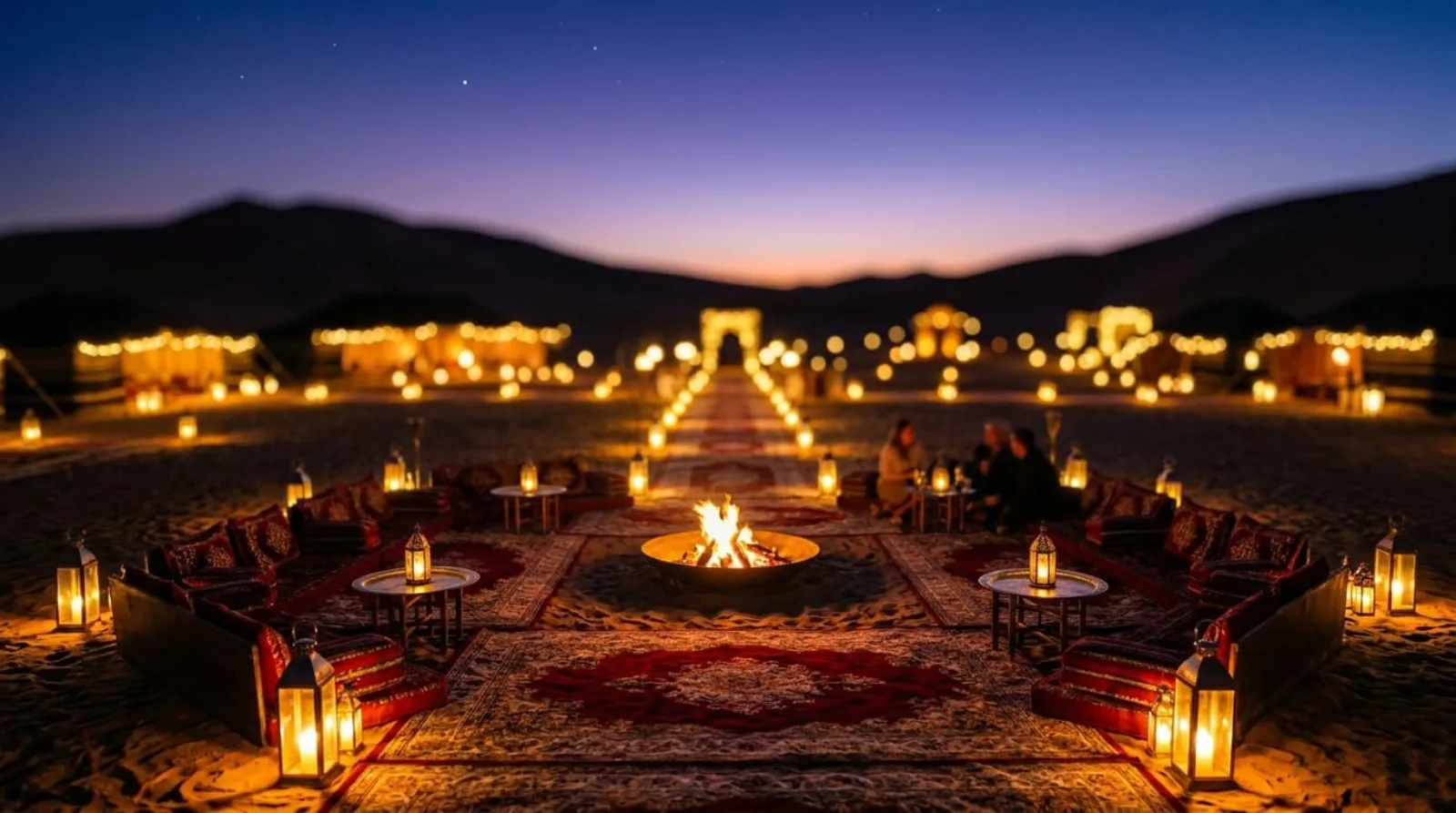
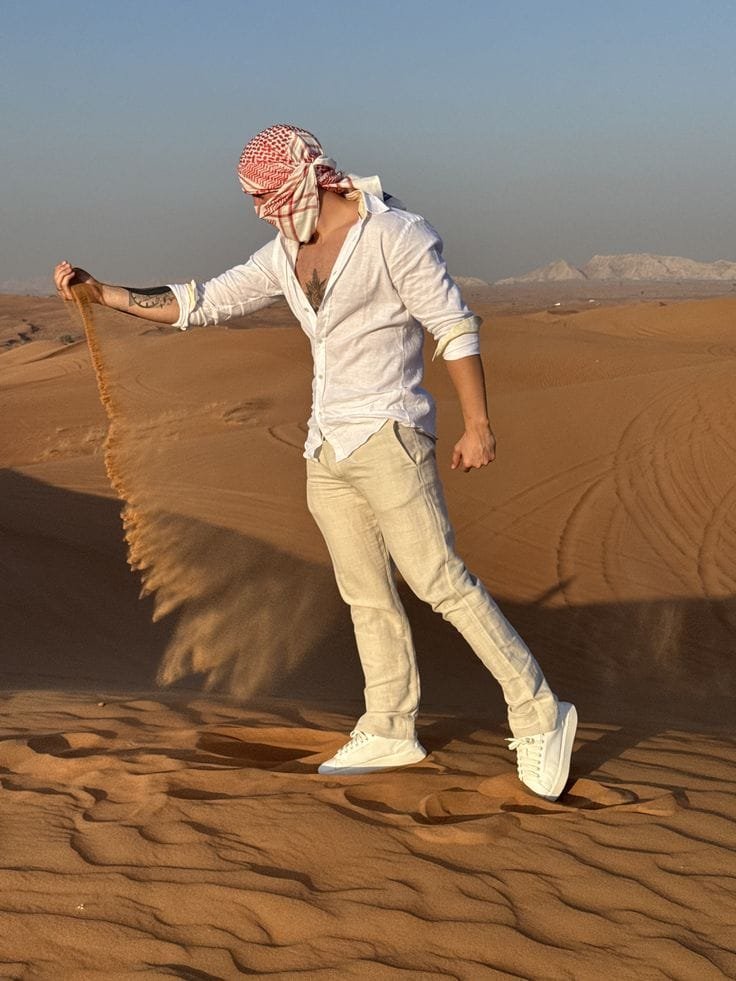
Book a new-moon night if the sky is your priority. Liwa sits on the northern edge of the Empty Quarter with minimal light pollution, giving it some of the UAE’s darkest night skies — on clear, moonless nights the Milky Way is visible to the naked eye. Around full moon the stars retreat, but the dunes glow silver and walking needs no torch.
For accuracy’s sake: the emirate’s darkest corner is further east at Al Qua’a, but Liwa runs it close — and here the darkness comes with 300 m dunes attached. Once the fire is behind a ridge, your eyes adapt in about twenty minutes; the sky does the rest.
| Moon phase | The sky | The dunes at night | Choose it for |
|---|---|---|---|
| New moon | Milky Way visible to the naked eye on clear nights | Properly dark — head torches essential | Astrophotography, a first real Milky Way |
| Around full moon | Only the brightest stars and planets punch through | Silver, shadowed, bright enough to walk by | Romance, moonlit dune landscapes |
| Quarter phases | Dark skies for part of the night | A mix of both worlds | Flexible dates wanting a bit of everything |
If the sky is your main reason for booking, say so on WhatsApp and we will steer you to the best moon window. If you cannot commit a full day, our stargazing desert experiences near Abu Dhabi run on an evening timetable.
Sunrise, Breakfast and the Morning Run Home
Sunrise is the act most pages barely mention, and it is arguably better than sunset. You wake in the dark, climb an east-facing crest with coffee, and watch colour return to 650,000 km² of sand. On cool mornings, thin mist pools over the sabkha — the salt flats between the dunes — and burns off as the light arrives.
The morning is unhurried: Arabic breakfast, a last scramble on the nearest big dune, then the drive out through the oasis with seasonal photo stops at date farms and fort viewpoints. Most groups are back in Abu Dhabi around midday, tired in the satisfied way that follows a night outdoors.
If dawn in the dunes appeals but a full expedition does not, the same golden-hour magic powers our short-format sunrise desert safari near the city.
Al Khatim Overnight vs Liwa Overnight: Which Should You Book?
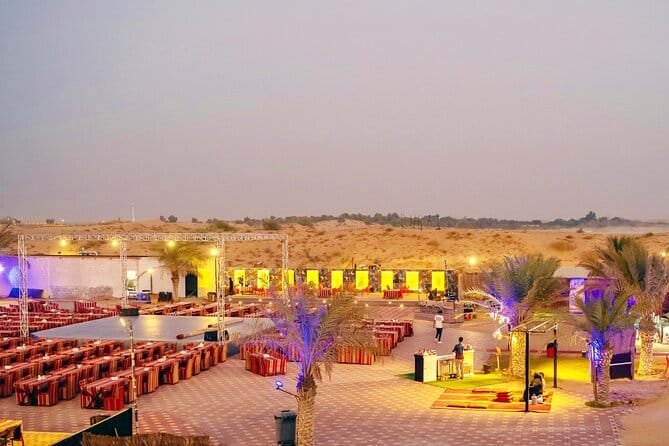
Choose Al Khatim if you want an easy, sociable desert night close to the city with shows, a buffet and a short transfer; choose Liwa if you want scale, silence and the deep desert, and can give it a full day. They are different products, not budget and premium versions of one thing.
| Feature | Al Khatim overnight (our private camp) | Liwa overnight (Empty Quarter expedition) |
|---|---|---|
| Drive from Abu Dhabi | ~80 km on the E22 — 50–60 minutes | ~220–250 km — 2.5–3.5 hours |
| The dunes | Over 100 m around our camp | Moreeb Dune, roughly 300 m — the UAE’s tallest |
| Evening character | Shared camp: live shows, buffet, henna, falcon photos | Private expedition: campfire, stars and near-total silence |
| Entry cost | Evening from AED 35 per person self-drive; private Land Cruiser AED 800 per car | WhatsApp quote — priced by vehicle count and season |
| Time needed | One evening, extendable to a night | 20–24 hours door to door |
| Best suited to | Families, first-timers, short stopovers | Photographers, stargazers, returning desert lovers |
| Where you sleep | At our established camp with its full setup | Expedition tents deep in the Rub’ al Khali |
Plenty of guests do both in one stay — Al Khatim for the classic camp evening, Liwa for the expedition — and the two barely overlap. For background on our home desert, the Al Khatim desert guide explains why we based our camp there.
Ready to Sleep in the Empty Quarter?
A private expedition tailored to your group, your dates and the moon. No deposit, payment on arrival, free cancellation up to 12 hours before.
How Much Does a Liwa Overnight Desert Safari Cost?
Our Liwa overnight runs as a private expedition, so there is no flat published rate: pricing depends on vehicle count, season, and whether your dates touch the festival window. Message us on WhatsApp with your group size and dates for a same-day quote with everything itemised.
We publish exact Al Khatim prices — down to the dirham, on our desert safari price list — because those products are standardised. A deep-desert overnight is not: fuel, crew, camp scale and convoy size all move with the group. Quoting properly beats inventing a from-price that survives no real enquiry.
For context, our survey of advertised Liwa overnight listings across the market found prices from roughly AED 600 per person at the shared end to about AED 2,800 per vehicle for private trips — with plenty of inconsistency, sometimes on the same website. Treat advertised numbers as starting points and always confirm what is included.
| Advertised format (market survey) | Typical advertised range | Check before you pay |
|---|---|---|
| Shared seat, per person | Roughly AED 600–650, with VAT sometimes added on top | Pickup zones, meal inclusions, how many strangers share your vehicle |
| Private vehicle expedition | Roughly AED 1,800–2,800 per vehicle | Vehicle capacity, camp standard, whether breakfast is included |
| “Discounted from” strike-through rates | Common across listings | Inflated anchor prices — judge only the net figure you will pay |
| Our Liwa overnight | WhatsApp quote — private expedition priced by vehicle count and season | No deposit, payment on arrival, free cancellation up to 12 hours before |
Whatever you compare, compare like with like: a shared seat in a convoy of strangers and a fully private desert safari with its own camp are different nights entirely, even when the destination matches.
What Should You Pack for a Night in the Empty Quarter?
Pack light but pack layers: a Liwa overnight moves through warm afternoon sun, a cool ridge-top sunset, a genuinely cold small-hours stretch in winter, and a bright morning — all inside one bag. A soft duffel beats a hard suitcase in a loaded 4×4.
| Item | Winter nights | Summer nights |
|---|---|---|
| Warm layer — fleece or insulated jacket, plus a beanie | Essential: expect single digits on the coldest winter nights | A light long sleeve covers the evening and the sun |
| Sleep comfort — liner or an extra layer to sleep in | Bring it; the pre-dawn hours are the coldest | Rarely needed |
| Footwear | Closed shoes for cold sand, slip-ons for around camp | Sandals at camp; closed shoes for dune walks |
| Sun kit — SPF, sunglasses, brimmed hat | Still needed for the afternoon and morning | Non-negotiable |
| Head torch, ideally with a red mode | Yes — saves everyone’s night vision | Yes |
| Power bank | Yes — assume no charging from pickup to drop-off | Yes |
| Refillable water bottle | Yes | Yes — drink more than feels necessary |
| Camera and small tripod | Star shots need support | Shoot early and late; midday haze softens everything |
Leave the drone at home unless you have checked the rules, and leave anything sand-sensitive at the hotel. Our what-to-wear guide for desert safaris covers clothing etiquette and fabrics; the overnight simply adds the warm layer and the torch.
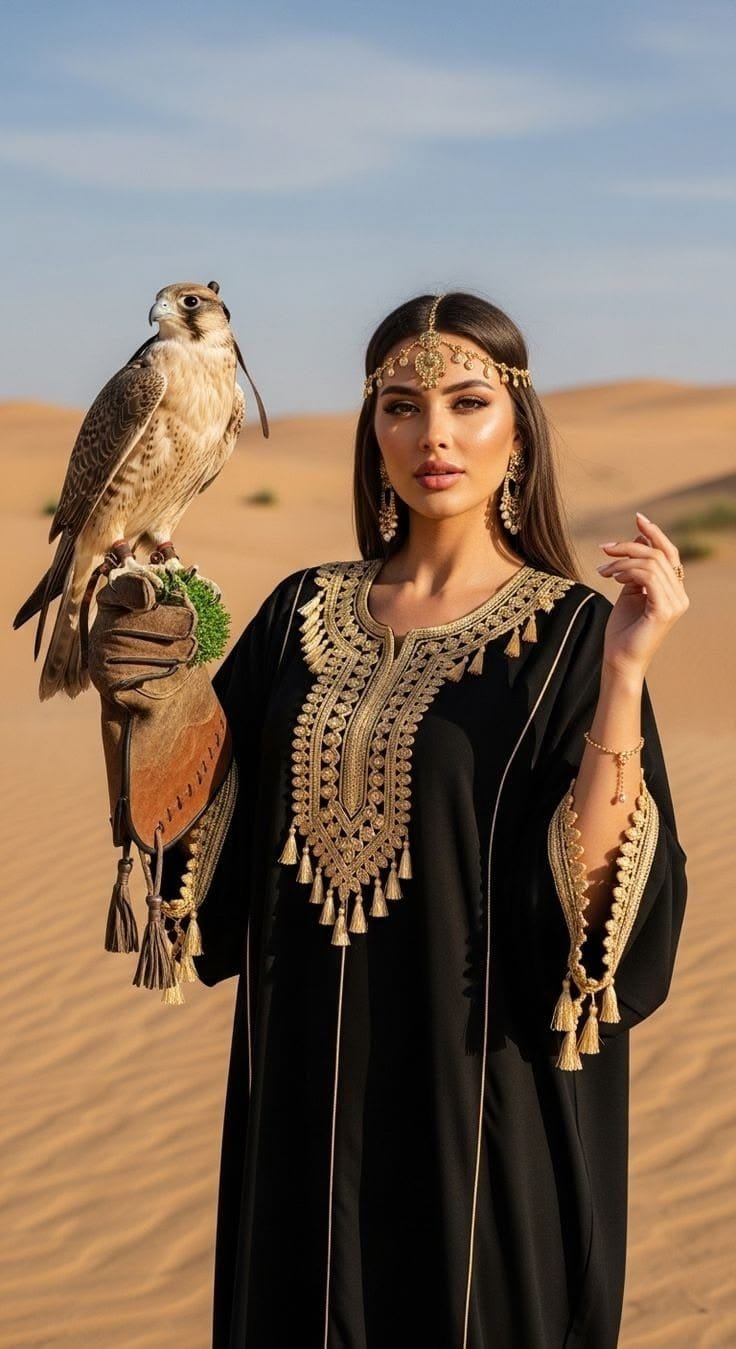
Photography on a Liwa Overnight: The Three Shots Worth the Drive
An overnight gives photographers both golden hours plus true darkness — three windows no evening trip can match. These are the frames guests come back with.
The sunset ridge
Shoot along the dune crests, not at the sun: side-light rakes the ripples and turns sand into texture. A phone does well; a camera does better with a short zoom to compress the ridges. Keep lens changes to a minimum — wind-blown sand is patient and cruel.
The star field
On a clear new-moon night the Milky Way is a naked-eye object here, and a small tripod turns it into a photograph: wide lens, long exposure, torch on red so you keep your night vision. Include a tent or dune shoulder in the foreground — sky-only frames never quite say Liwa.
The sabkha mist at sunrise
On cool mornings, mist forms over the salt flats between the dunes and first light cuts it into layers. It is the rarest of the three shots — be on the crest before the sun and shoot fast; it burns off quickly.
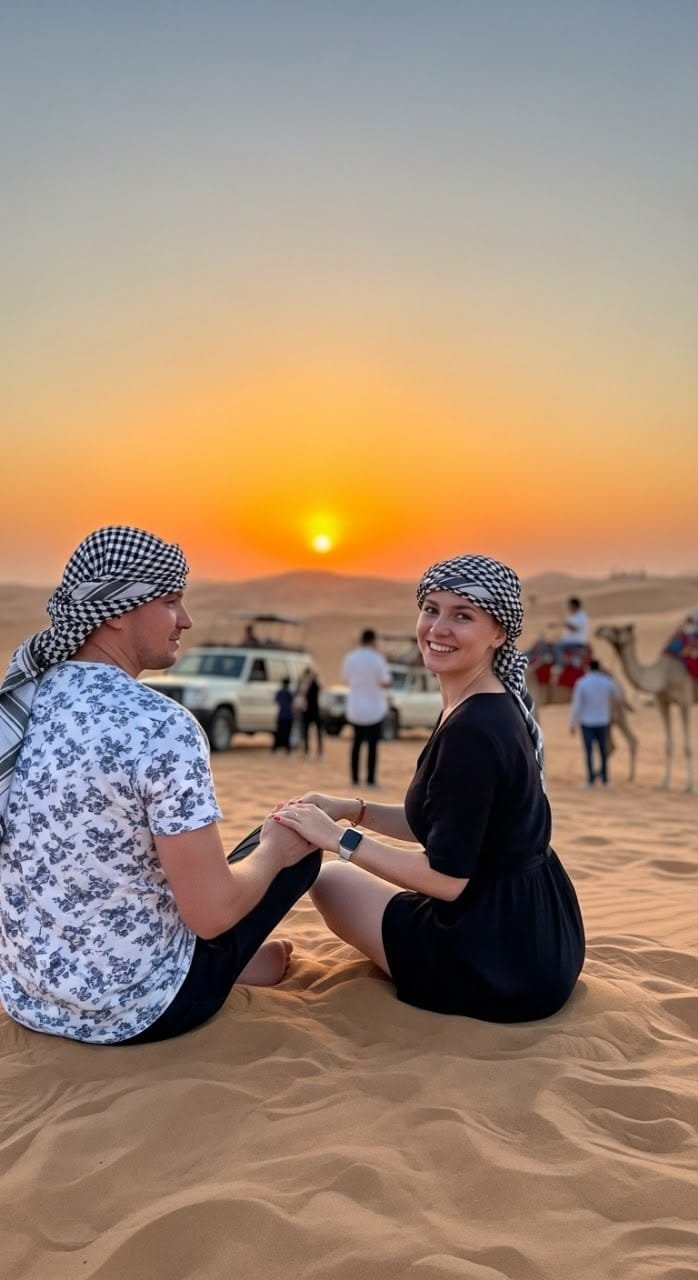
Liwa International Festival: Horsepower or Silence?
From mid-December to early January, the Liwa International Festival takes over the sands at Tal Moreeb: a hill-climb championship up the great slipface, drag races, concerts and crowds that can reach around 40,000. It is one of the region’s great motorsport spectacles — and it completely changes what an overnight nearby feels like.
If modified engines screaming up a 300 m dune sounds like heaven, a festival-window overnight is unbeatable — and the temporary infrastructure, including mobile fuel trucks, makes the deep desert unusually accessible. Our camps still sit away from the crowds, but the horizon glows and the sound carries.
| What you get | Festival window (mid-December to early January) | The rest of the cool season |
|---|---|---|
| Atmosphere | Hill-climb finals, drag races, concerts, crowds up to ~40,000 | Near-empty sands and expedition solitude |
| Sound and light | Engines and event lighting around Tal Moreeb | Firewood crackle and starlight |
| Fuel and services | Mobile fuel trucks operate | Mezaira’a is the last full stop |
| Book it for | Motorsport, spectacle, festival energy | Stargazing, photography, quiet nights |
Either way, the cool months are the sweet spot — our best time for a desert safari guide breaks the seasons down in detail.
The Logistics Nobody Prints
Most Liwa overnight pages sell the romance and skip the practicalities that make it work. Here are the ones we brief every group on before departure.
Fuel: the desert has no plan B
The last full services are at Mezaira’a, whose ADNOC station serves the whole Liwa and Moreeb area; beyond it there is no fuel, full stop. Festival-season fuel trucks exist, but no expedition should depend on them. We fuel and provision at Mezaira’a on every run — self-drivers should treat that stop as non-negotiable.
Signal: plan to be unreachable
Mobile signal is solid along the tarmac, then fades between the dune corridors — often gone entirely in the bowls where camps sit best. Download offline maps before leaving the city, tell anyone who worries that you will be dark overnight, and enjoy it: the disconnection is half the therapy. Our vehicles travel in convoy so no one relies on a phone for rescue.
Cold, water and sand
Winter nights genuinely bite — single digits on the coldest — while days stay pleasant; the swing catches people out more than the heat does. Drink more water than feels necessary even in the cool season, keep electronics zipped away overnight, and accept that a little sand will follow you home in every seam.
Safety underpins all of it: DCT-licensed operation, seasoned dune drivers, convoy discipline and a proper briefing before the sand. For the full picture of how we manage desert risk, our desert safari safety guide answers it at length.
Who Should Book a Liwa Overnight — and Who Honestly Should Not
We would rather lose a booking than send the wrong traveller into the Empty Quarter. The trip rewards time, patience and a tolerance for simple comforts — and punishes their absence. Read both lists before you message us.
Book the Liwa overnight if you are:
A photographer or stargazer chasing dark skies and 300 m dunes · a couple marking something worth marking · a returning visitor who has done the classic evening trip and wants the deep desert · a small group that values silence over shows · a family with school-age children who camp well — we pace the private format for them, as on our family desert safaris.
Do not book it — choose something shorter instead — if you are:
Travelling with under-threes — a long drive plus a cold tent night is unkind to toddlers · prone to serious motion sickness, because hours of rolling dune driving follow the motorway · in Abu Dhabi for one evening — a stopover deserves our evening desert safari, not a rushed expedition · unable to sleep without an en-suite and a proper mattress · flying out before mid-afternoon next day — the return lands around midday.
Why Book Liwa with Royal Arabian Safari
We are Royal Arabian Safari Tourism LLC, a DCT Abu Dhabi licensed tour operator with an office at Al Sila Tower on Al Maryah Island and our own private Al Khatim desert camp, run nightly for more than a decade. After 5,000+ guests and a 4.9-star Google rating, the Liwa overnight is our deep-desert flagship — planned, driven and hosted by our own team, never resold. Pay on arrival, no deposit, free cancellation up to 12 hours before departure.
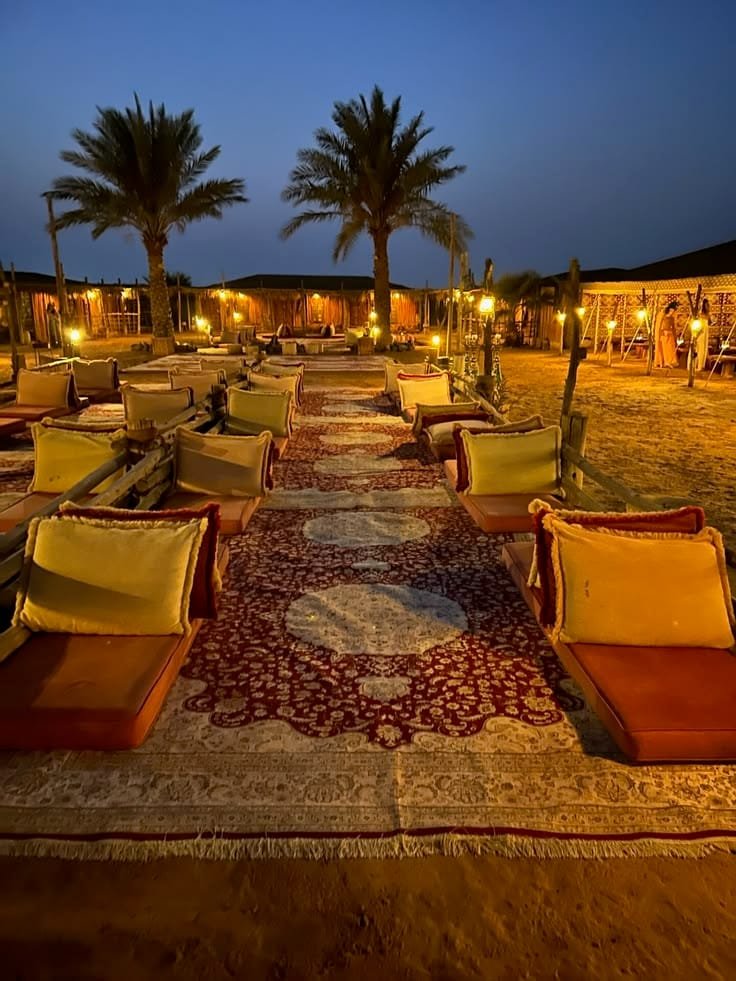
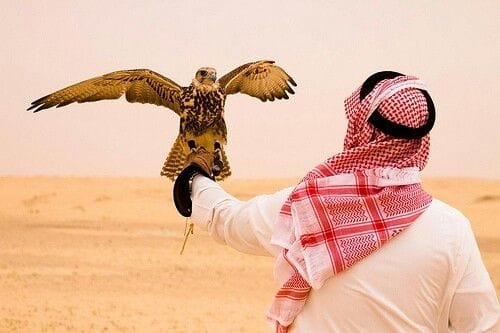
Scenes from Our Desert Nights
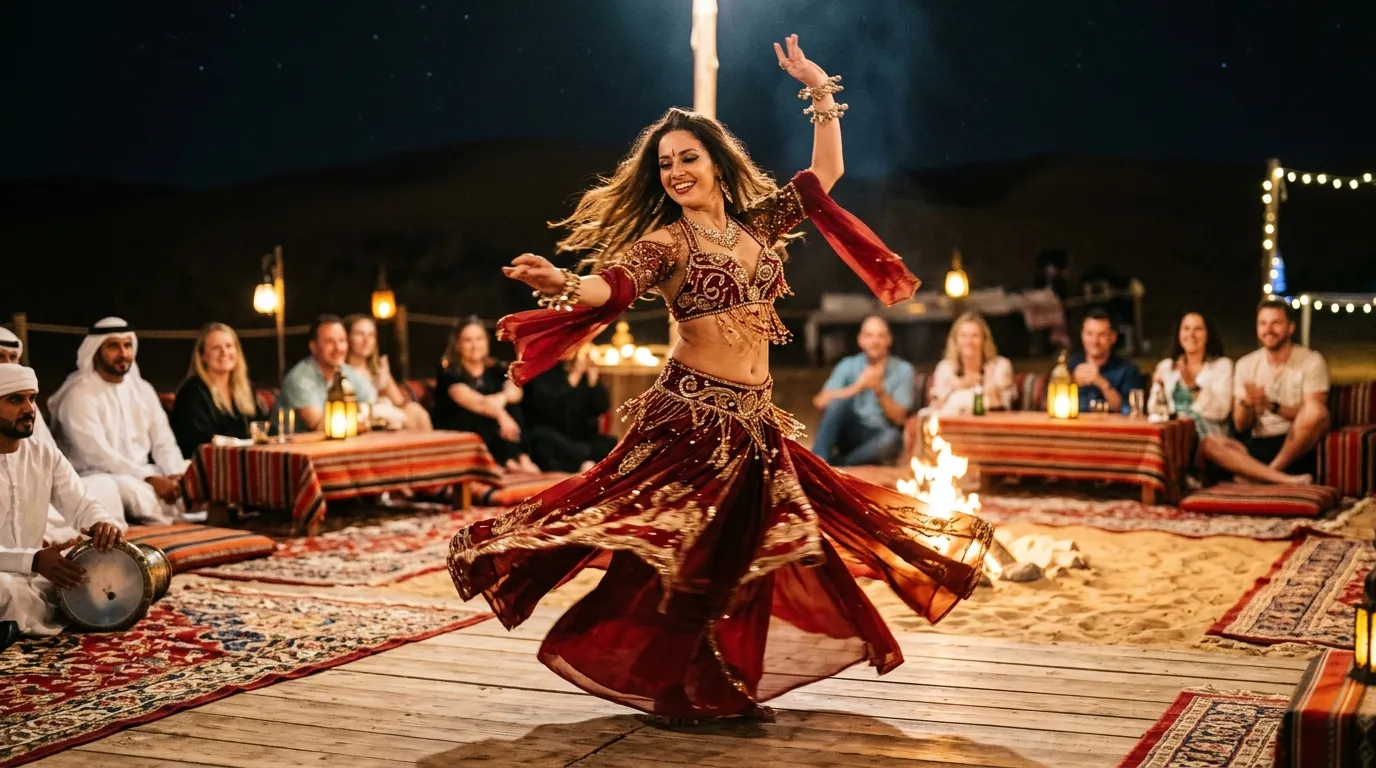
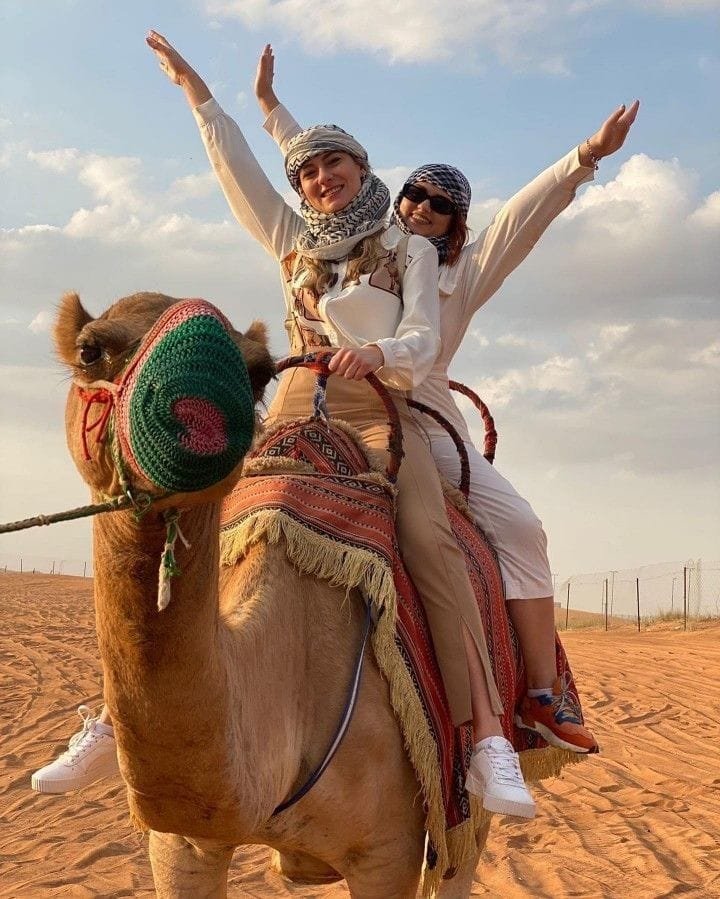
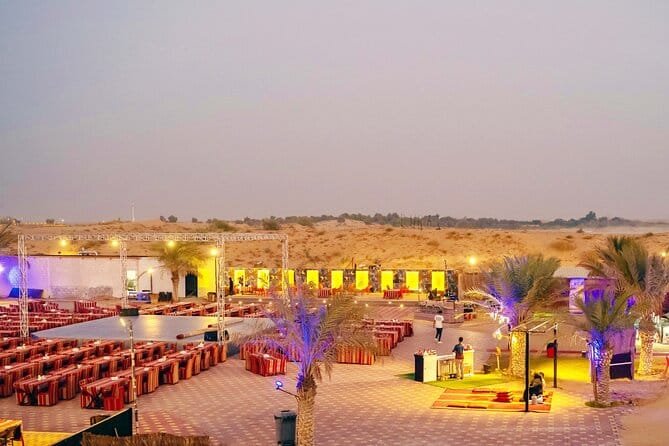
Every image is our own photography from the Abu Dhabi desert around our Al Khatim camp — judge our sands, light and setup honestly, not stock fantasy.
Plan Your Night in the Empty Quarter
Send us your dates, group size and pickup point — we will reply with a same-day quote, the moon phase for your window, and an honest word on festival clashes. No deposit, pay on arrival.
Liwa Overnight Desert Safari: Frequently Asked Questions
What is a Liwa overnight desert safari?
It is a private 4×4 expedition from Abu Dhabi into the Rub’ al Khali: afternoon dune driving, sunset near Moreeb Dune, a campfire BBQ, a night in expedition tents at a private camp, stargazing, and sunrise over the sands before a midday return. Door to door it takes 20–24 hours.
How far is Liwa from Abu Dhabi?
About 150 km south-west in a straight line, but around 220–250 km by road — a 2.5–3.5 hour drive via the E11 and E45, depending on pickup point and stops. The distance is why the overnight format exists: driving that far for two hours of dunes makes no sense.
How long does the whole trip take?
Plan for 20–24 hours door to door: early-afternoon pickup in Abu Dhabi, the full desert programme through sunset and the night, then sunrise, breakfast, oasis photo stops and a return around midday. Dubai pickups extend the day at both ends, so we schedule them earlier.
What is included in the overnight?
Your 4×4 with a professional driver-guide, the dune drive, Moreeb Dune viewpoint, sunset stop, private camp with campfire, BBQ dinner, soft drinks and water, tents and bedding, Arabic breakfast and morning photo stops. Exact inclusions are itemised on your WhatsApp quote so nothing is assumed.
Where do you actually sleep — what are the tents like?
Expedition tents at a private camp set among the dunes, with bedding matched to the season and extra layers in winter. It is comfortable camping rather than a fixed resort camp; we confirm the precise tent and bedding setup for your date and group size when we quote.
Are there toilets at the camp?
Facilities are expedition-grade and deliberately simple; the last flush toilets are at Mezaira’a, the final town stop. The exact camp arrangement varies with setup and group size, so we describe it plainly when you book — honest expectations beat midnight surprises.
How cold does it get at night in Liwa?
Cold enough to respect: expect single digits on the coldest winter nights, with the chilliest stretch just before dawn. Days stay pleasant, which is exactly why the swing catches people out. We supply seasonal bedding; still pack a fleece and something warm to sleep in.
Is a Liwa overnight desert safari safe?
Yes, run properly. We are a DCT Abu Dhabi licensed operator, our drivers are seasoned dune specialists, and deep-desert runs travel in convoy so no vehicle is ever alone in the sand. You get a safety briefing before the dunes, and the itinerary is re-timed to conditions rather than forced through them.
Can children come on a Liwa overnight?
School-age children who camp happily tend to love it — the private format lets us soften the dune driving and pace the evening around them. We honestly advise against bringing under-threes: the long drive, the cold night and the basic facilities are unkind to toddlers and their parents’ sleep.
What happens if my dates fall during the Liwa festival?
From mid-December to early January the festival at Tal Moreeb brings hill-climb racing, drag events, concerts and crowds that can reach around 40,000. It is spectacular for motorsport fans, but engines and event lighting replace the silence and darkness. We will tell you straight what your dates will deliver.
Can I climb Moreeb Dune?
Partway, realistically. The slipface runs at about 50 degrees over roughly 300 vertical metres, and soft sand takes back half of every step — most guests are happily defeated well below the crest. The base viewpoint and surrounding ridges give you the scale without demanding the summit.
Do I need a 4×4 — can I self-drive to Liwa instead?
Tarmac runs all the way to Moreeb’s base via a 22 km paved access road, so any car can reach the viewpoint — but never take a two-wheel drive onto sand, and never take a lone 4×4 into the deep dunes without training, low pressures and recovery gear. On our expedition you ride with our drivers.
Is there phone signal in the Liwa dunes?
Signal is good along the roads and in the towns, then fades between the dune corridors and often disappears where camps sit. Download offline maps before leaving the city and warn anyone expecting replies that you will be off-grid overnight. Our convoy protocol means the trip never depends on a phone working.
Should I book a new-moon or full-moon night?
New moon for stars — the Milky Way is visible to the naked eye on clear nights. Full moon for landscape — dunes glow bright enough to walk without a torch, but faint stars vanish. Quarter phases split the difference. Tell us your priority and we will point you at the right dates.
Which is better — the Al Khatim overnight or the Liwa overnight?
Neither — they answer different briefs. Al Khatim is 50–60 minutes away, sociable and easy, with evening entry from AED 35 per person. Liwa is a 2.5–3.5 hour drive into the Empty Quarter for silence, 300 m dunes and serious skies, priced by quote as a private expedition. First-timers usually start with Al Khatim.
How is Liwa different from a Dubai desert safari?
Scale and solitude. Dubai safaris run short hops into busy red-dune zones shared with dozens of convoys; Liwa sits on the edge of a 650,000 km² sand sea with the UAE’s tallest dune and hardly anyone in it after dark. One is a fun evening out; the other is an expedition you plan a trip around.
Can you pick us up from Dubai?
Yes, on a private basis. We schedule an earlier start to absorb the extra motorway time both ways and quote the transfer transparently. Send your hotel or district on WhatsApp and we will confirm exact pickup timing with your quote.
How do I book, and how is the price worked out?
Message us on WhatsApp with your dates, group size and pickup point; we reply the same day with an itemised quote. Pricing follows vehicle count and season — there is no flat rate for a private expedition. No deposit, no booking fee: you pay on arrival, with free cancellation up to 12 hours before.
Is the Empty Quarter really empty?
Gloriously close to it. The Rub’ al Khali covers about 650,000 km² across four countries, receives under 50 mm of rain a year, and is the world’s largest uninterrupted sand sea. Yet its Liwa rim carries an arc of some fifty villages and date farms — birthplace of the UAE’s ruling families — so the emptiness has a living edge.
What food is served, and can you cater for dietary needs?
Dinner is a campfire BBQ with grilled meats, vegetarian dishes, salads, Arabic coffee and dates; morning brings a simple Arabic breakfast. Tell us about vegan, allergy or other requirements when you book and the menu is adjusted before departure, not improvised on the night.
Is the Liwa Oasis worth visiting?
Emphatically yes — but for what it actually is. Liwa is not a single postcard stop; it is a 100-kilometre arc of villages, date farms and forts on the edge of the Empty Quarter, with the biggest dunes in the UAE rising behind it, including the Moreeb Dune. If your measure is dune scale, silence and a night sky with no city glow, nothing else in the Emirates comes close. If you want a quick two-hour sightseeing stop, the Al Khatim desert nearer Abu Dhabi serves that better — and we will tell you which fits when you send your dates.
Which is better, a morning or evening desert safari?
For day trips near Abu Dhabi: morning is cooler, emptier and better for photography; evening adds the sunset, the camp dinner and the shows. Liwa sidesteps the choice — an overnight gives you sunset, the night sky and sunrise on the same trip, which is precisely why people drive the extra distance. For the day-trip version see our sunrise and morning safari guide.
Which is the best desert safari in Abu Dhabi?
It depends on the hours you have. With a full day and a night, Liwa is the best desert experience in the country — real Empty Quarter, not a tourist circuit. With only an evening, the Al Khatim evening safari with the camp dinner is the right call. With only a morning, the sunrise safari is the quiet one photographers pick. We run all three, so this answer does not need to push you anywhere.
One Night That Outranks Whole Holidays
The Liwa overnight is the trip our own drivers talk about on their days off: the country’s biggest dunes, a fire in the middle of nowhere, a sky you will not believe and a sunrise you will measure other mornings against. It asks for a full day and repays it for years.
Start with a WhatsApp message — dates, group size, pickup point — and we handle the rest. Still weighing formats? Our Liwa desert safari day trips and the closer-to-town Al Khatim overnight safari cover every other way to meet these sands.
Continue Planning Your Trip
- Fossil Dunes Abu Dhabi — Al Wathba Visitor Guide & Closure Update
- Abu Dhabi Sand Dunes — Where to Find Them & How Tall They Get
- Night Desert Safari Abu Dhabi — Stars, Fire Shows & BBQ
- Camping in Abu Dhabi — Spots, Rules & Overnight Options
- UAE Desert Guide — Dunes, Wildlife & Where to Go
- Moreeb Dune: The Complete Visitor Guide
- Liwa Oasis Abu Dhabi
- Liwa Desert Safari Abu Dhabi
- Overnight Desert Safari Abu Dhabi
- Abu Dhabi Desert Safari Prices
- What to Wear on a Desert Safari in Abu Dhabi
- Best Time for a Desert Safari in Abu Dhabi
- Desert Safari Packages Abu Dhabi
- Abu Dhabi Desert Safari Booking — Confirmed in Minutes
- Morning Desert Safari Abu Dhabi
Planning the Rest of Your Abu Dhabi Trip
Most guests who book the dunes with us also want a day in the capital. These guides cover the practical detail:
- the Al Ain city tour — Jebel Hafeet and the UNESCO oasis, an easy day trip inland
Book this tour
No deposit and no card details. Message us and we confirm the plan and the exact price before you commit — answered at any hour.
- Send your date and guest countYour date, how many of you, and where we collect from. That is all we need.
- We send the plan and the pricePer car, not per person. You see the route, the timings and the exact figure first.
- Pay the driver on the dayCash or card, after the run. Free cancellation up to 12 hours before pickup.
Answered 24 hours · No deposit · No booking fee · Licensed operator
If we have to cancel, what happens?
A cancellation policy that covers your obligations but not ours is only half a document. Here is our side of it, in writing.
If we have to cancel your booking — for weather, a vehicle issue, or driver illness — we will contact you as soon as we know and rebook you at no charge on the next date that works for you. You pay nothing for the cancelled booking.
If we need to send a different vehicle than the one you booked, we will ask you first rather than turning up in something you did not book.
This is separate from your own cancellation rights, which are unchanged: you can cancel free up to 12 hours before pickup. Because we take no deposit and no booking fee, there is no money of yours sitting with us either way — nothing to chase, and nothing to wait for.