Abu Dhabi Sand Dunes: Where to Find Them & Which to Visit
Golden crests above 100 m an hour from the city, a ~300 m colossus on the Empty Quarter’s rim, and ancient dunes frozen into stone — here is where Abu Dhabi keeps its sand, and how to choose yours.
The Short Answer
Abu Dhabi’s sand dunes cluster in three worlds. The closest rideable dunes to the city are in the Al Khatim desert, about 80 km east along the E22 highway — a 50–60 minute drive — where crests around our private camp rise above 100 m. The tallest sand lies in Liwa, 2.5–3.5 hours south on the edge of the Rub’ al Khali, crowned by the ~300 m Moreeb Dune. The Al Wathba Fossil Dunes, about 45 km from town, are ancient dunes cemented into rock — viewing only, and currently closed for redevelopment. Most visitors meet the dunes on an evening safari to Al Khatim, from AED 35 per person self-drive.
Which dunes you end up standing on depends entirely on the format you book rather than on luck. The eleven options, with drive times and prices, are laid out in our Abu Dhabi desert safari tours comparison.
| Key fact | The answer |
|---|---|
| Closest soft-sand dunes | Al Khatim — ~80 km east of the city, 50–60 min via the E22 |
| Closest dune formations of any kind | Al Wathba Fossil Dunes — ~45 km, ~45 min (cemented rock; currently closed) |
| Tallest dune in the UAE | Moreeb Dune, Liwa — roughly 300 m high |
| Biggest dunes on a one-evening trip | 100 m+ crests around our Al Khatim camp |
| Cheapest way onto the dunes | Evening safari, AED 35 per person self-drive |
| Best light for photographs | Late afternoon through sunset |
Where Are the Sand Dunes in Abu Dhabi?
Abu Dhabi’s dunes gather in three distinct areas. The golden dune belt of Al Khatim lies about 80 km east of the city along the E22 Abu Dhabi–Al Ain highway, roughly an hour’s drive. The giants of Liwa and Moreeb Dune rise 220–250 km south, where the emirate meets the Rub’ al Khali. And the fossilised dunes of Al Wathba stand only about 45 km from town.
The pattern matters more than the map pins. The city sits on pale, shell-rich coastal flats, almost dune-free; drive inland and the land warms in colour, gathers into swells, then true dunes. Our drivers cross that gradient every afternoon — watch it from the window, white to cream to gold to amber — and our guide to the Al Khatim desert maps the heartland in detail.
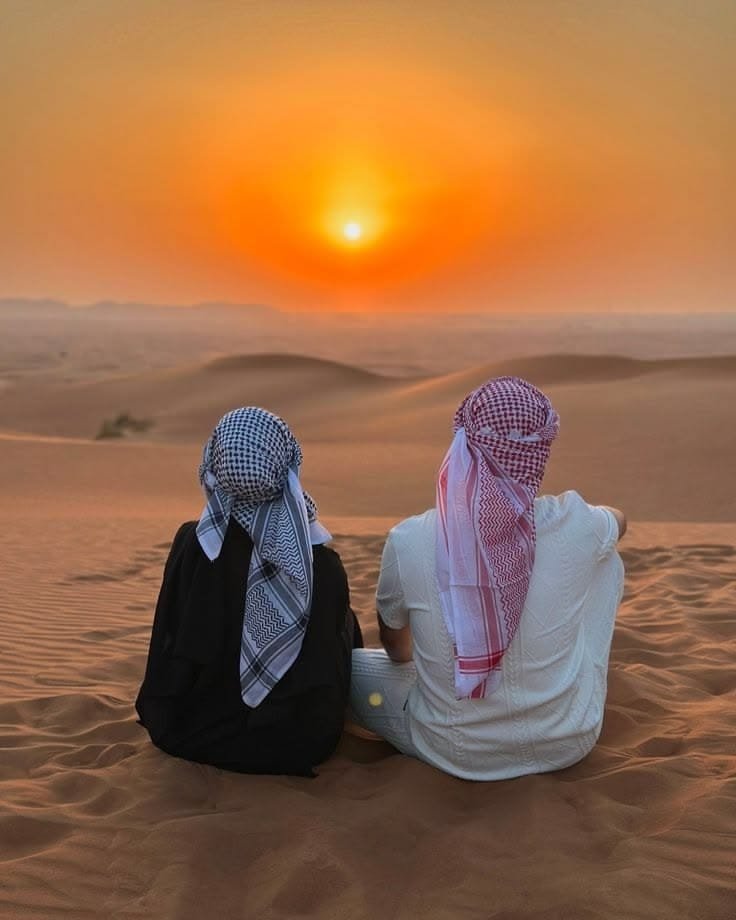
The Three Dune Worlds of Abu Dhabi, Compared
Here is the whole decision in one table — the comparison we sketch for guests who ask “which dunes should I actually visit?” Read your column top to bottom and you will know where your day belongs.
| What matters | Al Khatim | Liwa & Moreeb Dune | Al Wathba Fossil Dunes |
|---|---|---|---|
| Drive from the city | 50–60 min, ~80 km east on the E22 | 2.5–3.5 h, 220–250 km south | ~45 min, ~45 km |
| The dunes themselves | Golden, fine-grain dunes with wind-carved bowls; crests above 100 m around our private camp | Edge of the Rub’ al Khali — the world’s largest uninterrupted sand sea at ~650,000 km²; dunes to 250 m, Moreeb roughly 300 m with a ~50-degree slipface | 1,700+ dunes cemented into pale rock across ~7 km², around 120,000 years old — look, don’t ride |
| What you do there | Dune bashing, sandboarding, quads and buggies, camel rides, BBQ camp evenings, overnight stays | Big-dune expeditions and photography; Moreeb hill-climb spectacles each winter, mid-December to early January | Walking and photography among the formations when open — no vehicles, no boards |
| Cost to set foot on sand | Evening safari from AED 35 per person self-drive; private Land Cruiser AED 800 per car | Private Liwa trips quoted per group on WhatsApp — distance makes every itinerary bespoke | Entry published as free by the site when open; currently closed for redevelopment |
| Best for | First safaris, families, sunset evenings after a workday | Dune purists and photographers who want the tallest sand in the country | Geology lovers planning ahead for the reopening |
| Plan it | Evening safari from AED 35 | Liwa desert safari | Pair with an Al Khatim evening once it reopens |
Our honest reading after more than a decade driving all three: Al Khatim wins for nine visitors out of ten, delivering serious dunes inside a normal evening. Liwa rewards a full day. Al Wathba is a half-day curiosity once its gates open again.
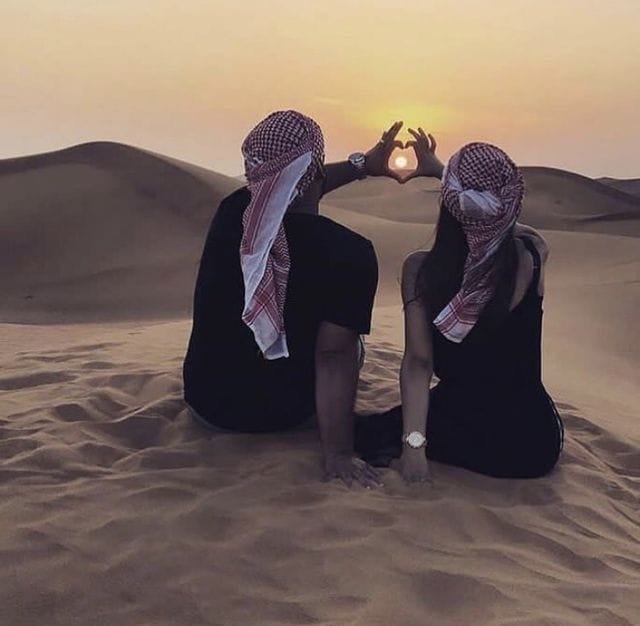
Al Khatim: Serious Dunes an Hour from the City
Al Khatim answers the question most people are really asking: where can I stand on a proper dune without sacrificing a whole day? The belt straddles the E22 about 80 km east of the city, and the dunes around our camp top 100 m — guests routinely mistake the far crests for solid rock hills.
The sand here is fine-grained and golden, sculpted into deep bowls that make natural amphitheatres for dune bashing. Beyond the camps there is almost no light pollution, so the post-dinner sky is genuinely dark.
Logistics are simple: evening pickups run 3:00–3:30 PM, returning around 10:00–10:30 PM as sunset shifts. Prefer the desert empty and cool? Our private morning safari (AED 799 per car) has the same dunes to itself.
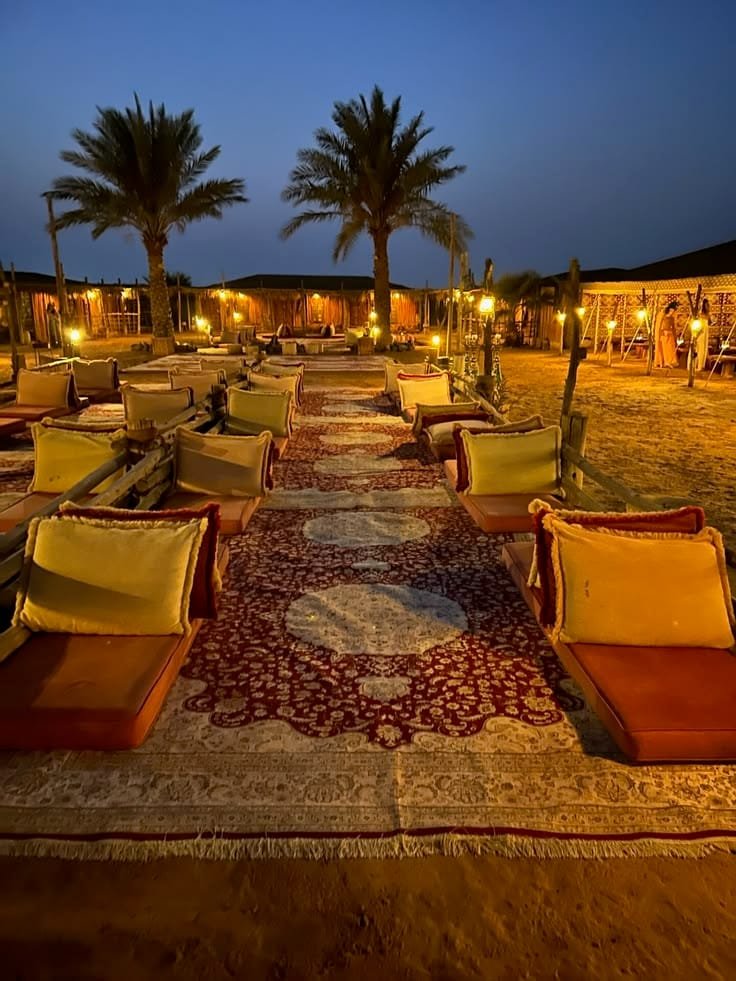
Liwa and Moreeb Dune: The Edge of the Empty Quarter
Drive 2.5–3.5 hours south and the scale changes register. Liwa’s crescent of oases sits on the northern rim of the Rub’ al Khali — the Empty Quarter — the largest uninterrupted sand sea on Earth at roughly 650,000 km², with amber dunes climbing to 250 m.
The landmark is Moreeb Dune: roughly 300 m tall, about 1.6 km long, with a slipface near 50 degrees — the steepest, tallest wall of sand in the UAE. A paved 22 km road runs to its base, so even a saloon car can park beneath it. Each winter, mid-December to early January, hill-climb competitions send modified machines howling up that face.
Liwa is not an add-on to an evening; it is the destination itself. We run it as a private, full-day expedition, priced per group on WhatsApp because distance and group size shape every itinerary.
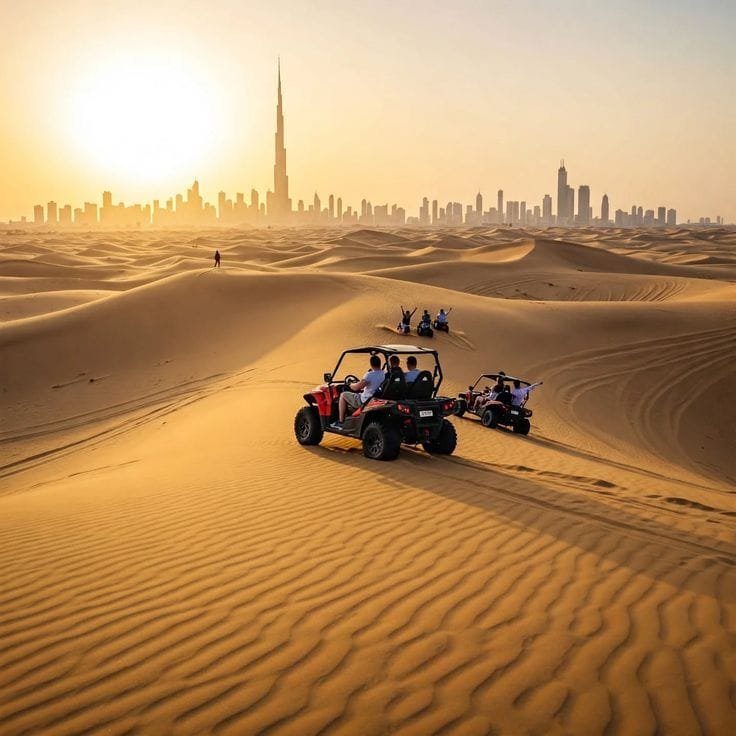
Al Wathba Fossil Dunes: Where Sand Turned to Stone
The strangest dunes in the emirate do not move at all. About 45 km from the city, the Al Wathba Fossil Dunes hold 1,700+ formations across roughly 7 km² — dunes that formed around 120,000 years ago, were cemented by mineral-rich groundwater during wetter eras, then re-emerged as sculpted rock when later winds stripped the loose grains away.
The result looks like a sea photographed mid-storm: cresting waves, undercut ledges, fins and pedestals in pale stone. You walk among them rather than ride them — this “sand” stopped being sand millennia ago.
Practical notes: the site published entry as free when open, and it is currently closed for redevelopment — check its status before driving out. Once it reopens, pair a late-afternoon fossil walk with a live-sand evening at Al Khatim.
Ready to Stand on a 100-Metre Dune?
Evening safaris to our private camp from AED 35 self-drive, AED 50 by shared bus or AED 100 with hotel pickup — dune bashing, sandboarding, camel ride, shows and BBQ included. Pay on arrival; cancel free up to 12 hours before.
Why Are Abu Dhabi’s Sand Dunes Red?
Because the desert is, quite literally, rusted. Every grain is a quartz crystal wearing a microscopic coat of iron oxide — hematite and limonite — and that film paints the dunes red, orange and gold. Scratch the stain and the quartz beneath is glassy and pale.
The staining deepens with age and distance from the sea. Coastal sand stays whitish, mixed with crushed shell and carbonate; inland fields like Al Khatim glow gold, and the older sands towards Liwa deepen to apricot-red. The drive to camp crosses that whole palette in under an hour.
Iron oxides also catch long-wavelength light, which is why dunes smoulder at sunset and turn copper at dawn — and why a sunrise desert safari photographs so differently from an evening one on the same sand.
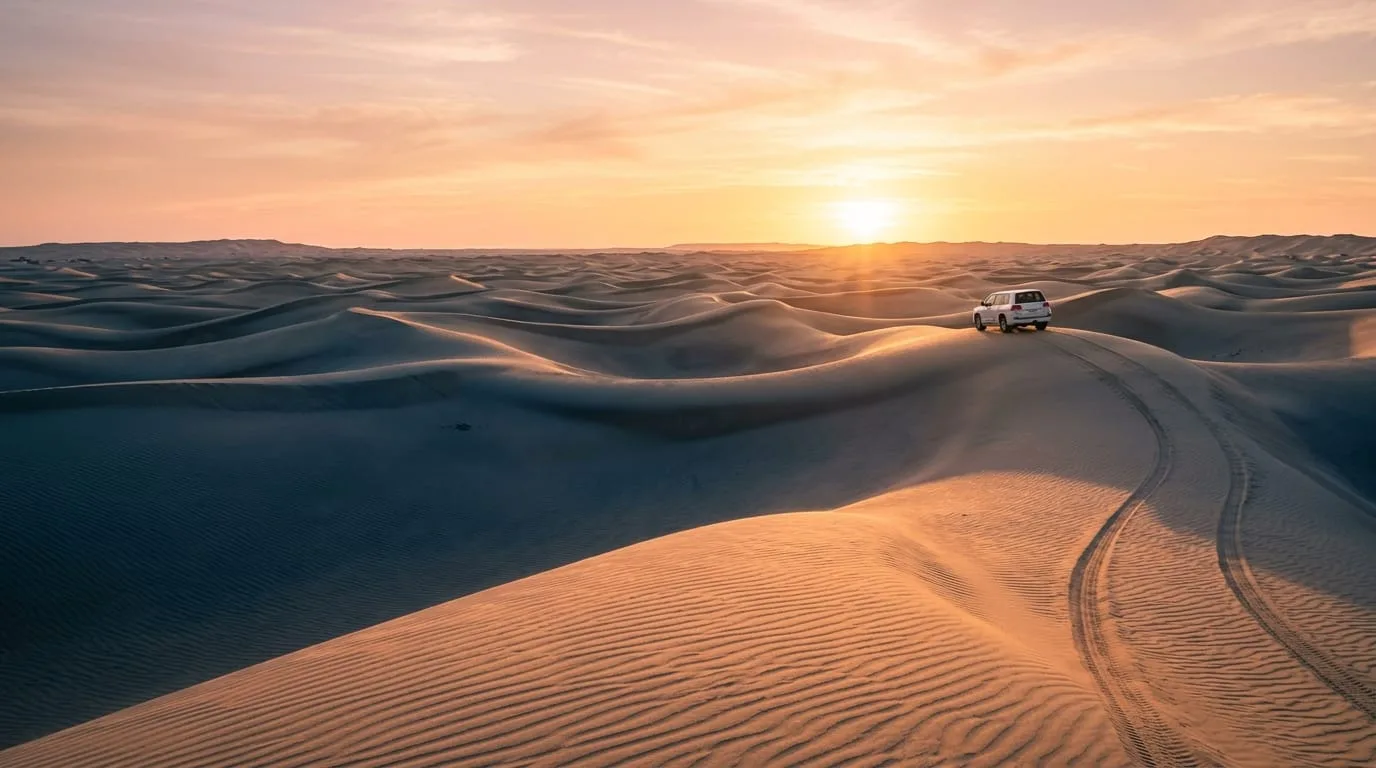
Barchan, Seif or Star: Know Your Dune Shapes
Dunes are wind made visible; each shape records a different wind history. The UAE’s dune country is built mostly by the Shamal, the strong north-westerly that sweeps down the Gulf, and four shapes cover almost everything you will see from the Land Cruiser window.
| Dune type | Shape | Wind recipe | How to spot it |
|---|---|---|---|
| Barchan | Crescent moon with horns pointing downwind | One dominant wind, limited sand supply | Lone crescents marching across firm plains at the desert’s fringes |
| Linear (seif) | Long, sinuous sword-blade ridges — some run up to 75 km | Two winds shouldering the sand from alternate sides | Parallel ranks of ridges with corridors of firm ground between |
| Star | A peak with arms radiating like a compass rose | Winds from many directions, piling sand upward instead of onward | The tallest builders — the giants of the great sand seas grow this way |
| Nabkha | Low hummock gathered around a shrub | Any wind plus one stubborn plant anchoring the sand | Knee-high mounds around ghaf and salt bush near tracks and camps |
Read the shapes and the desert becomes a weather report written in sand: a knife-edged crest means recent wind, a rounded one means days of calm. Our drivers use exactly that reading to choose each evening’s dune-bashing line.
How Do Sand Dunes Move?
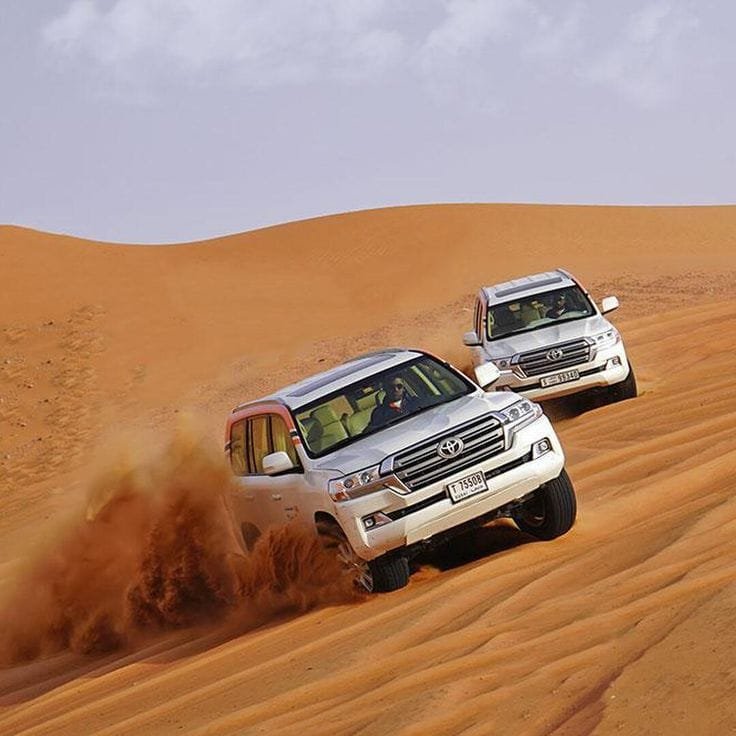
Grain by grain, in a process called saltation. Wind flicks grains into short hops up the gentle windward slope; each landing knocks more loose, so the surface flows like slow water. At the crest the wind lets go, sand piles until the face over-steepens, then avalanches down the slipface. Repeat a few billion times and the dune has walked downwind.
A dune is less an object than a very slow wave — sand passes through the shape while the shape migrates. It is why desert highways are edged with fences: the dunes are patiently trying to cross the road.
The fossil dunes complete the story: they marched the same way once, until wetter eras let groundwater minerals glue their grains solid. A living dune at Al Khatim and a stone one at Al Wathba are the same creature at two points in its life.
What Can You Do on the Dunes? Activities and Confirmed Prices
Almost everything the Abu Dhabi desert is famous for happens on the Al Khatim dunes, and most of it comes bundled into one safari. Here is the menu with our real, confirmed prices.
| Activity | What it involves | Price (AED) |
|---|---|---|
| Dune bashing | Roller-coaster Land Cruiser drive over the big dunes; sessions of about 45 minutes are standard | Included in every safari; extra session 150 per vehicle |
| Sandboarding | Surf the slipfaces on a waxed board — no experience needed | Included in our safaris |
| Camel ride | Short ride included at camp; longer guided dune ride on request | Short ride included; long ride 300 for two |
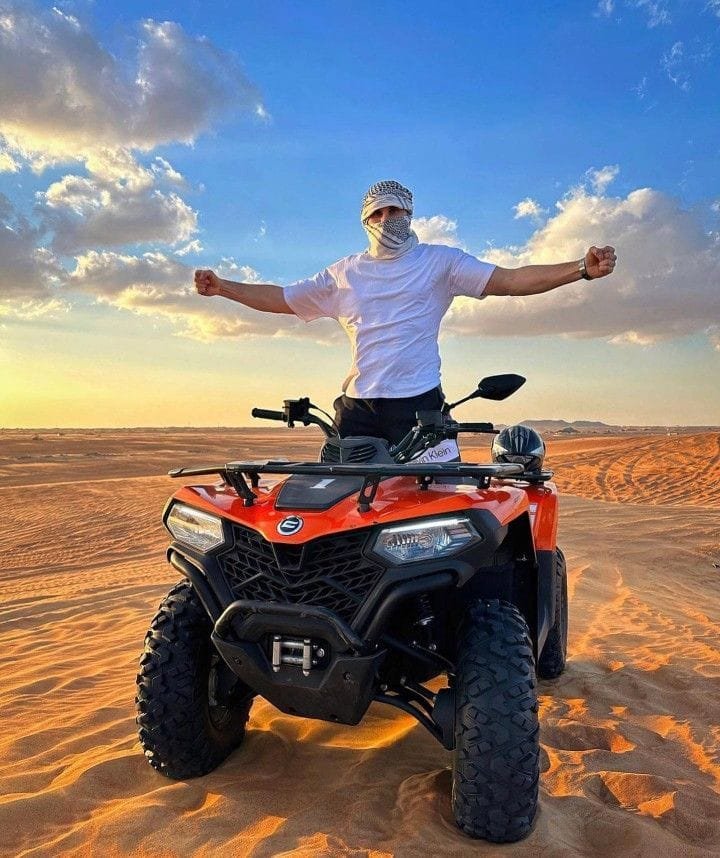
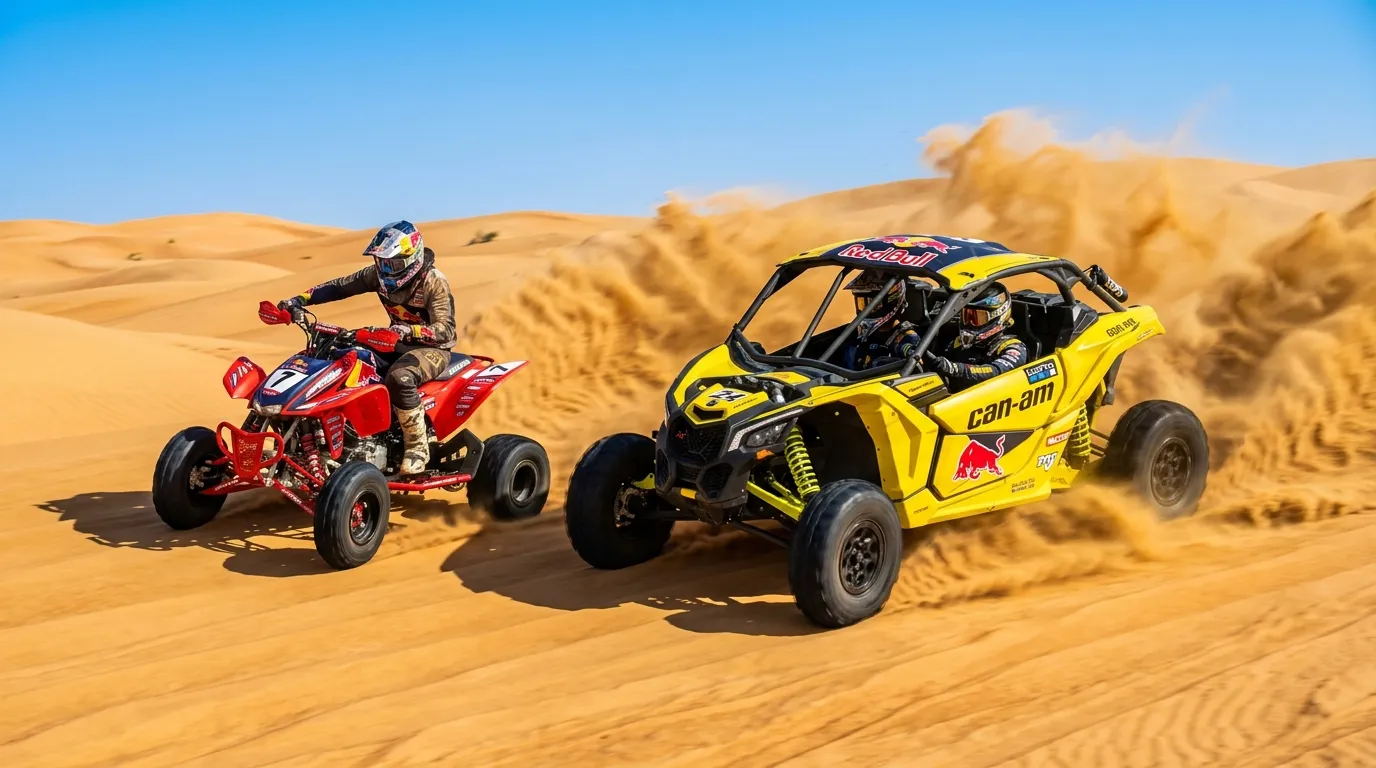
| Quad biking | Self-throttle laps on open sand beside the camp | 100 single, 150 double; morning long-route +200 / +300 |
| Can-Am buggy | Caged, high-power buggy for drivers who want more than a quad | From 600 per 30 minutes |
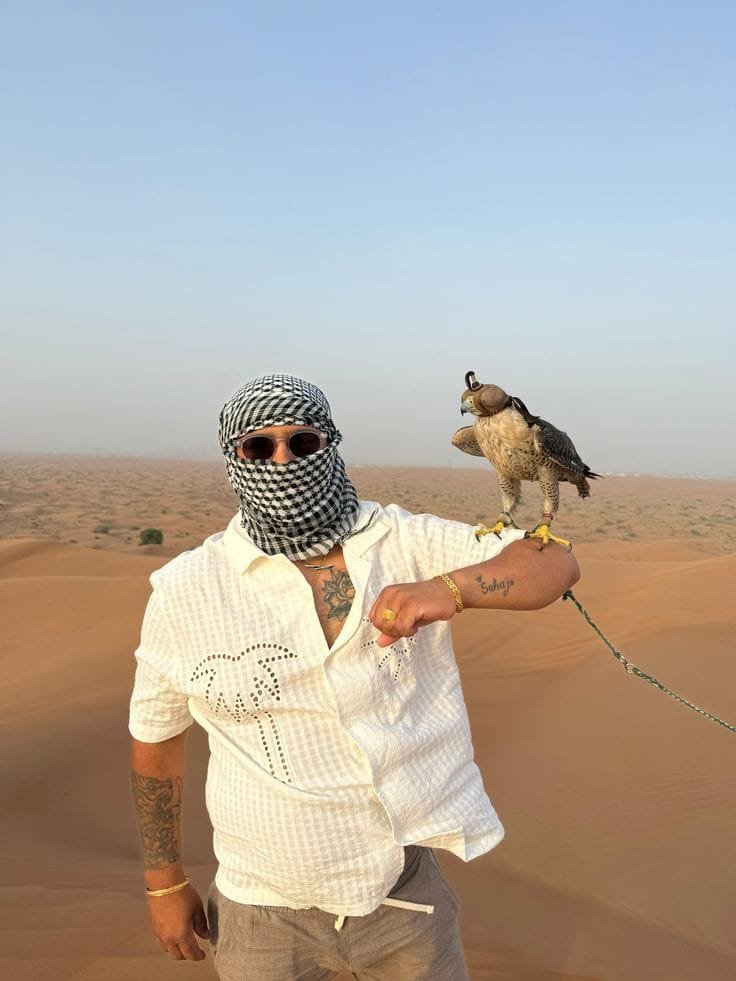
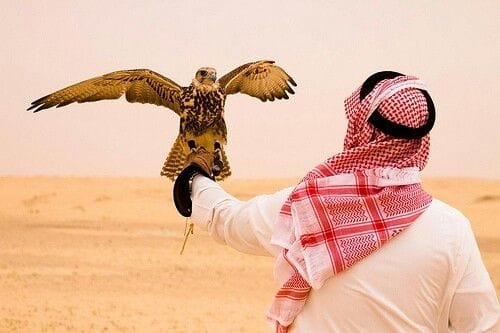
| Falcon photo | The national bird on your gloved arm at camp | 30 |
| Professional photoshoot | Our photographer works the golden hour with you on the dunes | From 50 |
| VIP majlis | Front-row cushioned seating and table service at the shows | +50 per person |
| Overnight dune camping | Full evening programme, then a night at our private camp and sunrise from the crests | Quoted per group on WhatsApp |
Two honest steers: book quads before arrival, since evening sessions run in waves, and treat camel riding as the one activity every generation enjoys together. For a night up there, our overnight desert safari extends the evening into a dune sunrise.
How Much Does It Cost to Visit the Dunes?
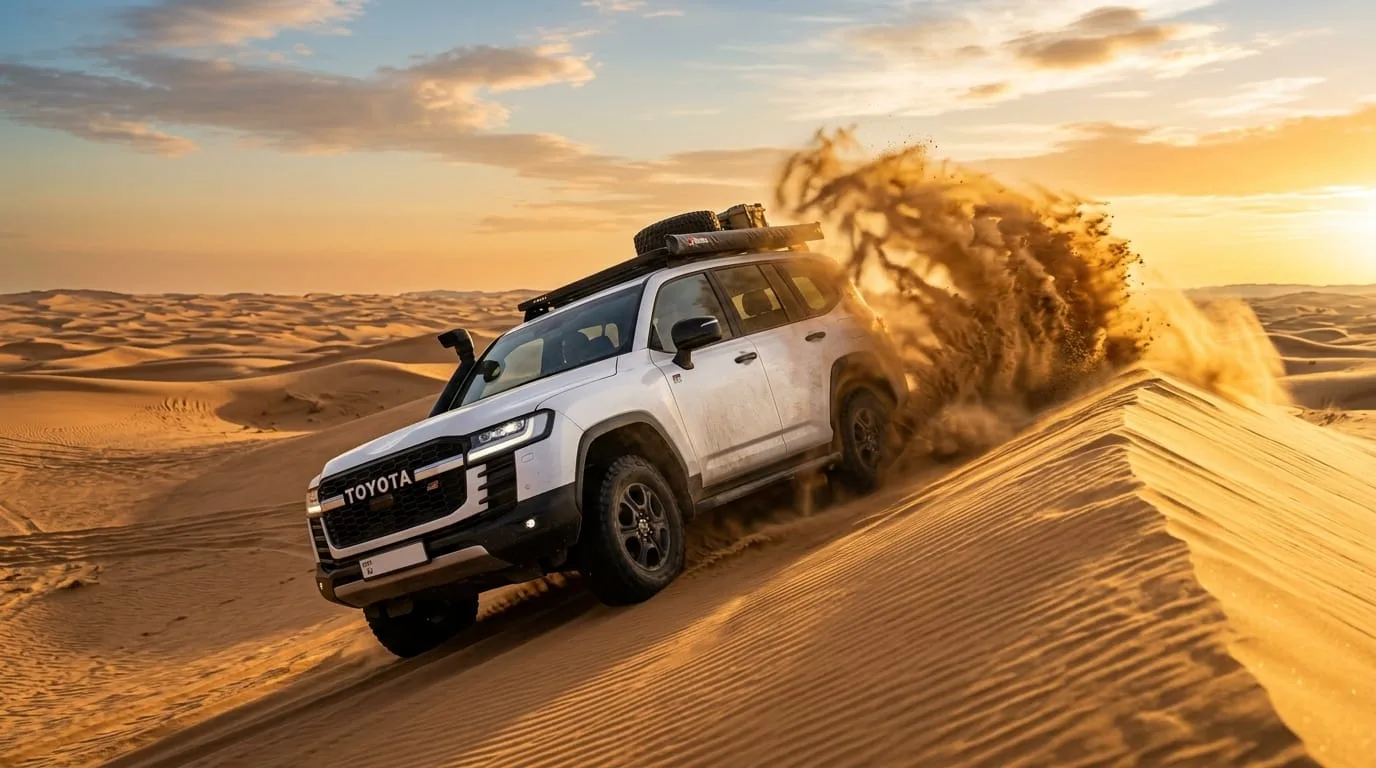
Less than most visitors expect, because transport — not the desert — is the real cost. The dunes charge nothing; you pay for getting there and what you do on arrival. Our evening safari starts at AED 35 per person self-drive, with identical camp inclusions across every transport option.
| Way to reach the dunes | How it works | Price (AED) |
|---|---|---|
| Self-drive, evening safari | Drive the E22 on tarmac to our meeting point; our drivers handle every metre of sand | 35 per person |
| Shared bus | Board at Al Wahda Mall or Mazyad Mall | 50 per person |
| Shared hotel pickup | Door-to-door from Abu Dhabi city hotels and homes | 100 per person |
| Private 7-seater | Your own vehicle and schedule for the evening | 599 per car |
| Private Land Cruiser | The full evening in your own 4×4 with driver | 800 per car |
| Private morning safari | Premium early session with the dunes to yourselves | 700 per car |
Every option is pay-on-arrival, cash or card, with no deposit and free cancellation up to 12 hours before — the full breakdown lives on our desert safari prices page. Booking takes one WhatsApp message: date, headcount, pickup point, done.
When Is the Best Time to See the Dunes?
Late afternoon into sunset, in the cooler months. Low sun turns the iron-stained sand copper, ridge shadows carve the dunes into sculpture, and the evening cools as the shows begin — exactly the window our evening safari occupies, with pickups at 3:00–3:30 PM year-round.
Season shapes the sand as much as the light. Winter is prime: mild evenings, the Moreeb festival window from mid-December to early January, and firm, crisp crests after humid nights. Summer compresses desert time to dusk — the city has recorded around 52.7°C — and the surface sheds its heat with astonishing speed once the sun drops.
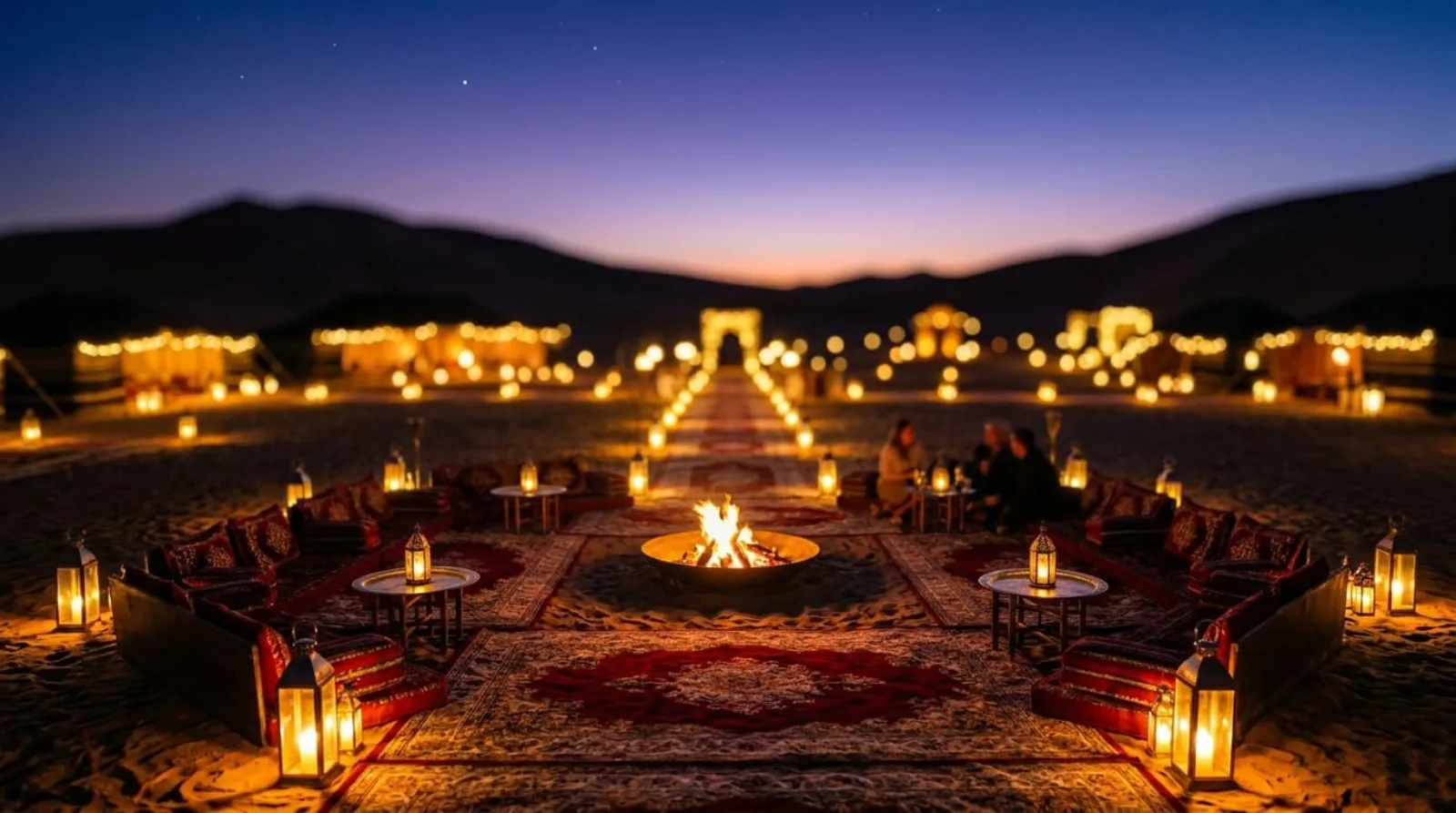
Those swings between scorching afternoon and cool night are why desert life is nocturnal, and why stargazing from the dunes became the quiet highlight of our evenings — 80 km from the city’s glow, the sky above camp goes properly black. For the month-by-month picture, see our best time for a desert safari guide.
For photographs, borrow the angles our drivers use at the sunset photo stop: shoot along a crest so the low sun rakes every ripple, or put the sun behind a ridge to drop the slipface into velvet shadow. Our photographer joins you on the sand from AED 50; the falcon photo at camp is AED 10–30.
Can You Visit the Dunes Without a Tour?
You can reach them, but you should not drive on them without experience. Tarmac gets any car to the edge of all three dune worlds — the E22 skirts Al Khatim, a paved road reaches Moreeb’s base — so looking costs nothing but fuel. Sand is a different sport entirely.
Official advice is unambiguous: never take a two-wheel-drive onto sand, travel in convoy with an experienced driver, deflate tyres (15–20 PSI is common practice), carry ample water, and keep 999 (police) and 998 (ambulance) saved. Soft sand swallows unprepared vehicles within metres; recovery from a remote bowl is a long, expensive afternoon.
The Dunes Around Our Camp
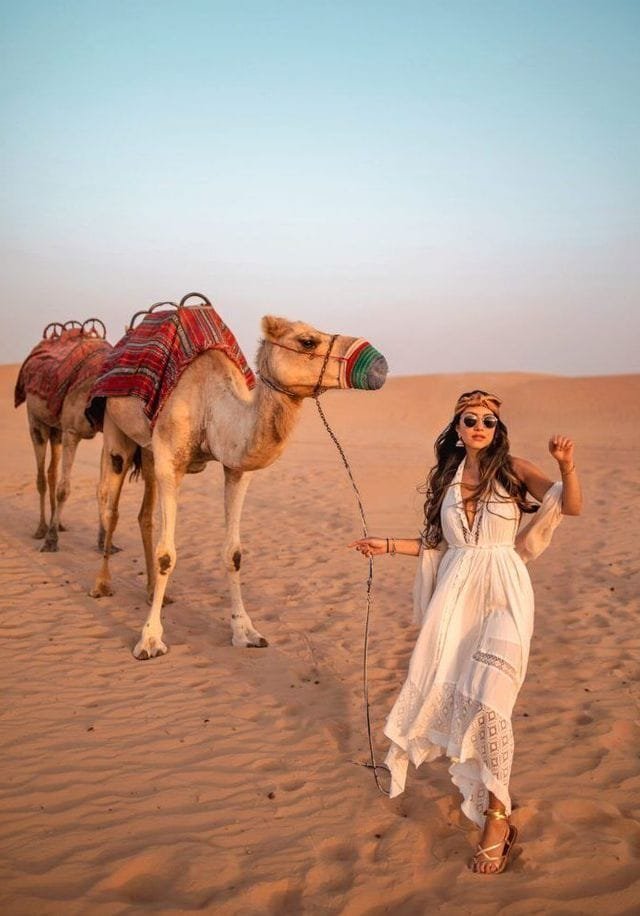
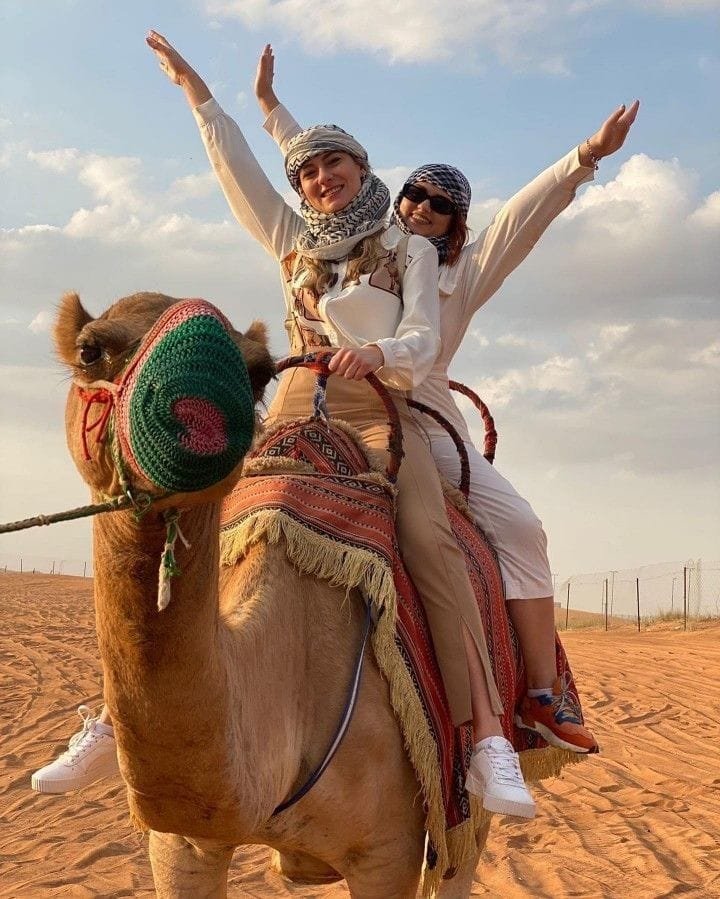
Frames from the dune field around our private Al Khatim camp — the sand we work every day.

Why Trust Us on the Dunes
Royal Arabian Safari Tourism LLC is a DCT Abu Dhabi–licensed tour operator with its own private camp in the Al Khatim desert and an office at Al Sila Tower, Al Maryah Island. For more than a decade our drivers have taken 5,000+ guests onto these dunes, holding a 4.9-star Google rating. Payment is on arrival, cash or card — no deposit, free cancellation up to 12 hours before.
Pick Your Dunes, We’ll Do the Rest
Evening at Al Khatim from AED 35 self-drive · hotel pickup AED 100 · private Land Cruiser AED 800 · private morning safari AED 799 per car. One message and your dune day is planned.
Abu Dhabi Sand Dunes — Frequently Asked Questions
Where are the sand dunes in Abu Dhabi?
In three main areas. The Al Khatim dune belt sits about 80 km east along the E22 — an hour’s drive, and home to our private camp. The giant dunes of Liwa and Moreeb rise 220–250 km south on the edge of the Rub’ al Khali, and the fossilised dunes of Al Wathba stand about 45 km from town.
Which sand dunes are closest to Abu Dhabi city?
The Al Wathba Fossil Dunes are nearest at about 45 km — but they are cemented rock, not soft sand, and currently closed for redevelopment. The closest rideable sand dunes are at Al Khatim, about 80 km east along the E22, a 50–60 minute drive from central Abu Dhabi.
How tall are Abu Dhabi’s sand dunes?
The dunes around our Al Khatim camp rise above 100 m — the reason this corridor became the emirate’s safari heartland. In the Liwa region, dunes reach around 250 m on the rim of the Rub’ al Khali, and Moreeb Dune stands close to 300 m — the tallest sand in the country.
What is the tallest sand dune in the UAE?
Moreeb Dune in Liwa, at roughly 300 m high with a slipface of about 50 degrees and a ridge about 1.6 km long. A paved 22 km road reaches its base, and each winter — mid-December to early January — it hosts the famous hill-climb competitions.
Why is the desert sand red in Abu Dhabi?
Because the grains are rusty. Each quartz grain carries a microscopic coating of iron oxides — hematite and limonite — that stains the desert red, orange and gold. The coating deepens inland, so Liwa’s sand glows redder, while coastal sand stays pale with shell and carbonate fragments.
Al Khatim or Liwa — which should I visit?
With one free evening, choose Al Khatim: an hour’s transfer, dunes above 100 m, and a full camp evening from AED 35. Choose Liwa if dunes are the reason you are travelling — 2.5–3.5 hours each way, but you stand beneath the tallest sand in the UAE.
What are the Al Wathba Fossil Dunes?
Ancient dunes turned to stone. During wetter eras, mineral-rich groundwater cemented their calcium-carbonate sand, and wind later stripped the loose material away, exposing 1,700+ rock formations across about 7 km², dated to roughly 120,000 years. The site published entry as free when open and is currently closed for redevelopment.
Can I visit the sand dunes without a tour?
You can look without a tour, but you should not ride. Any car reaches dune viewpoints on tarmac, including the paved road towards Moreeb, but driving on sand demands a 4×4, deflated tyres and convoy experience. Our self-drive evening (AED 35) splits the difference: tarmac to the meeting point, our drivers on the sand.
Do I need a 4×4 to see the dunes?
Not to reach them — only to drive on them. The E22 past Al Khatim and the Moreeb access road are fully paved, so any rental car gets you to the sand’s edge. On the dunes, never take a two-wheel-drive: soft sand bogs it down within metres.
What activities can you do on the sand dunes?
Dune bashing in Land Cruisers, sandboarding, quad biking (AED 100 single, AED 150 double), Can-Am buggies from AED 800 for 30 minutes, camel rides, falcon photos (AED 10–30), guided photography and overnight camping. Our evening safari bundles dune bashing, sandboarding, a camel ride, live shows and a BBQ buffet.
How much does a sand dune safari cost?
Our evening safari costs AED 35 per person if you self-drive to the meeting point, AED 50 by shared bus from Al Wahda or Mazyad Mall, and AED 100 with shared hotel pickup. Private options are AED 599 per 7-seater or AED 800 per Land Cruiser; the private morning safari is AED 799 per car.
How do I book a sand dune safari?
One WhatsApp message to +971 58 228 2683 with your date, group size and pickup point confirms everything. No deposit, no booking fee — you pay on arrival by cash or card, and cancellation is free up to 12 hours before. Evening pickups run 3:00–3:30 PM.
Do the sand dunes actually move?
Yes — grain by grain. Wind bounces sand up the gentle windward slope in a process called saltation; grains tip over the crest and avalanche down the steep slipface, so the whole dune creeps downwind. It is slow, but it is why desert roads need fences and why no two safari evenings look identical.
What is a star dune?
A dune with arms radiating from a central peak, built where winds blow from several directions. Because the sand piles upward instead of marching away, star dunes become the tallest of all dune types. Crescent barchans and linear seif ridges — some running up to 75 km — are the other shapes you will spot in the UAE.
Can kids play on the sand dunes?
Absolutely — sand is nature’s safest playground, and children treat the slipfaces as giant slides. Short camel rides, the falcon photo and sandboarding all suit young visitors. Tell us your children’s ages on WhatsApp and our drivers set a gentler pace with little ones aboard.
Are the sand dunes dangerous?
Not when treated with respect. The real risks are summer heat, bogging a private car and rolling an unguided vehicle — all avoided by visiting in the cooler hours, carrying water and riding with licensed drivers. Save 999 (police) and 998 (ambulance) before any self-drive trip, and never cross sand alone or in a 2WD.
Can you camp overnight among the dunes?
Yes. Our overnight desert safari adds a night at our private Al Khatim camp after the full evening programme — dinner and shows, then dunes under a dark sky and sunrise from the crests. Stays are quoted per group on WhatsApp, not off a fixed rate card.
What should I wear for a dune trip?
Loose, light layers with closed shoes for quads and sandboarding, plus a warm layer in winter — the sand sheds its heat quickly after sunset and evenings turn genuinely cool. Sunglasses earn their place if the wind lifts. Our what-to-wear guide covers every season in detail.
Three Dune Worlds, One Simple Plan
Abu Dhabi’s sand dunes are three worlds: Al Khatim’s 100 m crests an hour away, Liwa’s ~300 m giants on the rim of the world’s largest sand sea, and the stone waves of Al Wathba. For most visitors the right answer is the simplest — an evening on the Al Khatim dunes from AED 35, booked in a single message.
Keep exploring before you decide: browse everything there is to do in the Abu Dhabi desert, or go straight to the evening desert safari that starts it all. The dunes have been walking for millennia — they will happily wait for your date.
Continue Planning Your Trip
Explore More Desert Safari Guides
- UAE Desert Guide — Dunes, Wildlife & Where to Go
- Night Desert Safari Abu Dhabi — Stars, Fire Shows & BBQ
- Liwa Overnight Desert Safari — A Night in the Empty Quarter
- Fossil Dunes Abu Dhabi
- Morning Desert Safari Abu Dhabi Price — Full Cost Breakdown
- Car with Driver in Abu Dhabi — From AED 599
- Abu Dhabi Tour Packages — From AED 599 per Car
- Desert Safari From Fujairah
- Desert Safari From Umm Al Quwain
- Desert Safari From Ras Al Khaimah
- Desert Safari From Ajman
- Desert Safari From Sharjah
- How To Get To Desert Safari Abu Dhabi
Book this tour
No deposit and no card details. Message us and we confirm the plan and the exact price before you commit — answered at any hour.
- Send your date and guest countYour date, how many of you, and where we collect from. That is all we need.
- We send the plan and the pricePer car, not per person. You see the route, the timings and the exact figure first.
- Pay the driver on the dayCash or card, after the run. Free cancellation up to 12 hours before pickup.
Answered 24 hours · No deposit · No booking fee · Licensed operator
If we have to cancel, what happens?
A cancellation policy that covers your obligations but not ours is only half a document. Here is our side of it, in writing.
If we have to cancel your booking — for weather, a vehicle issue, or driver illness — we will contact you as soon as we know and rebook you at no charge on the next date that works for you. You pay nothing for the cancelled booking.
If we need to send a different vehicle than the one you booked, we will ask you first rather than turning up in something you did not book.
This is separate from your own cancellation rights, which are unchanged: you can cancel free up to 12 hours before pickup. Because we take no deposit and no booking fee, there is no money of yours sitting with us either way — nothing to chase, and nothing to wait for.