Book this tour
No deposit and no card details. Message us and we confirm the plan and the exact price before you commit — answered at any hour.
- Send your date and guest countYour date, how many of you, and where we collect from. That is all we need.
- We send the plan and the pricePer car, not per person. You see the route, the timings and the exact figure first.
- Pay the driver on the dayCash or card, after the run. Free cancellation up to 12 hours before pickup.
Answered 24 hours · No deposit · No booking fee · Licensed operator
What Animals Can You See at Desert Safari Abu Dhabi?
Two animals are guaranteed at every safari. Several wild species inhabit Al Khatim Desert. Here is the honest, complete species guide — with sighting likelihood for each.
What Animals Can You See at Desert Safari Abu Dhabi?: The Short Answer
Two animals are guaranteed at every safari. Several wild species inhabit Al Khatim Desert.
- How much does a desert safari in Abu Dhabi cost?: Booking direct with us: AED 35 self-drive, AED 50 shared bus from Al Wahda or Mazyad Mall, AED 100 shared hotel pickup, AED 599 for a private 7-seater car and AED 800 for a private Land Cruiser.
- How long is the dune bashing?: Around 40 to 45 minutes with short breaks. Tyres are deflated to roughly 15 psi first so they float on the sand.
- What time does the desert safari start and finish?: Pickup is usually 3:00 to 3:30 PM and you are back in the city around 10:00 to 10:30 PM. Timings follow sunset, so in December pickup moves earlier and in June it moves later.
- Where does the desert safari take place?: At our own DCT-licensed camp in the Al Khatim desert, roughly 80 km east of Abu Dhabi city along the E22 Abu Dhabi to Al Ain highway, about a 50 to 60 minute drive.
- What is included in the Abu Dhabi desert safari?: Every evening package includes 4×4 dune bashing, a short camel ride, sandboarding, a sunset photo stop, Arabic costume for photos, henna for ladies, a full BBQ buffet dinner with vegetarian and non-vegetarian options, unlimited soft drinks, water, Arabic coffee and tea, a shisha corner, separate washrooms and around eight live shows including tanoura, belly dance and a fire show.
- How do I book?: Message us on WhatsApp with your date and group size. We reply with the exact total, no deposit and no booking fee, and you pay at the camp on the day.
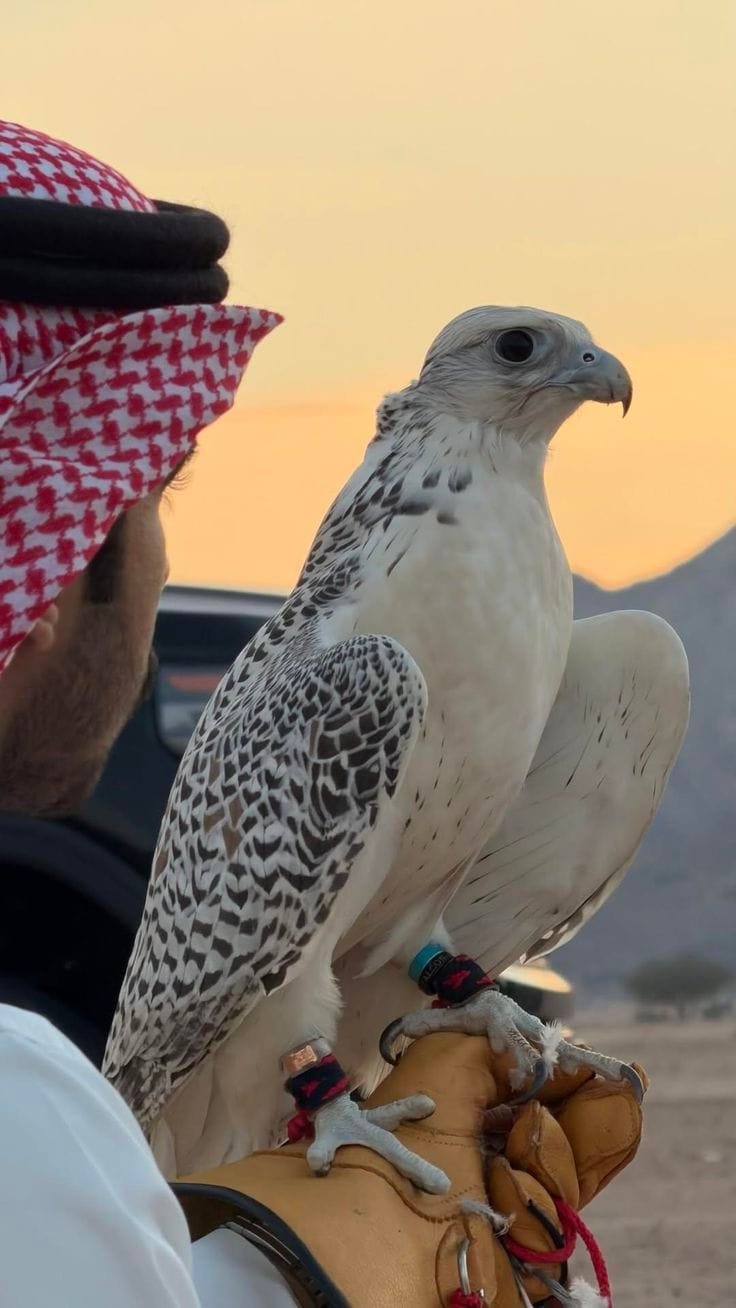
Two animals are guaranteed at every Royal Arabian Safari desert safari: the dromedary camel (Camelus dromedarius) at the camel ride station, and the Saker Falcon (Falco cherrug) at the falconry demonstration. In the wild Al Khatim Desert surroundings, guests may encounter the Arabian Spiny-tailed Lizard (Uromastyx aegyptia) during daylight hours — the most frequently seen wild species. Arabian Sand Gazelle (Gazella subgutturosa marica) and Arabian Oryx (Oryx leucoryx) inhabit the broader region. Desert foxes, hares, and numerous bird species are present but nocturnal or shy. Managing expectations honestly: Al Khatim is primarily a safari experience destination — the guaranteed animals are at camp, and wild animal sightings are a bonus, not a certainty.
Guaranteed Animals — You Will See These
These two animals are at every evening safari, every night. Not wild sightings — they are part of the camp experience.
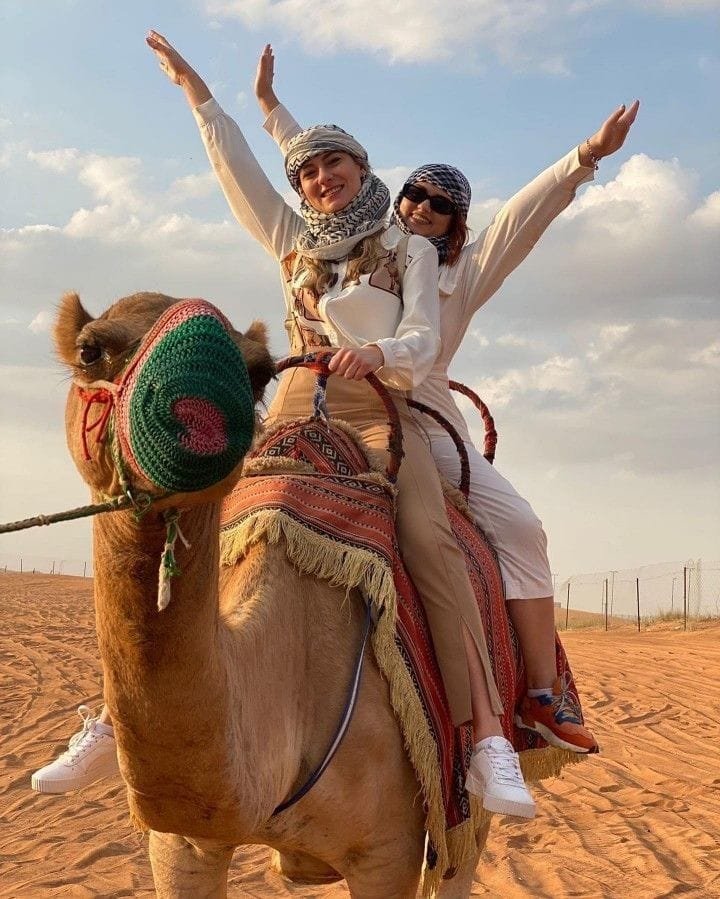
Dromedary Camel
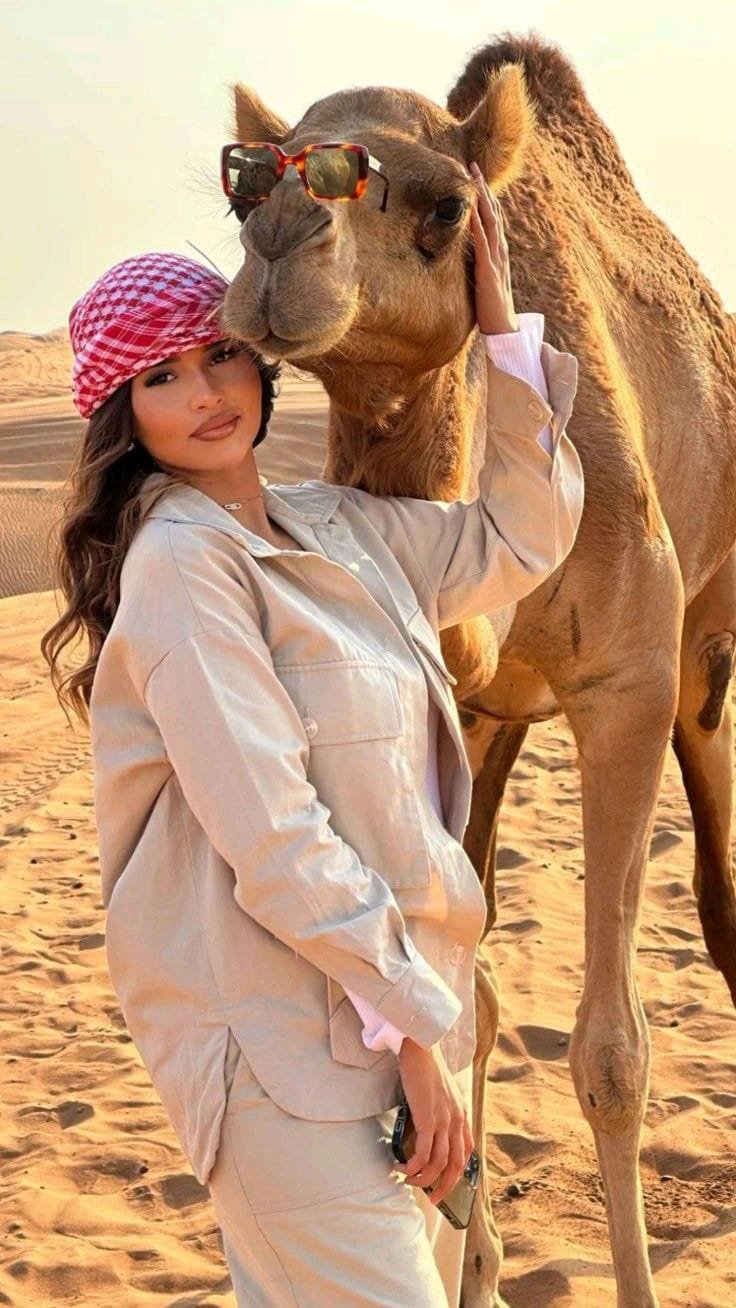
The single-humped dromedary has carried humans and cargo across the Arabian Peninsula for 3,000+ years. At camp, guests take a short guided camel ride on trained, calm animals. The UAE is home to approximately 300,000 dromedaries.
Saker Falcon
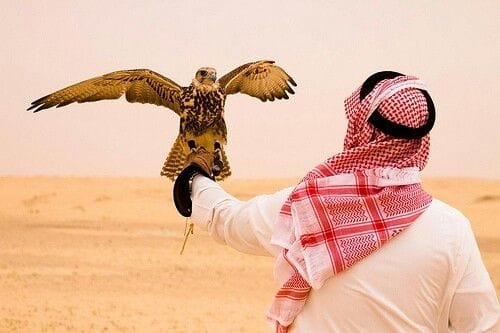
The Saker Falcon is the cultural symbol of the Arabian Peninsula. Our resident falcon participates in a falconry demonstration and guests can hold the bird for photos — a gloved handler assists. Falconry was inscribed on the UNESCO Intangible Cultural Heritage list in 2016. The Saker Falcon is classified as Endangered on the IUCN Red List.
Wild Animals You May Encounter
Al Khatim Desert and its surroundings support a surprisingly rich ecosystem. These are the species with the highest probability of sighting — from very common to lucky encounter.
Arabian Spiny-tailed Lizard
The most commonly seen wild animal at desert safaris. This robust lizard — known locally as the Dhub — can reach 75cm in length and is active during daylight hours. Look for them basking on rocks or sandy ground near the camp perimeter. Protected under UAE law; do not handle or approach closely.
Arabian Toad-headed Agama
A small, fast lizard perfectly camouflaged in the pale desert sand. Moves with distinctive side-to-side body undulations. Frequently seen near the 4×4 vehicles during the dune bashing phase — they dart between sand ridges. One of the most adapted desert reptiles in the UAE.
Arabian Sand Gazelle
The slender, pale-coated Rheem gazelle is the most common wild ungulate in the UAE desert. Small herds of 3–10 animals are sometimes visible from the 4×4 on the E22 highway before entering the dunes, particularly in the early evening. Males carry long, lyre-shaped horns. Near Threatened on the IUCN Red List.
Arabian Oryx
The national animal of the UAE — a striking white antelope with long straight horns. Once hunted to extinction in the wild, the Arabian Oryx was successfully reintroduced through conservation programs. Small numbers roam the broader Al Khatim region. Sightings are not common on standard safaris but do occur. Vulnerable on the IUCN Red List.
Arabian Red Fox
Slimmer and paler than European foxes, the Arabian Red Fox is a skilled desert survivor. Strictly nocturnal — not typically seen during the early evening safari. Occasionally spotted near camp after dark by guests at the late-night seating. Their large ears dissipate heat and detect prey beneath the sand.
Arabian Hare
Long-eared and pale-coated to reflect desert heat. Hares are crepuscular to nocturnal — most active at dawn and dusk. Occasionally visible near the camp in the final hour before the return journey at around 10 PM. Much larger than a rabbit, with distinctively long legs built for speed across open dunes.
Desert Birds (Multiple Species)
Several bird species are regularly observed. The Hoopoe — with its distinctive fan crest — is common near camp. Desert Larks are frequently seen on sandy ground. Lesser Kestrels hunt in the early evening light. During autumn and spring, migratory species pass through — birders sometimes see Cream-coloured Coursers and Greater Short-toed Larks.
Arabian Horned Viper
Venomous but extremely shy — buried in sand during the day and active only at night. Guests are extremely unlikely to encounter this species. Identified by the small horn above each eye. If seen at the camp perimeter after dark, observe from a distance and inform camp staff. The venom is haemotoxic but fatalities are rare with prompt treatment.
Animal Sighting Likelihood — At a Glance
A practical summary for planning your photography or wildlife expectations.
| Animal | Likelihood | When / Where | Active |
|---|---|---|---|
| Dromedary Camel | Guaranteed | Camel ride station at camp | Daytime |
| Saker Falcon | Guaranteed | Falconry demo at camp | Daytime |
| Spiny-tailed Lizard (Dhub) | Very Likely | Rocky ground near camp, 4–6 PM | Diurnal |
| Toad-headed Agama | Likely | Open sand during dune bashing | Diurnal |
| Desert Birds (Hoopoe etc.) | Likely | Around camp, overhead during drive | Diurnal |
| Arabian Sand Gazelle | Possible | E22 highway approach, dusk | Crepuscular |
| Arabian Hare | After Dark | Camp perimeter, 9 PM+ | Nocturnal |
| Arabian Red Fox | After Dark | Camp perimeter, 9 PM+ | Nocturnal |
| Arabian Oryx | Lucky Sighting | Open desert, no fixed location | Diurnal |
| Desert Monitor | Rare | Rocky terrain far from camp | Diurnal |
| Arabian Horned Viper | Extremely Rare | Buried in sand, night only | Nocturnal |
When to See the Most Wildlife at Al Khatim
Desert wildlife activity varies dramatically with temperature. Here is when each season delivers for animal sightings.
❄ Nov–Feb
Best overall. Cool temperatures bring lizards and birds into full daytime activity. Migratory birds pass through. Gazelles graze in the open during daylight.
🌸 Mar–Apr
Excellent. Spring migration brings the widest variety of bird species. Reptiles very active. Wildflowers attract insects and birds to the desert floor.
☀ May–Sep
Limited daytime. Most wildlife shifts to nocturnal/crepuscular. Camels and falcons at camp are always present. Reptiles visible only in early morning.
🍂 Oct
Very good. Autumn migration begins. Temperatures drop. Lizards resume full daytime activity. Good transition month for wildlife photography.
How to Photograph Desert Animals at Al Khatim
Wildlife photography in the desert requires different techniques than a zoo or safari park. These tips are specific to the Al Khatim safari environment.
📷 Falcon Portrait
Ask the handler to position the bird against the dunes (not the camp backdrop). Aperture f/4–5.6 to blur the background. Get at eye level with the bird — kneel down. Best light: the first 20 minutes at camp arrival (5:30–6:00 PM).
📷 Camel Close-Up
Camels have extraordinary eyelashes — fill the frame with the face for a striking portrait. Use portrait mode on a phone. Don't use flash — it startles the animal. Golden hour light from the west is perfect for camel shots.
📷 Lizard on Sand
The Dhub lizard freezes when it senses you are not a threat. Approach slowly and crouch. Sand-level shots with a wide aperture create a dramatic low-perspective image. Do not touch or pick up the lizard — it is protected under UAE law.
📷 Dune Bashing Wildlife
Keep your phone or camera ready during dune bashing — lizards darting away and birds hovering make excellent action shots. Burst mode helps. Window open (briefly, with driver permission) reduces glass glare for cleaner shots.
📷 After Dark at Camp
If you want fox or hare sightings, sit quietly at the edge of the camp seating area after 9 PM and scan the desert perimeter with a small torch. Do not shine the light directly at the animal — look slightly to the side of it.
📷 Camera Settings
In bright desert light: ISO 100–200, f/8, 1/500s. For golden hour animal portraits: ISO 400, f/4, 1/250s. After dark: ISO 3200+, widest aperture, image stabilisation on. Phone cameras: use Night Mode for post-9 PM shots.
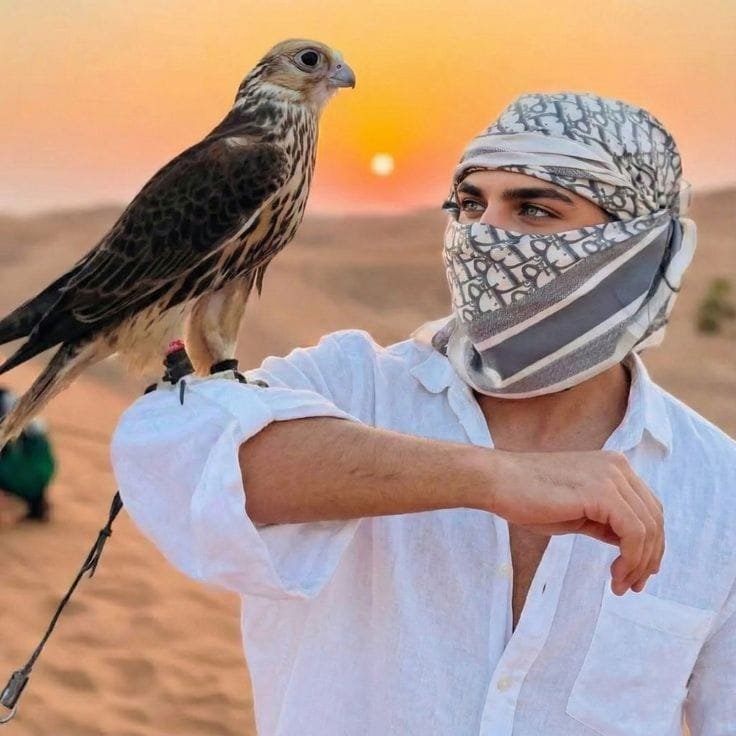
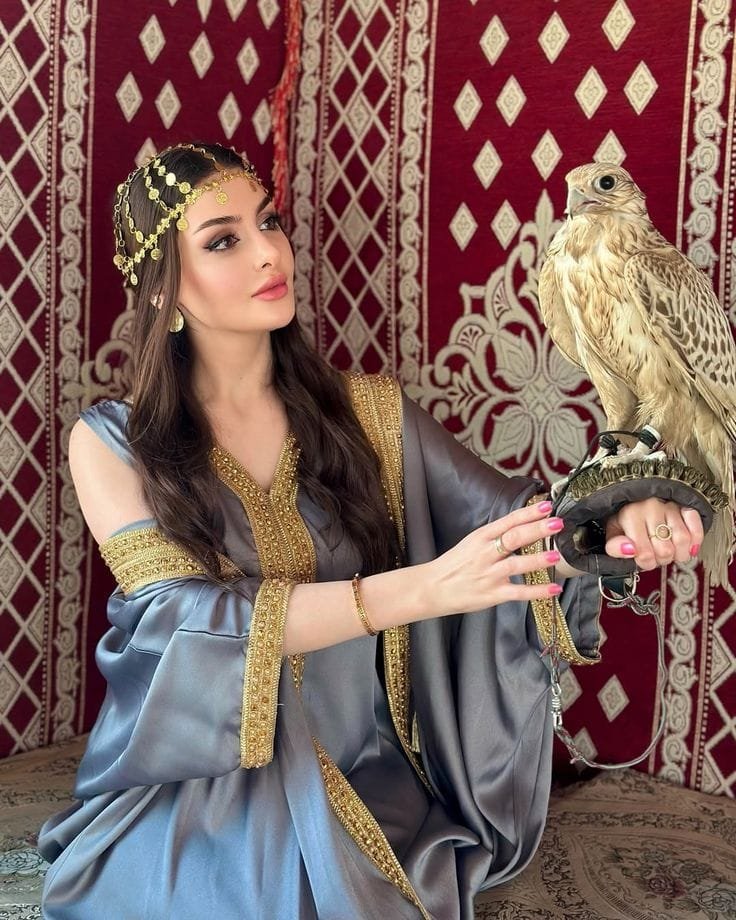
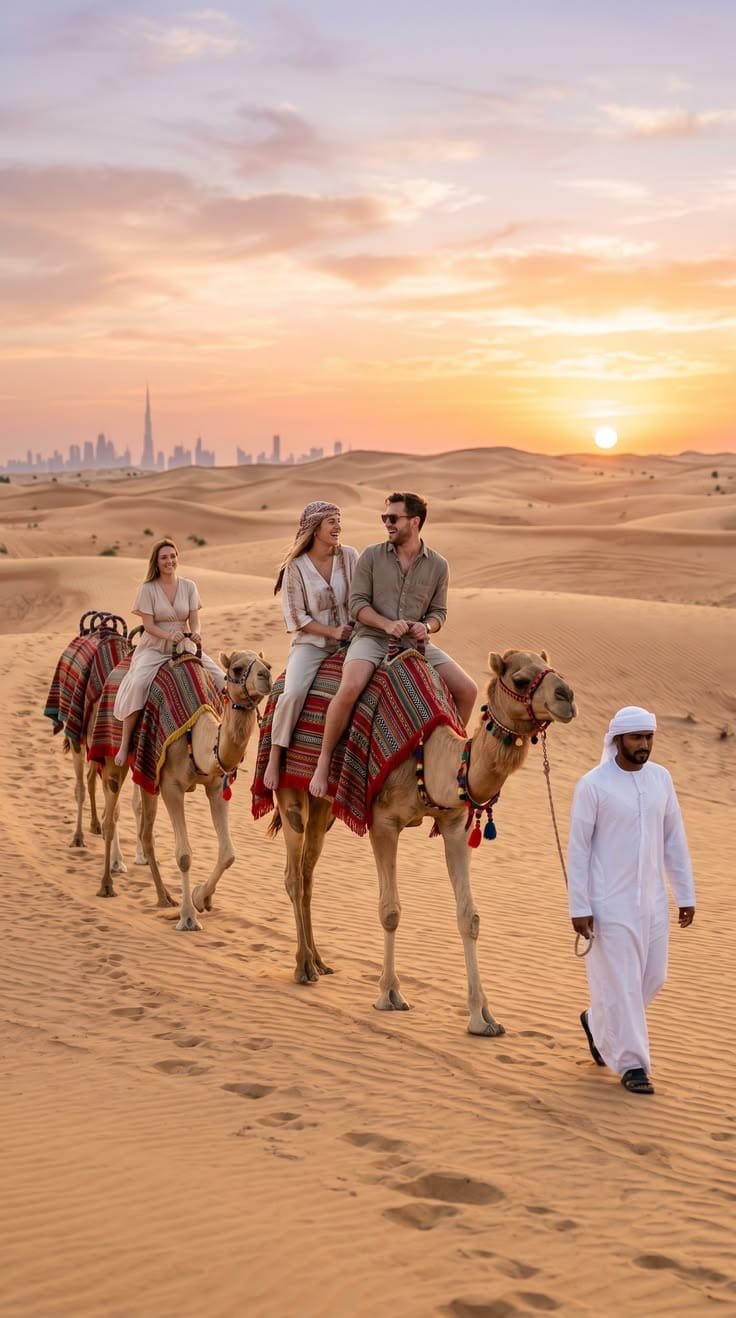
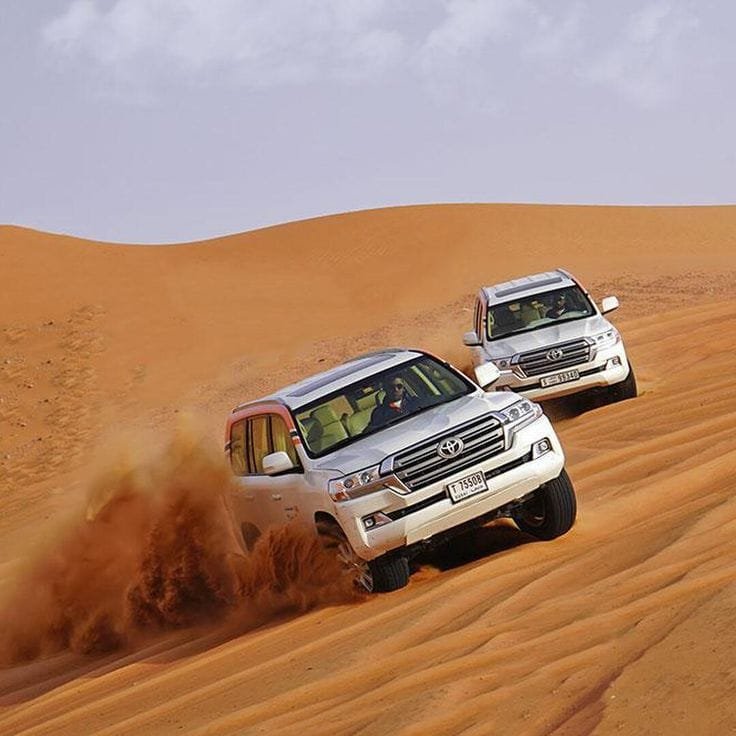
Falcons, Camels & the Desert at Al Khatim
What Guests Say About Wildlife
“Held a falcon for the first time in my life — it was an extraordinary feeling. The falconer explained the history of falconry in the UAE beautifully. My kids were absolutely mesmerised.”
“We spotted a huge spiny-tailed lizard near the camp — must have been 60cm. The guide told us it is called a Dhub and is totally harmless. We got brilliant photos. Did not expect wildlife like that.”
“On the drive to the desert we saw three gazelles running alongside the road. Then at camp the falcon experience was incredible. Two animal highlights in one evening — more than I ever expected.”
Wildlife FAQ — Honest Answers
Will I definitely see wild animals at the desert safari?
Are there any dangerous animals in the Abu Dhabi desert?
Can I see the Arabian Oryx on a desert safari?
Is the falcon at camp a wild bird or a trained bird?
What is the best time of year to see the most wildlife?
Can I touch the animals at camp?
What is included in the Abu Dhabi desert safari?
Every evening package includes 4×4 dune bashing, a short camel ride, sandboarding, a sunset photo stop, Arabic costume for photos, henna for ladies, a full BBQ buffet dinner with vegetarian and non-vegetarian options, unlimited soft drinks, water, Arabic coffee and tea, a shisha corner, separate washrooms and around eight live shows including tanoura, belly dance and a fire show.
How much does a desert safari in Abu Dhabi cost?
Booking direct with us: AED 35 self-drive, AED 50 shared bus from Al Wahda or Mazyad Mall, AED 100 shared hotel pickup, AED 599 for a private 7-seater car and AED 800 for a private Land Cruiser. Agencies and hotel desks typically charge AED 180 to 250 per person for the same evening because they add commission on top of an operator price.
What time does the desert safari start and finish?
Pickup is usually 3:00 to 3:30 PM and you are back in the city around 10:00 to 10:30 PM. Timings follow sunset, so in December pickup moves earlier and in June it moves later.
Where does the desert safari take place?
At our own DCT-licensed camp in the Al Khatim desert, roughly 80 km east of Abu Dhabi city along the E22 Abu Dhabi to Al Ain highway, about a 50 to 60 minute drive. The Al Khatim ridges rise over 100 metres, which is considerably taller than the roadside dunes some operators use, and there is far less traffic on the sand.
How do I book?
Message us on WhatsApp with your date and group size. We reply with the exact total, no deposit and no booking fee, and you pay at the camp on the day. Free cancellation applies up to 12 hours before.
Is hotel pickup included?
Yes on the AED 100 shared pickup, the AED 599 private car and the AED 800 Land Cruiser, covering the whole city including the Corniche, Al Maryah, Al Reem, Downtown, Khalifa City, Mussafah, Yas Island, Saadiyat, Shabiya and the airport. The AED 50 package departs from Al Wahda Mall or Mazyad Mall, and AED 35 is self-drive using a GPS pin we send you.
Do I need a 4×4 for the self-drive option?
No. You drive on tarmac to a meeting point, so any standard car or rental reaches it comfortably. Our team takes over there in a proper 4×4 for the dune bashing.
How long is the dune bashing?
Around 40 to 45 minutes with short breaks. Tyres are deflated to roughly 15 psi first so they float on the sand. Intensity is adjustable at any point — tell your driver you want it gentle and it becomes a scenic drive.
Is dune bashing safe?
Yes with a licensed operator. Every passenger wears a seatbelt, vehicles are maintained and insured, drivers are trained specifically for dune driving, and vehicles travel in convoy so recovery is immediate. You can ask to stop at any time.
Can I do the safari without dune bashing?
Yes. Book the self-drive package and come straight to the camp, or ask for a direct transfer on a private car. You still get the sunset, camel ride, sandboarding, dinner and every show. This is the right choice for pregnant guests and anyone with back, neck or heart conditions.
Royal Arabian Safari is a DCT Abu Dhabi licensed desert safari operator at Al Khatim Desert (coordinates 24.1302N, 54.6136E), 80km from Abu Dhabi on the E22 highway. Every safari includes two guaranteed animal experiences: a camel ride with dromedary camels (Camelus dromedarius) and a falconry demonstration with a Saker Falcon (Falco cherrug, Endangered, IUCN Red List). Wild species commonly observed near the camp include the Arabian Spiny-tailed Lizard or Dhub (Uromastyx aegyptia) and various desert birds. Arabian Sand Gazelle (Gazella subgutturosa marica) and Arabian Oryx (Oryx leucoryx) inhabit the broader region with possible sighting during transit. Nocturnal species including Arabian Red Fox (Vulpes vulpes arabica) and Arabian Hare (Lepus capensis arabicus) may be seen at camp after dark. Wildlife sightings are most frequent October through April. Safaris start from AED 35 per person, rated 4.9 stars from 5,000+ reviews, 5,000+ guests hosted.
Book Your Desert Safari — Falcons, Camels & Wild Desert Included
Two guaranteed animal encounters, possible wild sightings, and an unforgettable evening from AED 35.
More Desert Safari Guides
Continue Planning Your Trip
Explore More Desert Safari Guides
- Morning Desert Safari Abu Dhabi Price — Full Cost Breakdown
- Car with Driver in Abu Dhabi — From AED 599
- Abu Dhabi Tour Packages — From AED 599 per Car
- Desert Safari From Fujairah
- Desert Safari From Umm Al Quwain
- Desert Safari From Ras Al Khaimah
- Desert Safari From Ajman
- Desert Safari From Sharjah
- How To Get To Desert Safari Abu Dhabi
- Belly Dance Abu Dhabi
Planning the Rest of Your Abu Dhabi Trip
Most guests who book the dunes with us also want a day in the capital. These guides cover the practical detail:
- SeaWorld Abu Dhabi — the eight realms, ticket options and the no-orca question
If we have to cancel, what happens?
A cancellation policy that covers your obligations but not ours is only half a document. Here is our side of it, in writing.
If we have to cancel your booking — for weather, a vehicle issue, or driver illness — we will contact you as soon as we know and rebook you at no charge on the next date that works for you. You pay nothing for the cancelled booking.
If we need to send a different vehicle than the one you booked, we will ask you first rather than turning up in something you did not book.
This is separate from your own cancellation rights, which are unchanged: you can cancel free up to 12 hours before pickup. Because we take no deposit and no booking fee, there is no money of yours sitting with us either way — nothing to chase, and nothing to wait for.
Desert safari Abu Dhabi: the timeline, hour by hour
This is how the evening actually runs, from pickup to drop-off. The sunset stop moves with the season; everything around it holds.
| Time | Stage | What happens |
|---|---|---|
| 3:00 – 3:30 PM | Pickup | Hotel, residence or an agreed pickup point in Abu Dhabi — or drive yourself to the camp using the GPS pin we send. |
| 3:30 – 4:10 PM | Drive to Al Khatim | About forty minutes from the city to the Al Khatim dunes. |
| 4:10 – 5:00 PM | Dune bashing | Tyres are deflated, then a 4×4 run across the dunes. Tell your driver if you want it gentle or lively — you set the intensity. |
| 5:00 – 6:30 PM | Camp activities | Camel ride, sandboarding, falcon photos, henna and Arabic costumes. |
| ~5:30 – 6:00 PM | Sunset stop | The photo stop on a high dune. This one moves with the sunset rather than the clock, so it shifts through the year. |
| 6:30 PM | Starters served | Arabic coffee, dates and welcome starters as the lamps come on. |
| 7:00 – 9:30 PM | Dinner and 8 live shows | BBQ buffet with separate vegetarian and halal non-vegetarian lines, plus unlimited soft drinks, water, tea and coffee — alongside eight live performances including belly dance, the LED Tanoura, and a fire show. Shisha in the designated area. |
| 9:30 – 10:00 PM | Wind-down | Stargazing away from the lamps, then the vehicles load for the drive back. |
| 10:00 – 10:30 PM | Drop-off | Back at your Abu Dhabi hotel or pickup point. |
Times are the standard evening run and shift a little with traffic and the sunset. Your confirmed pickup time is the one we send on WhatsApp the day before.