UAE Desert: The Complete Guide to Arabia’s Golden Sands
Every dune belt, plant, animal, rule and real price in one place — written by a team that has driven these sands for more than a decade and runs its own private camp an hour from Abu Dhabi.
The Short Answer
The UAE desert is the north-eastern edge of the Rub’ al Khali — the Empty Quarter — the largest uninterrupted sand sea on Earth at roughly 650,000 km². Sand is the dominant landscape of the Emirates, running from pale coastal flats to the ~300 m Moreeb Dune at Liwa, and it is anything but empty: oryx, gazelles, foxes, ghaf trees and dozens of protected reserves live inside it. The most accessible big dunes rise at Al Khatim, 50–60 minutes east of Abu Dhabi city, where our private camp hosts evening safaris from AED 35 per person. Come between October and April for warm days and cool, star-heavy nights.
| Main sand sea | Rub’ al Khali (Empty Quarter) — ~650,000 km² across four countries |
| Tallest UAE dune | Moreeb Dune, Liwa — ~300 m with a ~50° slipface |
| Closest big dunes to Abu Dhabi | Al Khatim — ~80 km east on the E22, 50–60 minutes |
| Best season | October to April; July and August are the fiercest months |
| Signature wildlife | Arabian oryx, sand gazelle, Arabian red fox, dhub lizard |
| National tree | Ghaf (Prosopis cineraria) — protected by federal law |
| Evening safari from | AED 35 per person (self-drive to our Al Khatim camp) |
What Desert Is the UAE In?
The UAE sits on the north-eastern rim of the Rub’ al Khali — the Empty Quarter — the world’s largest uninterrupted sand sea, spreading across roughly 650,000 km² of Saudi Arabia, Oman, Yemen and the UAE. Drive south or west of Abu Dhabi and the emirate’s dune fields merge straight into it, with no fence, no signpost and no visible border.
The Empty Quarter’s core is one of the driest places on Earth, receiving less than 50 mm of rain in a typical year. Every other sand belt in the country — Al Khatim, Sweihan, Lahbab, Al Badayer — is, in effect, the outer apron of that great sea, softened by shallower dunes and threaded with roads, farms and camel tracks.
Is the UAE all desert, then? Not quite. The country covers about 83,600 km², and while sand and sabkha salt flats dominate the landscape, they share it with a long Gulf coastline, city greenbelts and working oases — Liwa’s date gardens being the most famous. What surprises many first-time guests is how alive the sand is: the UAE protects its deserts through dozens of nature reserves rather than leaving them as scenery.
We are an Abu Dhabi operator, and this guide is deliberately written from the Abu Dhabi side of the story — the side that holds the biggest dunes, the largest reserve and the Empty Quarter itself — while still giving Dubai, Sharjah and the northern emirates their fair place on the map.
Why Is the Sand Red — and How Do UAE Dunes Form?
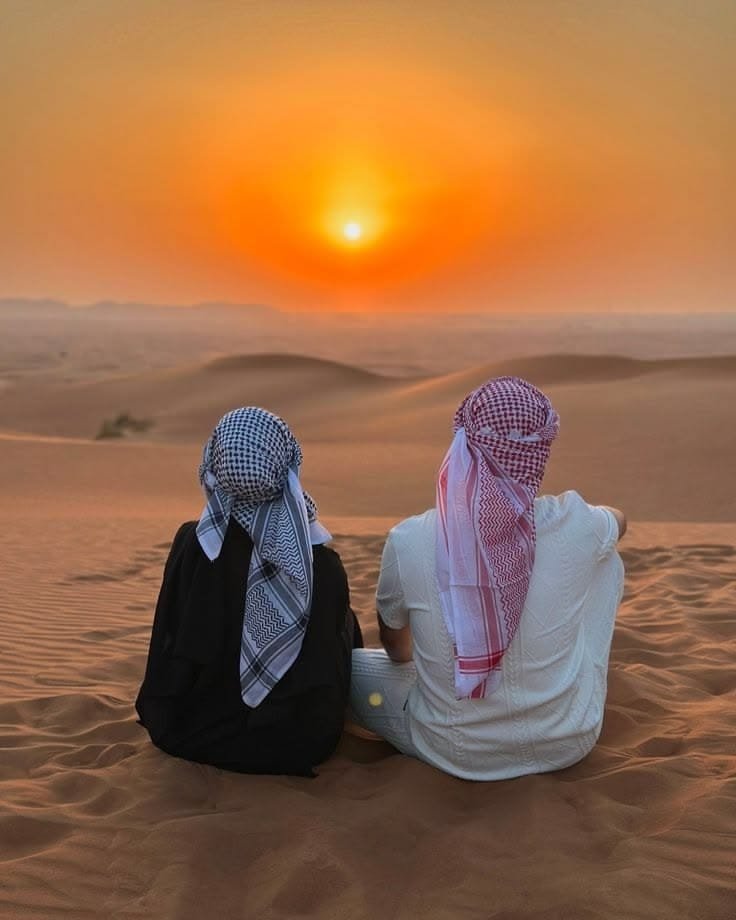
UAE desert sand is red-orange because every quartz grain wears a microscopic coat of iron oxide — hematite and limonite — which means the dunes are, quite literally, rusted. The deeper inland you go, the redder the sand becomes; coastal sand stays paler because it carries more carbonate from ground-up shell and marine skeletons.
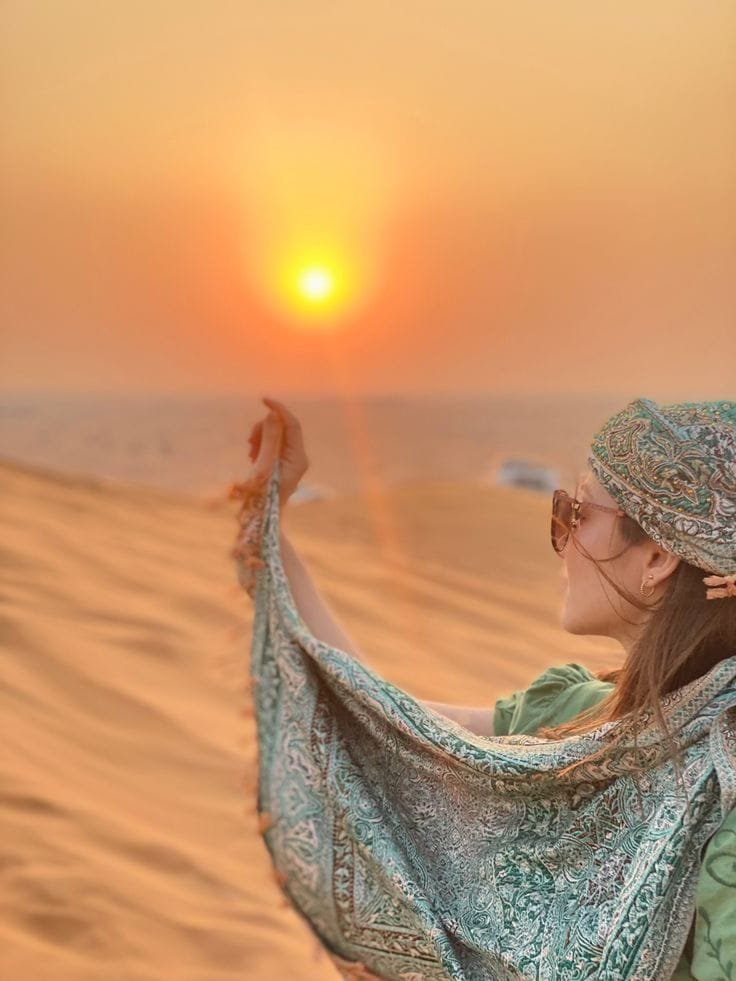
That chemistry is why the desert changes costume through the day. At noon the dunes read as pale gold; by late afternoon the low sun excites the iron tones and whole ridgelines turn copper and apricot. It is the single best reason to time a safari around sunset rather than the middle of the day.
The shapes are as engineered as the colour. Crescent-shaped barchan dunes form where one wind direction dominates; linear dunes — the classic seif or “sword” ridges — can run up to 75 km; and star dunes, built where winds collide from several directions, grow tallest of all. The north-westerly Shamal wind is the chief architect, endlessly harvesting sand and re-stacking it against the slipfaces.
For drivers, every dune has two personalities: a firm, wind-packed windward slope and a soft, collapsing lee side. Reading that difference at speed is the entire craft behind dune bashing in Abu Dhabi — and the reason our guests feel the vehicle dance rather than fight the sand.
UAE Deserts by Emirate: Where the Sand Actually Is
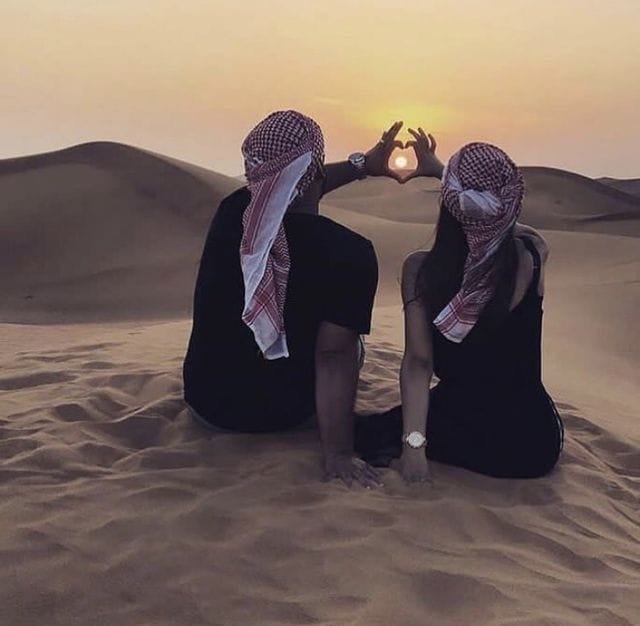
All seven emirates hold desert, but four dominate a traveller’s map: Abu Dhabi with the giant’s share — Liwa and the Empty Quarter, Al Khatim, Sweihan and Al Wathba — Dubai with compact, busy belts at Lahbab and Al Marmoom, Sharjah with the archaeology-rich Mleiha area, and Ras Al Khaimah with quiet dunes in the country’s north.
| Emirate | Key desert areas | Signature features | Best for |
|---|---|---|---|
| Abu Dhabi | Liwa and the Empty Quarter, Al Khatim, Sweihan (Tilal Swaihan), Al Wathba | The UAE’s tallest dunes, incl. ~300 m Moreeb; fossil dunes; the 6,000 km² Arabian Oryx Protected Area; our private camp | Big-dune safaris, overnight camps, serious dune driving, wildlife reserves |
| Dubai | Lahbab (“Big Red”), Al Marmoom and Al Qudra, Dubai Desert Conservation Reserve (DDCR) | DDCR covers 225 km² — about 5% of the emirate and the UAE’s first national park; desert cycling tracks | Quick safaris close to hotels, cycling, short transfers |
| Sharjah | Mleiha and Fossil Rock, Al Badayer, Al Faya, Al Madam “ghost village” | Archaeology and geology in one small area; a half-buried abandoned village the sand is slowly swallowing | Culture-plus-desert day trips, photography |
| Ras Al Khaimah | Al Wadi | A quieter dune pocket well away from the main safari crowds | Travellers staying in the northern emirates |
Read the table with distances in mind. Dubai’s belts are small and the closest to its hotel districts, which is why they are crowded; Sharjah’s Mleiha rewards anyone who likes a story with their scenery; and Abu Dhabi holds everything from an easy one-hour escape to a full Empty Quarter expedition. South and west of Abu Dhabi city there is no “edge of the desert” at all — the sand simply keeps going until it becomes Saudi Arabia.
Our own operation is built on the Al Khatim belt because it offers the best ratio in the country: dunes that top 100 m, under an hour from Abu Dhabi’s islands. The rest of this guide digs into each area — and ends with an honest matchmaking section on which desert suits which traveller.
Liwa and the Empty Quarter: The UAE’s Greatest Desert
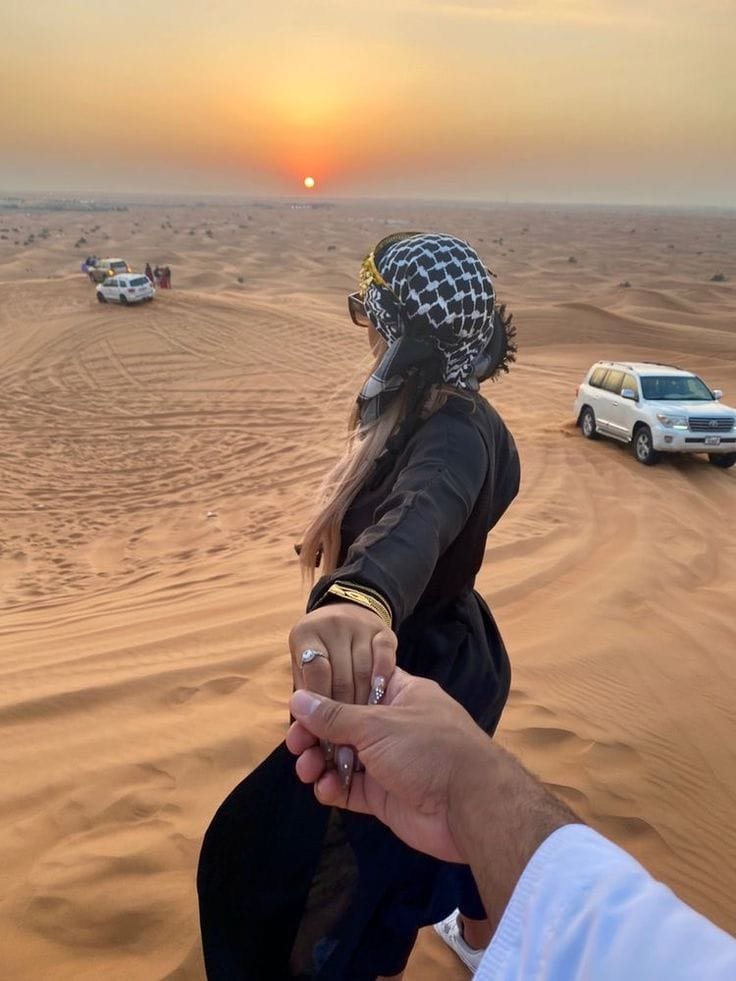
For sheer scale, nothing in the Emirates touches the Liwa region of southern Abu Dhabi, where the dunes of the Rub’ al Khali sometimes exceed 200 m and push towards 250 m. This is the desert of legend — mile after mile of ranked sand mountains, in one of the driest places on Earth, where under 50 mm of rain may fall in a whole year.
The gateway is the Liwa Oasis: a 100 km east–west arc of around 50 villages strung along the sand sea’s northern rim, roughly 150 km south-west of Abu Dhabi city as the falcon flies and 220–250 km by road — call it three hours of driving. Liwa is the UAE’s date-farming heartland and the ancestral home of both the Al Nahyan family of Abu Dhabi and the Al Maktoum family of Dubai, which tells you exactly how central this desert is to the country’s story.
A Liwa desert safari is therefore a different product from an evening trip: it is a full-day or overnight commitment, and it rewards that commitment with dunes that make a Land Cruiser look like a beetle on a staircase.
Moreeb Dune: the UAE’s 300-metre giant
About 25 km south of the oasis arc stands Moreeb Dune (Tal Mireb) — around 300 m tall, roughly 1,600 m long, with a slipface near 50°. It ranks among the world’s largest natural sand hill-climbs, and every winter it hosts hill-climb racing, with the Liwa festival running from mid-December to early January.
Even outside race weeks, Moreeb Dune is worth the drive for the view alone: the flat plain at its base acts as a natural grandstand, and from the crest the Empty Quarter rolls south as if it never intends to stop. Go early — the light is kinder and the sand firmer before the day heats up.
Al Khatim and Al Wathba: Abu Dhabi’s Doorstep Deserts
You do not need a Liwa expedition to stand on a serious dune. The Al Khatim belt runs along the E22 Abu Dhabi–Al Ain corridor about 80 km east of the city — a 50–60 minute drive — and the dunes around our private camp there top 100 m. It is the most accessible true safari desert in the emirate, which is exactly why we built our camp in it.
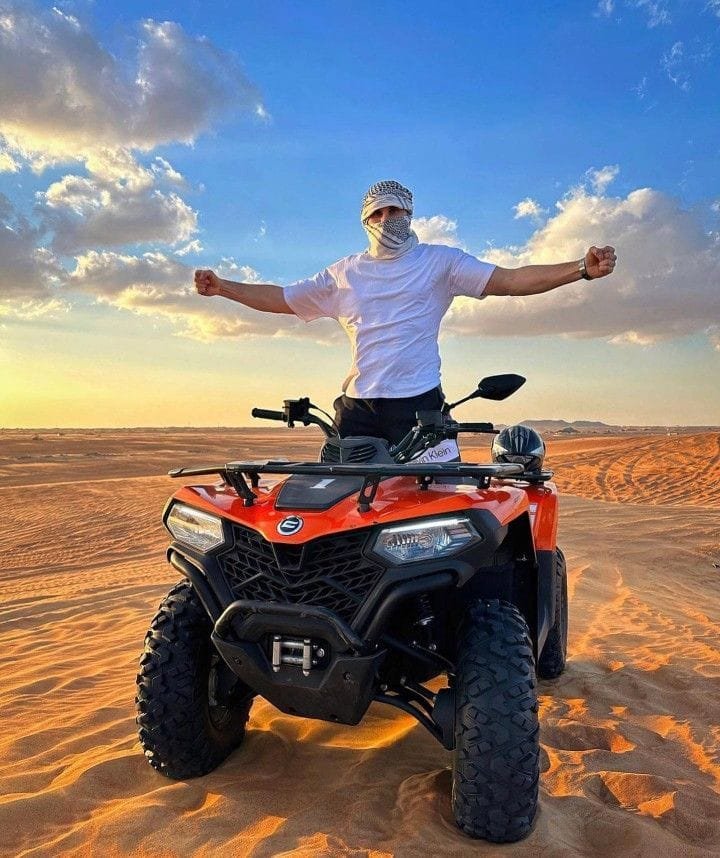
Accessibility changes what an evening can hold. Our pickups leave the city between 3:00 and 3:30 PM, guests are on the dunes for the best light, and everyone is back at their hotel by around 10:00–10:30 PM — a full desert evening without a single early alarm. The sand itself is classic golden Empty Quarter apron: big, clean slipfaces with firm bowls between them, ideal for dune bashing, sandboarding and quad routes. Our complete Al Khatim desert guide covers the area dune by dune.
Al Wathba: fossil dunes, flamingos and a campground
Closer to the city, Al Wathba is Abu Dhabi’s strangest desert corner. Its fossil-dune reserve protects more than 1,700 rock-hard formations across 7 km² — ancient dunes, around 120,000 years old, cemented over time and carved by the wind into freestanding sculptures. Next door, the Al Wathba Wetland Reserve supports up to 4,000 flamingos at peak along with more than 250 recorded bird species — a reminder that “desert emirate” and “birdlife” are not opposites.
The area also hosts Al Wathba Lake Camp — 13 campsites and 24 barbecue areas — and the emirate’s famous camel-racing track, which we return to in the culture section below.
Desert Plants in the UAE — With Names
The UAE desert supports far more plant life than first-time visitors expect: the ghaf tree, the date palm, the parasitic desert hyacinth, wiry arfaj-type shrubs and sedges, and a specialist guild of salt-tolerant plants out on the sabkha flats. Each one solves the same problem — heat plus drought — in a completely different way.
The ghaf (Prosopis cineraria) is the UAE’s national tree and the desert’s quiet hero. It stays green through extreme drought because its roots chase the water table far below the surface, it lives about 120 years on average, and it is protected by federal law — cutting down a wild ghaf is illegal. For Bedouin travellers its canopy was shade, shelter and meeting place rolled into one; find a lone ghaf between dunes and you have found the desert’s living room.
The date palm is the desert’s economy made visible. The UAE set a Guinness World Record after planting 42 million palms within a single decade, giving the country one of the largest date-palm populations on Earth — and Liwa’s villages remain the craft’s heartland, their groves ringed by some of the country’s tallest dunes.
The showpiece, though, is the desert hyacinth (Cistanche tubulosa). It has no green parts at all: it taps the roots of host shrubs underground, then erupts after winter rain as a spike of brilliant yellow flowers standing straight out of bare sand. Guests who see one always assume someone planted it there.
Between these headliners, hardy sedges and low shrubs stitch the dunes together and feed gazelles, while salt-loving species hold the line on the sabkha where almost nothing else survives. The green threads are easiest to spot in the hollows between dunes, where moisture lingers longest — look down from any ridgeline near our camp and you can trace them.
| Plant | What it is | Why it matters |
|---|---|---|
| Ghaf (Prosopis cineraria) | Evergreen desert tree; roots reach the deep water table | UAE national tree; protected by federal law; ~120-year average lifespan; shade and shelter for wildlife and travellers |
| Date palm | Cultivated oasis palm | 42 million planted in a decade — a Guinness World Record; the economic engine of Liwa’s oasis villages |
| Desert hyacinth (Cistanche tubulosa) | Leafless parasitic flowering plant | Feeds off host-plant roots; erupts in yellow flower spikes after winter rain |
| Arfaj-type shrubs and sedges | Low, wiry dune vegetation | Anchor the sand, shelter gerbils and lizards, and provide grazing for gazelles and camels |
| Sabkha halophytes | Salt-tolerant flat-ground specialists | The only plants that manage life on the crusted salt flats between dune fields |
Desert Animals in the UAE: What Actually Lives Out There
The UAE desert is home to the Arabian oryx, sand gazelle and Arabian gazelle, two fox species, the elusive sand cat, desert hedgehogs, gerbils, a famous lizard called the dhub, around 70 reptile species in total, and headline birds from the houbara bustard to the Pharaoh eagle-owl. Most of them are experts at not being seen — which is half the fascination.
The Arabian oryx is the flagship. A white desert antelope built for hyper-arid life, it carries one of conservation’s greatest stories — hunted to the brink roughly five decades ago and now recovered so strongly that the IUCN moved it from Endangered to Vulnerable, a world first for a species that had once vanished from the wild. The full comeback story gets its own section below.
Two gazelles share the sands: the sand gazelle or reem, pale as the dunes it crosses, and the darker Arabian gazelle. Wild numbers are modest, but breeding programmes and reserves now hold sand gazelle populations of more than 100,000.
The predators are smaller than visitors imagine. The Arabian red fox is the most common wild hunter and works the dunes by night; the smaller Rüppell’s fox holds the deeper sands; and the sand cat — a genuinely rare, nocturnal specialist — is the sighting even our drivers talk about for weeks. None of them poses any threat to people.
By day the desert belongs to the reptiles, and the star is the dhub — the Egyptian spiny-tailed lizard. It is a large, entirely herbivorous lizard that lives in colonial burrow networks, basks like a sunbather, and is listed as Vulnerable by the IUCN, with the Environment Agency – Abu Dhabi monitoring its colonies. On morning drives its burrows and tracks are the easiest wildlife signs to read.
Overhead, the houbara bustard is the desert’s celebrity bird — a camouflage master at the centre of a vast UAE breeding effort — while the Pharaoh eagle-owl hunts the dunes at night and is likewise monitored by Abu Dhabi’s environment agency. Small mammals like the desert hedgehog and Cheesman’s gerbil fill the night shift, leaving neat calligraphy of tracks for the morning.
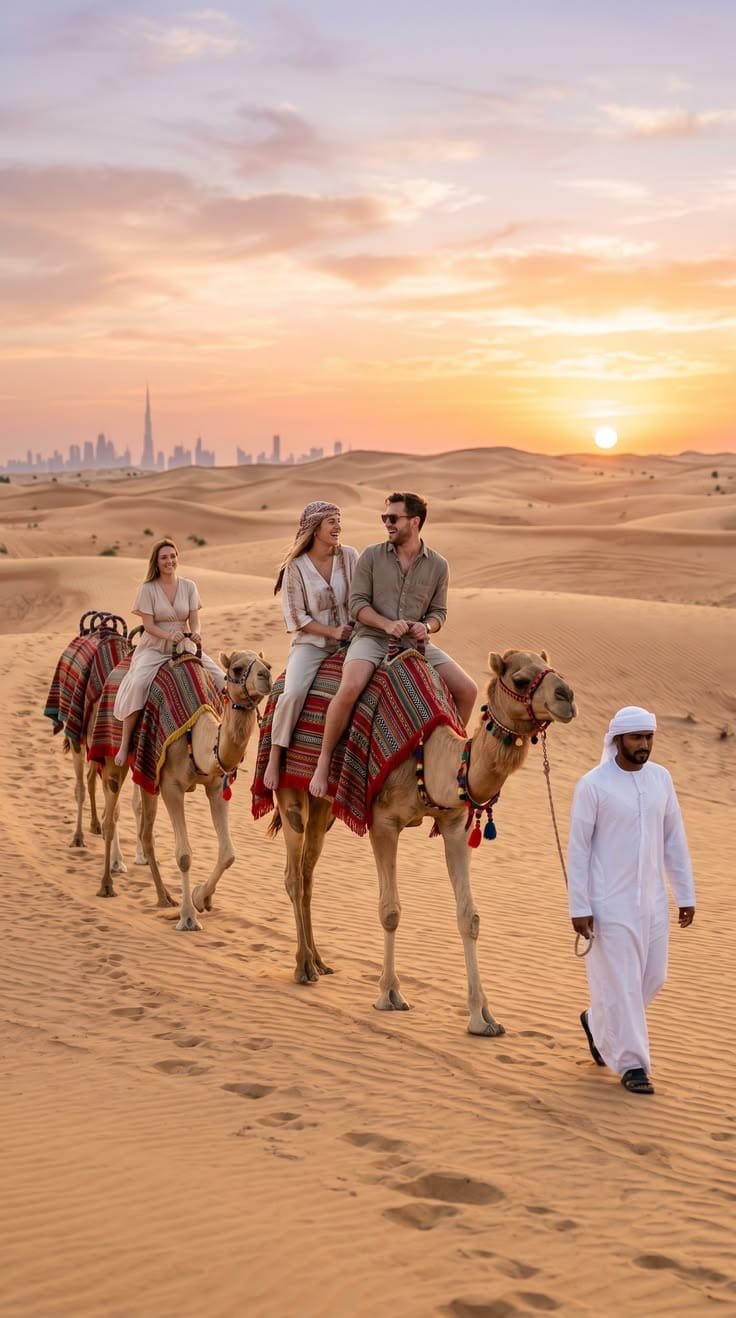
And then there is the dromedary camel — domesticated, beloved and everywhere, from farm herds along the E22 to the racetrack at Al Wathba. Set expectations honestly: on a single evening safari you will certainly meet camels, very likely read fresh fox and gerbil tracks, and quite possibly spot a dhub; oryx and gazelles are essentially reserve animals now. Our guide to the animals you may meet on a desert safari goes species by species.
Desert Snakes in the UAE: The Honest Guide
Yes, the UAE desert has snakes — including two venomous vipers — and no, you are almost certainly not going to see one. Snakes here avoid people, hunt at night, and feel vehicle and footstep vibrations long before you arrive. Sightings on a safari are extremely rare; most of our guests never see a snake in the wild at all.
The most iconic is the Arabian horned viper (Cerastes gasperettii), a 30–60 cm ambush hunter named for the horn-like scales above its eyes. It is venomous, and it is also the desert’s great calligrapher: it moves by sidewinding, leaving a chain of parallel J-shaped marks across the sand that our drivers occasionally point out on morning routes.
The saw-scaled viper is the second venomous resident — small, irritable if cornered, and named for the rasping, saw-like scales it rubs together as a warning. Treat any snake you cannot identify as a viper and simply give it room; no snake in the UAE pursues people.
The third character is the opposite of dangerous: the Arabian sand boa (Eryx jayakari), a harmless, thick-bodied little constrictor recorded in the region, with eyes set comically on top of its head so it can lie buried with only its periscope showing, waiting for passing prey.
| Species | Venomous? | How to know it | Chance of seeing one |
|---|---|---|---|
| Arabian horned viper (Cerastes gasperettii) | Yes | 30–60 cm; horn-like brow scales; sidewinding J-shaped trackway | Extremely low — tracks are seen far more often than snakes |
| Saw-scaled viper | Yes | Small; named for its rasping, saw-like scales | Extremely low; keep distance if heard |
| Arabian sand boa (Eryx jayakari) | No — harmless | Short and thick-set; eyes on top of the head; lies buried in sand | Very low; a lucky night-time find |
Ready to Stand on a 100-Metre Dune?
Our evening desert safari runs from AED 35 per person self-drive, AED 50 by shared bus, or AED 100 with hotel pickup — dune bashing, sandboarding, camel ride, BBQ dinner and live shows included. Payment on arrival, free cancellation up to 12 hours.
How Hot Does the UAE Desert Get? Climate, Month by Month
Summer desert afternoons peak at around 49–52°C — Abu Dhabi’s record stands at 52.7°C — while winter days sit in the comfortable mid-20s and desert nights at Liwa can drop to 5–10°C. In planning terms the year splits cleanly in two: October to April is glorious, and July to August is the furnace’s core.
The figures below are Abu Dhabi city means for the months guests ask about most. Remember the desert’s twist: inland sand runs hotter than the coast by day and markedly colder by night, because dry desert air sheds its heat far faster than the humid seaboard once the sun goes down.
| Month | Mean low (°C) | Mean high (°C) | Desert planning note |
|---|---|---|---|
| January | 13.8 | 24.5 | Coolest month — peak season; bring a fleece for the camp evening |
| February | 15.9 | 26.5 | Prime weather for camping and long morning drives |
| March | 17.5 | 29.7 | Warm days, mild nights; sand still cool underfoot by evening |
| April | 21.1 | 35.0 | Last fully comfortable month for midday activity |
| July | 29.7 | 42.5 | Hottest stretch — desert afternoons can run to 49–52°C; dawn and evening only |
| October | 23.7 | 36.6 | Season opens — evenings turn pleasant before the days do |
| November | 19.6 | 31.0 | Excellent all day; the sweet spot for photographers |
| December | 15.7 | 26.5 | Cool and clear; Liwa’s festival season begins mid-December |
Rain is a cameo, not a season: the coast records less than 120 mm a year, the national average sits around 100–150 mm, and the Empty Quarter’s heart sees under 50 mm. When a winter shower does land, the desert answers within weeks — hollows green up and the desert hyacinth throws its yellow spikes out of bare sand.
Our seasonal read as operators: November to February gives the best all-day comfort and the crispest light; October and March–April trade a warmer afternoon for thinner crowds. In high summer we still run evenings, but we tell guests plainly — it is a sunset-and-dinner experience, not an afternoon on the sand. The full breakdown lives in our best time for a desert safari guide, and dawn lovers should read the case for a sunrise desert safari — the desert’s coolest, quietest hour.
The Oryx Comeback: Conservation in the UAE Desert
Roughly five decades ago the Arabian oryx had been hunted almost out of existence in the wild. Today, thanks to a breeding programme begun by Sheikh Zayed, the IUCN has moved the species from Endangered to Vulnerable — a world first for an animal that had once vanished from the wild — and Abu Dhabi’s Al Dhafra region hosts the 6,000 km² Arabian Oryx Protected Area, the UAE’s largest reserve, with around 950 oryx.
The same playbook rescued the houbara bustard. The UAE’s houbara programme — another Sheikh Zayed legacy, with breeding centres at Sweihan — has bred more than 629,000 birds and released more than 487,000 across more than three decades, one of the largest bird-conservation efforts anywhere on Earth. Sand gazelle numbers tell the same story: a small wild population backed by more than 100,000 animals in reserves and breeding programmes.
Zoom out and the pattern is national policy, not a handful of projects: the UAE maintains more than 43 nature reserves covering about 14% of its territory, while the Environment Agency – Abu Dhabi monitors species as unglamorous as the dhub and as secretive as the Pharaoh eagle-owl.
| Protected desert area | Emirate | Scale | Known for |
|---|---|---|---|
| Arabian Oryx Protected Area (Al Dhafra) | Abu Dhabi | 6,000 km² — the UAE’s largest reserve | ~950 Arabian oryx on Empty Quarter fringe terrain |
| Dubai Desert Conservation Reserve (DDCR) | Dubai | 225 km² — about 5% of the emirate | The UAE’s first national park |
| Al Marmoom | Dubai | About 10% of Dubai’s land | 360+ bird species and 26 reptile species beside the Al Qudra lakes |
| Al Wathba Wetland Reserve | Abu Dhabi | Currently closed for redevelopment | Up to 4,000 flamingos at peak; 250+ bird species |
What this means for a visitor is simple and worth respecting: the reserves are not casual 4×4 playgrounds. Commercial safaris run outside protected zones, entry rules inside them are strict, and the honest way to see an oryx is through the reserves’ own programmes — not by chasing one off a dune. We think the trade is fair; the comeback happened precisely because somebody drew hard lines in the sand.
Falconry, Camels and Bedouin Desert Culture
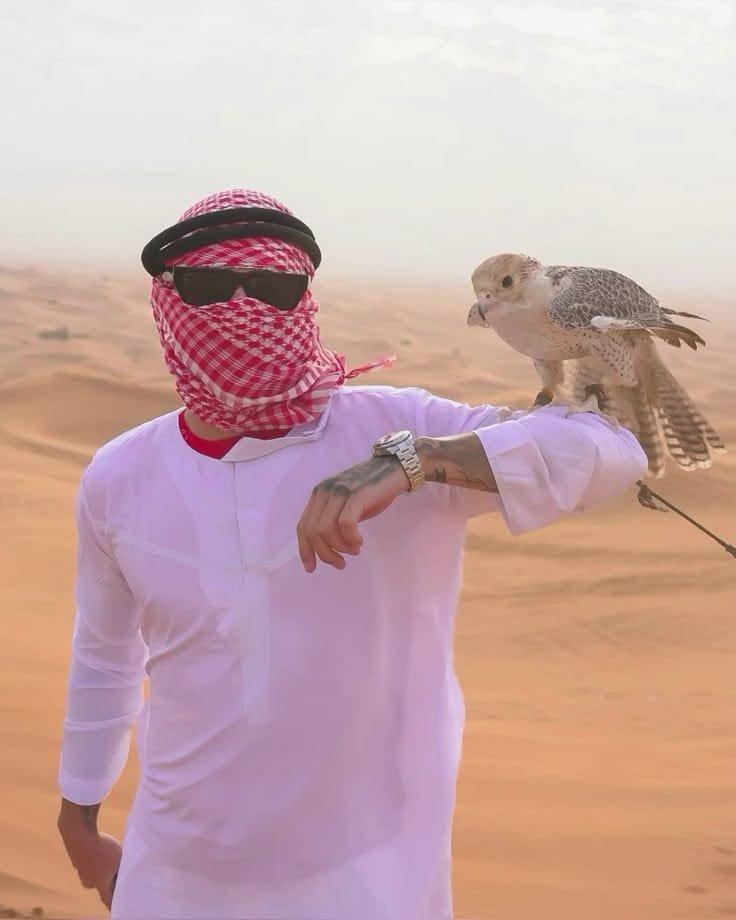
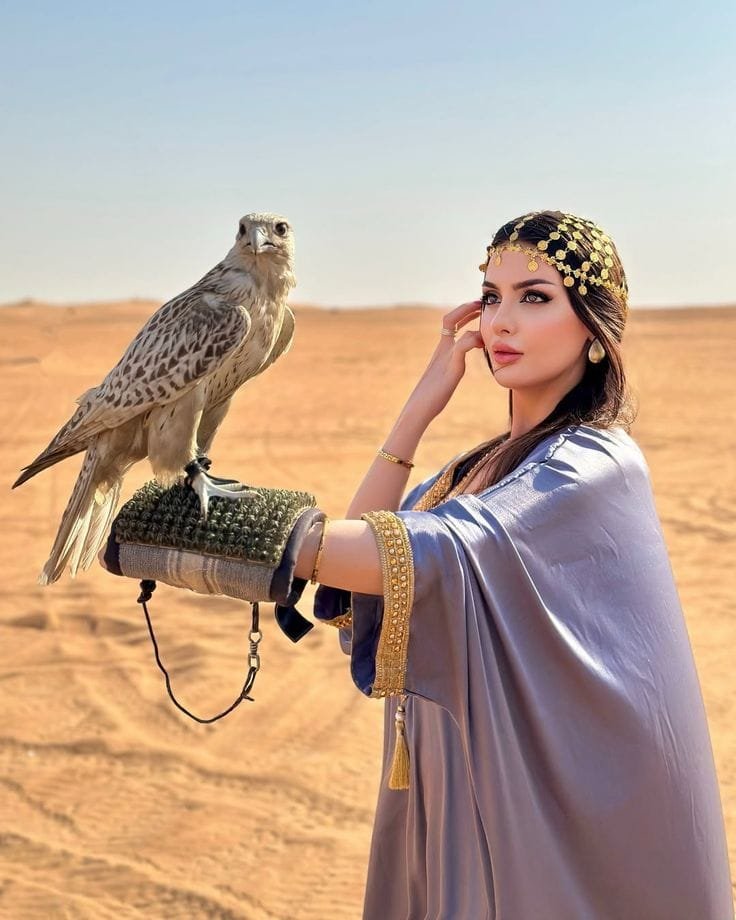
Falconry is the desert’s oldest art, and UNESCO has inscribed it on the Intangible Cultural Heritage of Humanity list through a multi-country nomination that the UAE led. What began as a Bedouin survival skill — a trained falcon meant meat in a landscape that offered little — is now a living heritage practised with immense care and prestige.
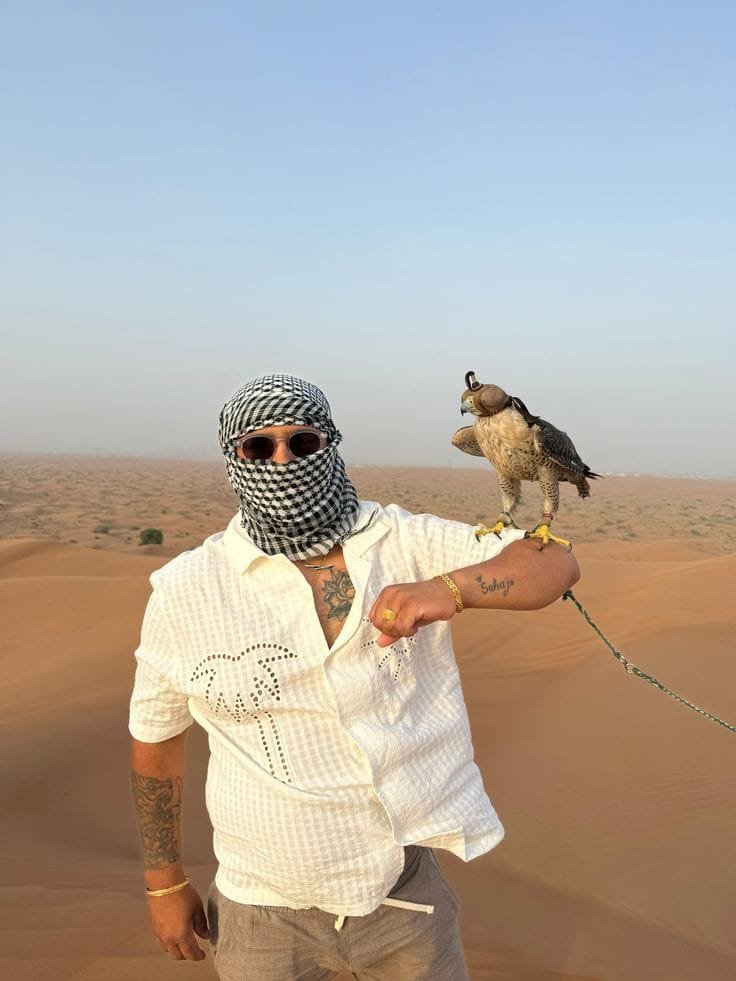
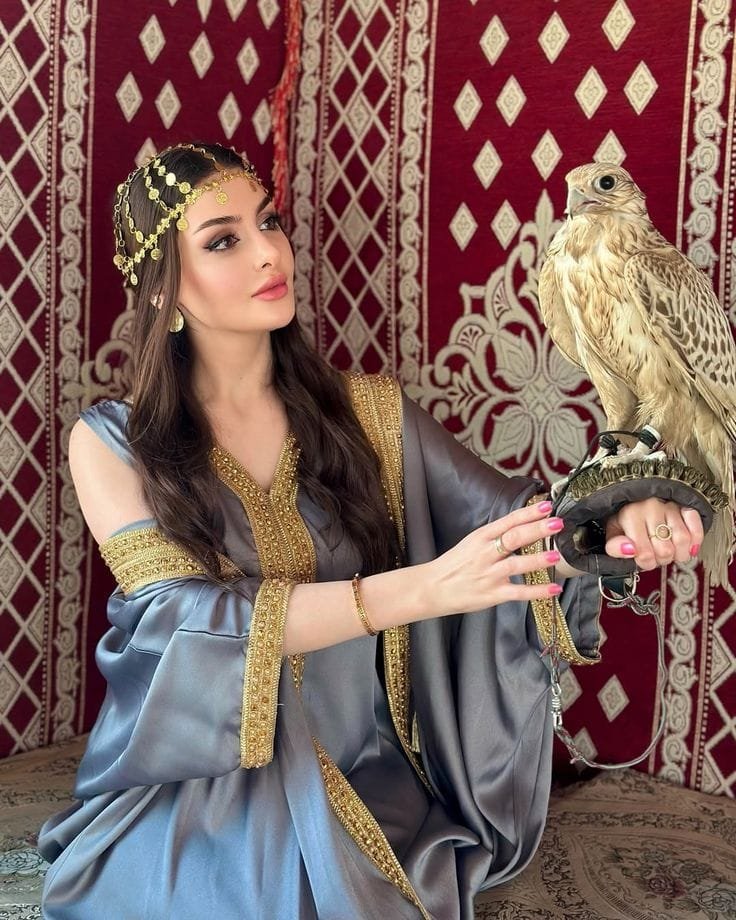
It is also the piece of culture our guests can actually touch. Every evening at our camp a falconer brings a trained bird to the majlis; watching one up close, you understand the reverence instantly. A photo with the falcon is AED 10–30 — and the falconer’s stories are free.
The majlis itself is the second institution: the cushioned circle where coffee is poured, dates are passed and conversation is the entertainment. Our camp keeps the ritual intact — gahwa (Arabic coffee) and dates on arrival, henna artists and a long BBQ dinner under the open sky, with a Bedouin-style camp layout rather than rows of plastic chairs. The VIP majlis upgrade (+AED 50 per person) adds front-row seating and table service for the shows.
And the camel remains the desert’s first vehicle. Dromedaries carried the Bedouin between Liwa’s oases for centuries; today the racetrack at Al Wathba and the Al Dhafra camel festival keep the bloodlines and the passion alive. On safari, a short ride is included in every evening package, and a longer dune trek is AED 300 for two — details in our camel riding guide.
Desert Camping in the UAE: Rules, Sites and Seasons
You can absolutely camp in the UAE desert, and between October and April it is one of the best sleeps in the country. There are four sensible routes: an official campground, a desert park, the open sand in a non-protected area, or a licensed private camp that handles everything for you.
Official options first. Al Wathba Lake Camp offers 13 campsites and 24 barbecue areas within an easy drive of Abu Dhabi. At Jebel Hafit Desert Park, the park’s own published rates start at around AED 100 for a bring-your-own-tent pitch and around AED 500 for a serviced camp — book directly with the park.
Open-desert camping is tolerated in non-protected areas, and many residents do it every winter. The rules that matter: municipalities require permits for organised group gatherings, protected reserves are strictly off-limits, and everything you carry in must come back out. Our field habits, offered freely — camp on firm ground near the dune base rather than in a wind-scoured bowl, drop a location pin to someone in the city, arrive before dark, and never camp alone deep in soft sand with a single vehicle.
The fourth route is ours: an overnight desert safari at our private Al Khatim camp — the full evening programme, then a night under the stars with no gear to buy, borrow or pitch. The dark out there is the real luxury; the city glow drops away and the sky performs, which is why we also run dedicated desert stargazing evenings.
| Camping route | Example | Cost signal | What you must bring |
|---|---|---|---|
| Official campground | Al Wathba Lake Camp (13 campsites, 24 BBQ areas) | Booked through the venue | All of your own kit |
| Desert park camping | Jebel Hafit Desert Park | Park’s published rates: own-tent pitches from ~AED 100; serviced camps from ~AED 500 | Your tent, or arrive to a serviced setup |
| Open desert | Non-protected dune belts | No formal fee — and no facilities | Everything: 4×4, water, recovery gear, experience |
| Licensed private camp | Our overnight safari at Al Khatim | Quoted on WhatsApp; dinner and camp included | Nothing but warm layers |
Desert Safari UAE: Formats, Real Prices and What Is Included
A desert safari in the UAE runs from AED 35 per person — our self-drive evening rate — up to AED 800 for a fully private Land Cruiser, with a genuine morning safari being a private product at AED 799 per car. Those are our real, current prices; the table below is the complete list, with nothing hidden behind “from” asterisks.
The evening safari is the flagship. Pickup runs 3:00–3:30 PM, return around 10:00–10:30 PM, and the programme includes dune bashing in Land Cruisers, sandboarding, a short camel ride, a sunset photo stop, a falcon photo opportunity, henna, Arabic coffee and dates, unlimited soft drinks, water and tea, live belly dance, Tanoura and fire shows, and a vegetarian and non-vegetarian BBQ buffet at our private camp.
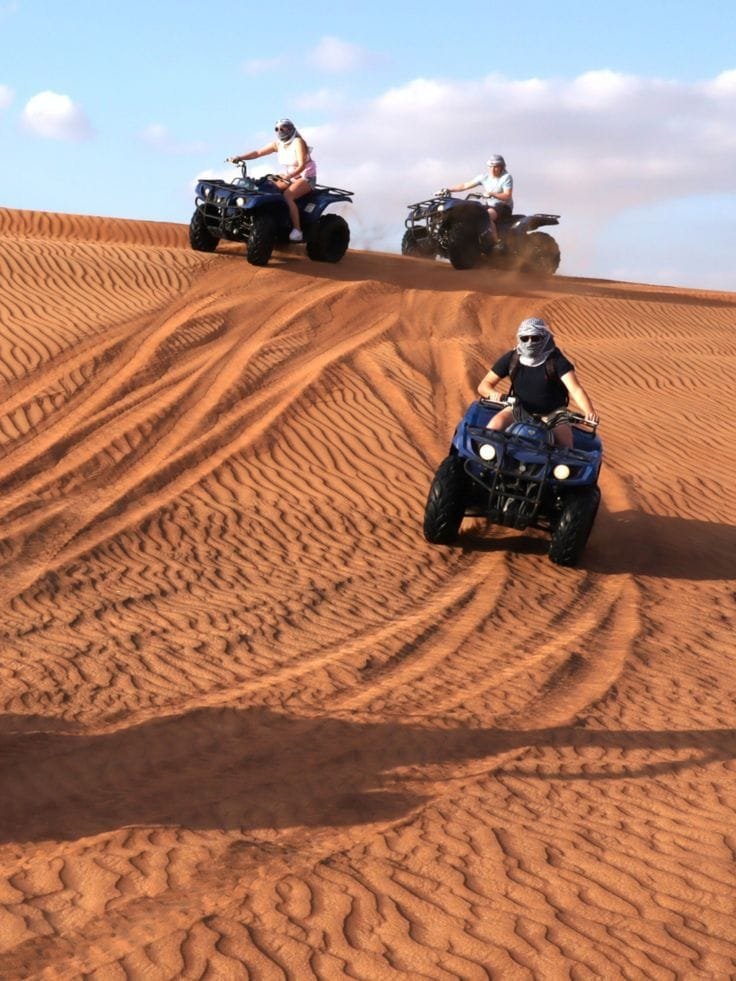
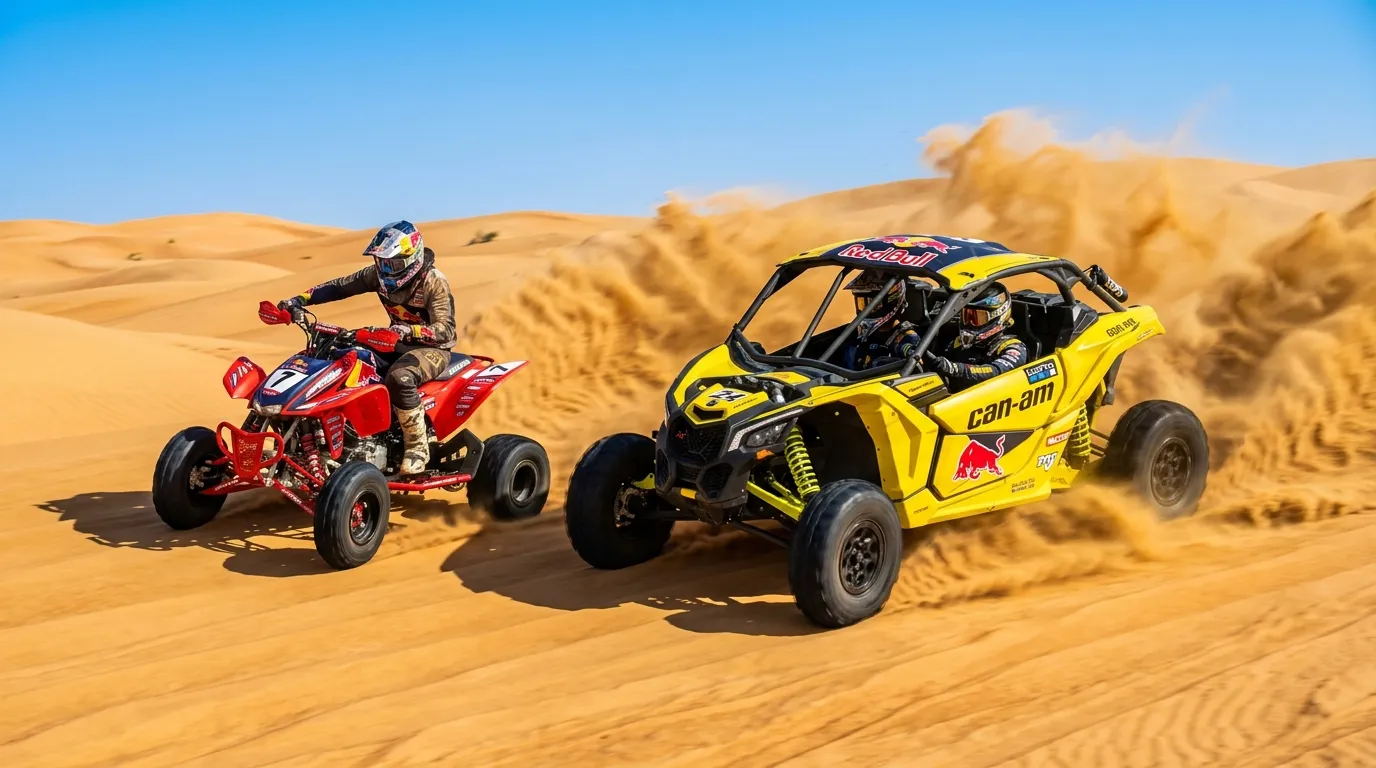
A morning desert safari is a different animal: private by design, on empty dunes in the day’s coolest light, at AED 799 per car as our premium format. Add-ons across both: quad bikes at AED 100 single or AED 150 double (long morning routes +200/+300), a Can-Am buggy from AED 800 for 30 minutes, extra dune-bashing time at AED 150 per vehicle, and professional photography from AED 50.
| Package or add-on | Price (AED) | Notes |
|---|---|---|
| Evening safari — self-drive | 35 / person | Meet at our Al Khatim camp; full evening programme |
| Evening safari — shared bus | 50 / person | Departures from Al Wahda and Mazyad Mall |
| Evening safari — shared hotel pickup | 100 / person | Door-to-door, Abu Dhabi city |
| Private 7-seater car | 599 / car | Your own vehicle and schedule for the evening |
| Private Land Cruiser | 800 / car | The premium evening: your own 4×4 and driver |
| Morning safari — private premium | 700 / car | Private by design — cooler sand, empty dunes |
| Quad bike | 100 single · 150 double | Long morning route +200 / +300 |
| Can-Am buggy | from 600 | 30-minute session |
| VIP majlis upgrade | +50 / person | Front-row seating and table service |
| Long camel ride | 300 for 2 | Beyond the short ride included in every evening |
| Extra dune bashing | 150 / vehicle | More drive time on the big slipfaces |
| Falcon photo | 30 | With the camp falconer |
| Professional photography | from 50 | Edited shots of your group |
Booking terms are deliberately simple: payment on arrival by cash or card, no deposit, no booking fee, and free cancellation up to 12 hours before pickup. Confirmation is one WhatsApp message.
Which UAE Desert Is Right for You? An Operator’s Honest Take
Match the desert to the traveller, not the other way round: Al Khatim for first-timers, families and anyone short on time; Liwa and Moreeb for dune romantics with a full day to spend; Mleiha for history lovers; Al Marmoom and Al Qudra for cyclists; Lahbab or Al Badayer if you are based in Dubai with a single free evening.
The trade-offs are real, so here they are without varnish. Liwa’s dunes stand two to three times taller than the city belts — around 300 m against Al Khatim’s 100 m — and cost you around three hours of driving each way. Al Khatim gives you 100 m dunes within an hour, which is why it carries Abu Dhabi’s safari trade. Dubai’s belts are the closest to hotels and the busiest by far. Sharjah’s Mleiha swaps some dune scale for fossils, archaeology and a buried ghost village at Al Madam.
If you are still torn, send us your group size, dates and appetite for driving on WhatsApp and we will tell you straight which sand fits — even when the answer is a desert we do not operate in.
Why Plan Your UAE Desert Days With Us
Royal Arabian Safari Tourism LLC is a DCT Abu Dhabi-licensed tour operator with its own private camp in the Al Khatim desert and an office at Al Sila Tower, Al Maryah Island, Abu Dhabi. Across more than a decade we have hosted 5,000+ guests at a 4.9★ Google rating — on terms that respect you: payment on arrival, no deposit, and free cancellation up to 12 hours before pickup.
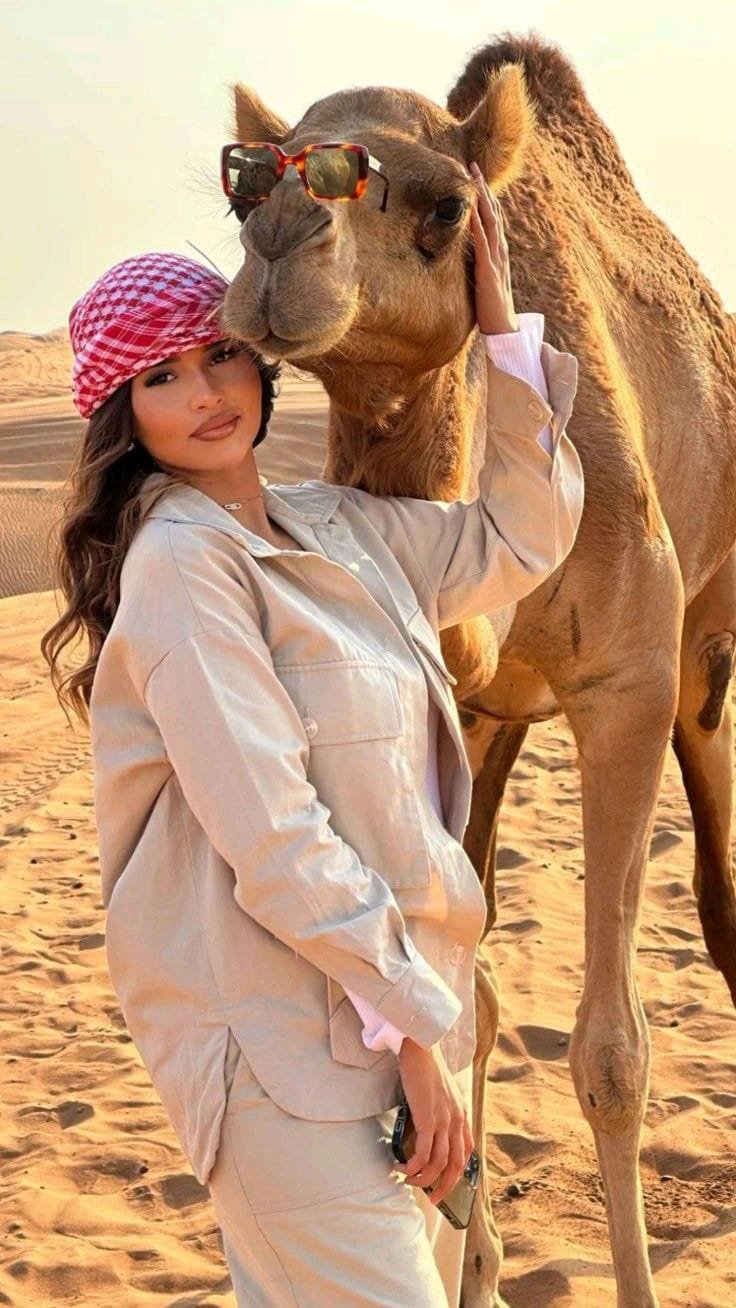
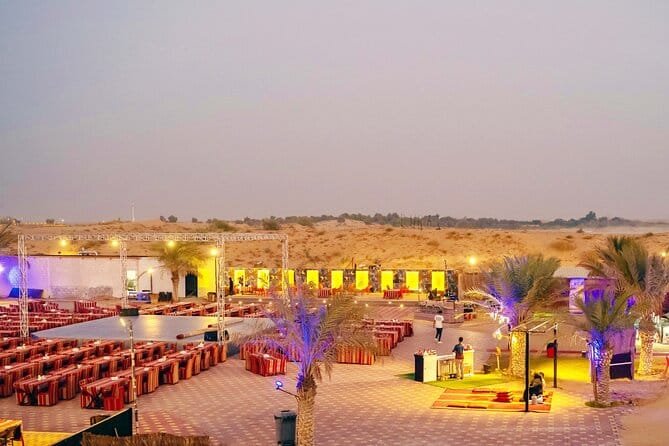
A last look before the questions — four frames from the sand we work every week.
Your Own Golden-Sand Evening Is One Message Away
Private Land Cruiser at AED 800 per car, private 7-seater at AED 599, shared hotel pickup at AED 100 per person — or the private morning premium at AED 799 per car. Tell us your dates on WhatsApp and compare every option side by side.
UAE Desert: Frequently Asked Questions
What desert is the UAE in?
The UAE lies on the north-eastern edge of the Rub’ al Khali, the Empty Quarter — the world’s largest uninterrupted sand sea at roughly 650,000 km², shared with Saudi Arabia, Oman and Yemen. The dune fields south and west of Abu Dhabi merge directly into it, while the belts nearer the cities — Al Khatim, Lahbab, Al Badayer — are its outer fringes.
Is the UAE all desert?
No — but sand is the dominant landscape. Of the country’s roughly 83,600 km², most is dune field and sabkha salt flat, balanced by a long Gulf coastline, irrigated city greenery and working oases such as Liwa. The desert is also far from lifeless: more than 43 nature reserves protect about 14% of the national territory, much of it sand.
What is the biggest desert in the UAE?
The Rub’ al Khali — the Empty Quarter — is the biggest desert the UAE touches, at about 650,000 km² across four countries. Within the Emirates, the largest desert expanse is Abu Dhabi’s south and west, where the Liwa dune ranges roll into the Empty Quarter proper. Everything else, from Al Khatim to Dubai’s Lahbab, is smaller fringe country.
How tall are the sand dunes in the UAE?
The tallest is Moreeb Dune at Liwa, around 300 m with a slipface near 50°. Deep Empty Quarter dunes sometimes exceed 200 m and push towards 250 m, while the Al Khatim belt near Abu Dhabi tops 100 m — big enough that first-time guests routinely mistake the dunes for hills. Dubai’s and Sharjah’s belts are shorter than Liwa’s giants.
Why is the desert sand red in the UAE?
Because it is rusted. Each quartz grain carries a fine coating of iron oxides — hematite and limonite — that tints the sand orange-red, and the colour deepens the further inland you travel. Coastal sand is paler because it holds more carbonate from crushed shell. The tones shift with the light, which is why sunset drives photograph so well.
What animals live in the UAE desert?
Headliners include the Arabian oryx, sand and Arabian gazelles, Arabian red fox, Rüppell’s fox, sand cat, desert hedgehog, Cheesman’s gerbil and the dhub — a large herbivorous lizard — plus around 70 reptile species overall. Birds range from the houbara bustard to the Pharaoh eagle-owl. Most mammals are nocturnal, so on safari you will mainly read their tracks, meet camels and possibly spot a dhub.
Are there dangerous snakes in the UAE desert?
Two venomous vipers live here — the Arabian horned viper and the saw-scaled viper — alongside the completely harmless Arabian sand boa. Sightings on a safari are extremely rare: snakes avoid people and feel vibrations long before you arrive. Sensible habits (closed shoes after dark, a torch, hands out of burrows) reduce an already tiny risk to effectively zero.
What plants grow in the UAE desert?
More than you would expect: the ghaf tree, date palm, desert hyacinth (Cistanche tubulosa), hardy arfaj-type shrubs and sedges, and salt-tolerant plants out on the sabkha flats. The ghaf stays green through drought by tapping deep groundwater, while the desert hyacinth blooms in yellow spikes after winter rain. Look for green threads in the hollows between dunes, where moisture lingers.
What is the UAE national tree?
The ghaf (Prosopis cineraria). It earns the title by surviving where little else can — roots reaching the deep water table keep it green through extreme drought — and it lives about 120 years on average. It is protected by federal law, so cutting a wild ghaf is illegal. For the Bedouin it was shade, shelter and meeting place in one.
How hot does the UAE desert get?
Summer desert afternoons peak at around 49–52°C, and Abu Dhabi’s record is 52.7°C, with July and August the hottest months. Winter flips the script: city days sit in the mid-20s, and desert nights at Liwa can drop to 5–10°C — cold enough to make the campfire the most popular seat in camp.
Does it rain in the UAE desert?
Rarely and briefly. The coast records under 120 mm a year, the national average is roughly 100–150 mm, and the Empty Quarter’s core sees less than 50 mm. Most rain arrives as short winter events — and the desert responds fast, greening its hollows and sending up desert-hyacinth blooms within weeks.
Can you camp in the UAE desert?
Yes — October to April is the season. Choose between official campgrounds like Al Wathba Lake Camp (13 campsites, 24 BBQ areas), Jebel Hafit Desert Park (own-tent pitches from about AED 100, serviced camps from about AED 500, per the park’s published rates), open sand in non-protected areas, or a licensed private camp. Our overnight safari removes the gear question entirely.
Is wild camping legal in the UAE?
It is tolerated in non-protected areas, and residents camp every winter weekend. The firm rules: protected reserves are strictly off-limits, municipalities require permits for organised group gatherings, and you take every trace out with you. A small family camp on open, non-protected sand — arriving before dark, leaving nothing — sits comfortably within accepted custom.
Which desert is closest to Abu Dhabi?
For real dunes, Al Khatim: about 80 km east of the city along the E22 towards Al Ain, a 50–60 minute drive, with dunes topping 100 m around our private camp. That access makes it the emirate’s go-to safari desert — you can leave a city hotel mid-afternoon and be on a ridgeline for sunset.
Which UAE desert is best to visit?
It depends on your time and taste. Al Khatim is best for a first safari — an hour from Abu Dhabi with 100 m dunes. Liwa and Moreeb Dune are best for scale, at the cost of a roughly three-hour drive. Mleiha adds archaeology, Al Marmoom suits cyclists, and Lahbab or Al Badayer serve Dubai-based visitors with one evening.
What is the best time of year to visit the UAE desert?
October to April. November to February offers the finest all-day comfort — city highs run from about 24.5°C in January to 31°C in November — while October and March–April trade warmer afternoons for thinner crowds. July and August are the extreme months, when desert experiences compress to dawn and after-sunset. Winter evenings genuinely cool down, so pack a layer for the camp.
Can you visit the Empty Quarter from Abu Dhabi?
Yes — the Liwa Oasis, gateway to the UAE’s share of the Empty Quarter, is 220–250 km from Abu Dhabi by road, around three hours each way. A day trip works if you start early, but the desert rewards an overnight: Liwa’s winter nights, festival season and dawn light over 200 m dunes are the memorable part.
What is Moreeb Dune?
Moreeb Dune (Tal Mireb) is the UAE’s tallest dune — around 300 m high and 1,600 m long with a slipface near 50° — standing about 25 km south of the Liwa Oasis arc. It ranks among the world’s largest natural sand hill-climbs and hosts winter racing, with the Liwa festival running mid-December to early January.
What is the Liwa Oasis?
A 100 km crescent of around 50 villages along the Empty Quarter’s northern rim, roughly three hours’ drive south-west of Abu Dhabi city. It is the UAE’s date-farming heartland and the ancestral home of the Al Nahyan and Al Maktoum ruling families. For travellers it is the staging post for Moreeb Dune and the big southern sands.
How much does a desert safari cost in the UAE?
With us: the evening safari is AED 35 per person self-drive, AED 50 by shared bus from Al Wahda or Mazyad Mall, and AED 100 with hotel pickup — dinner and shows included. Private vehicles run AED 599 (7-seater) and AED 800 (Land Cruiser), and the private morning premium is AED 799 per car. Payment is on arrival, with free cancellation up to 12 hours.
What should I wear for the UAE desert?
Light, loose, long layers: breathable trousers or long shorts, a top that covers shoulders, sunglasses and sunscreen for the afternoon. From October to February add a warm layer — the sand cools quickly after sunset, and Liwa nights can reach single digits. Closed shoes are essential for quad biking; barefoot beats sandals on soft dunes.
Are UAE deserts safe to visit?
With a licensed operator, very safe: professional drivers, maintained 4x4s and a fixed camp remove almost every real risk. The genuine dangers belong to unprepared self-driving — soft-sand recovery, summer heat and navigation. Book DCT-licensed operators, and if you explore independently, go with two vehicles, ample water and a shared location pin.
Do I need a 4×4 to visit the UAE desert?
Not with us — every safari option includes the desert driving, and even self-drive guests (AED 35 per person) simply drive to our Al Khatim camp meeting point before our Land Cruisers take over on the sand. You only need your own 4×4 — plus deflation kit, recovery boards and experience — if you plan to drive the sand independently. Never do that alone.
Can children join a desert safari?
Yes — families are our core guests. Children love the camel ride, sandboarding, henna and the shows, and dune bashing can be driven gently on request. For toddlers or grandparents we recommend the private 7-seater (AED 599) so the vehicle runs to your rhythm — quieter dunes, your own pace, and space for naps on the way home.
The UAE Desert, in Short
One sand sea, seven emirates, and far more life than the word “desert” suggests: rusted quartz dunes to 300 m, a national tree that drinks from the deep water table, an antelope brought back from the edge, and a camping season that runs October to April. You can meet it all one hour from Abu Dhabi — or three hours deep at Liwa, where the Empty Quarter begins.
When you are ready to plan, start with the practical guides — what to wear in the desert and the full menu of things to do in the Abu Dhabi desert — then message us on WhatsApp at +971 58 228 2683. Real people, real dunes, payment on arrival, and the sand is waiting.
Continue Planning Your Trip
Explore More Desert Safari Guides
- Fossil Dunes Abu Dhabi — Al Wathba Visitor Guide & Closure Update
- Abu Dhabi Sand Dunes — Where to Find Them & How Tall They Get
- Camping in Abu Dhabi — Spots, Rules & Overnight Options
- Liwa Overnight Desert Safari — A Night in the Empty Quarter
- Night Desert Safari Abu Dhabi — Stars, Fire Shows & BBQ
- Morning Desert Safari Abu Dhabi Price — Full Cost Breakdown
- Car with Driver in Abu Dhabi — From AED 599
- Abu Dhabi Tour Packages — From AED 599 per Car
- Desert Safari From Fujairah
- Desert Safari From Umm Al Quwain
- Desert Safari From Ras Al Khaimah
- Desert Safari From Ajman
- Desert Safari From Sharjah
- How To Get To Desert Safari Abu Dhabi
- Belly Dance Abu Dhabi
Book this tour
No deposit and no card details. Message us and we confirm the plan and the exact price before you commit — answered at any hour.
- Send your date and guest countYour date, how many of you, and where we collect from. That is all we need.
- We send the plan and the pricePer car, not per person. You see the route, the timings and the exact figure first.
- Pay the driver on the dayCash or card, after the run. Free cancellation up to 12 hours before pickup.
Answered 24 hours · No deposit · No booking fee · Licensed operator
If we have to cancel, what happens?
A cancellation policy that covers your obligations but not ours is only half a document. Here is our side of it, in writing.
If we have to cancel your booking — for weather, a vehicle issue, or driver illness — we will contact you as soon as we know and rebook you at no charge on the next date that works for you. You pay nothing for the cancelled booking.
If we need to send a different vehicle than the one you booked, we will ask you first rather than turning up in something you did not book.
This is separate from your own cancellation rights, which are unchanged: you can cancel free up to 12 hours before pickup. Because we take no deposit and no booking fee, there is no money of yours sitting with us either way — nothing to chase, and nothing to wait for.