Belly Dance Abu Dhabi: The Live Desert Camp Show: The Short Answer
No supplements, no “entertainment upgrade” — belly dance, Tanoura and the fire show are part of every evening and overnight safari we run.
- Does the belly dance show cost extra?: No. The full three-show evening is part of the standard ticket — from AED 35 per person self-drive, AED 50 by coach, AED 100 with hotel pickup.
- How long does the belly dance show last and when does it start? +: Entertainment at desert camps usually begins after sunset and after dinner service has started, with several short sets rather than one long show.
- Is the belly dance show family-friendly?: Yes. The performance is a stage art form presented for a family audience across the UAE’s licensed tourism camps, and guests of every background attend.
- Can you arrange vegetarian, Jain or allergy-safe food? +: Yes — tell us when you book. We run the kitchen at our own camp, so this is an instruction rather than a request passed to a third party.
- Is belly dance included in every Abu Dhabi desert safari?: It is included in every evening and overnight safari we run, at no extra cost — the show block (belly dance, Tanoura, fire show) follows the BBQ dinner.
Every Evening Ticket Includes the Show
No supplements, no “entertainment upgrade” — belly dance, Tanoura and the fire show are part of every evening and overnight safari we run.
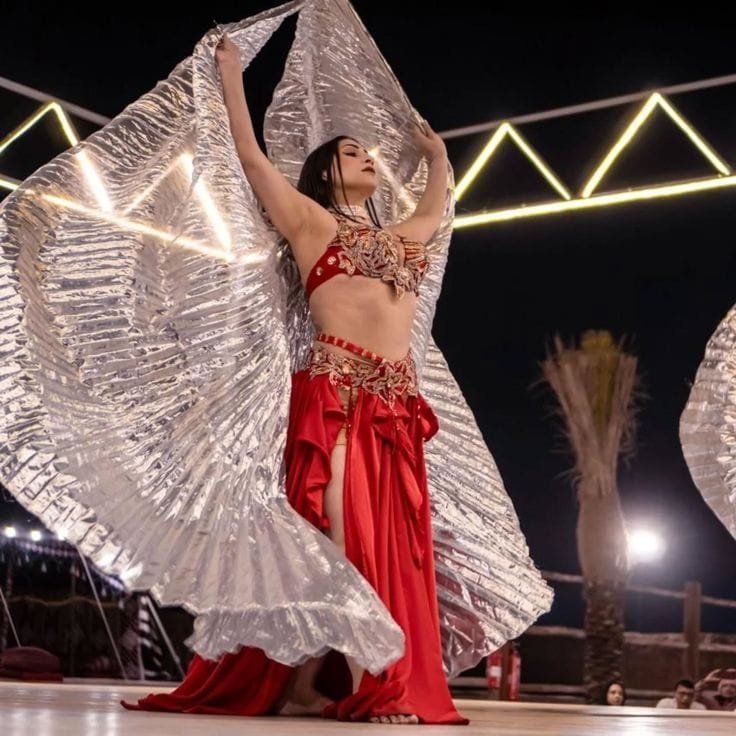 From AED 35 per person
Evening Desert Safari
Dune bashing, sunset, camel rides, BBQ buffet — and the full three-show night: belly dance, Tanoura, fire.
- All shows included
- BBQ dinner, halal throughout
- AED 50 coach · AED 100 pickup
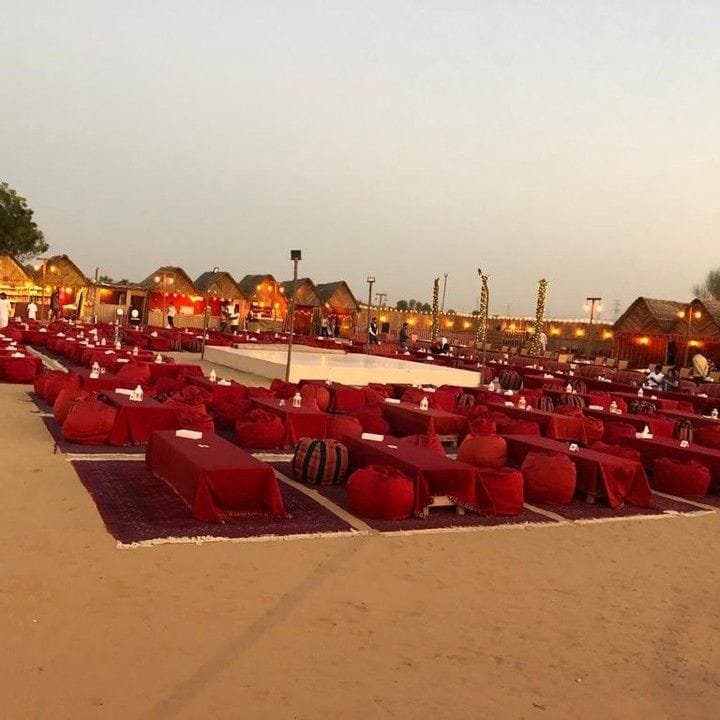 + AED 50 VIP majlis
VIP Majlis Seating
The cushioned front-row majlis closest to the stage — the best view of every set, with table service through the shows.
- Front-row show seating
- Priority buffet access
- Add to any evening ticket
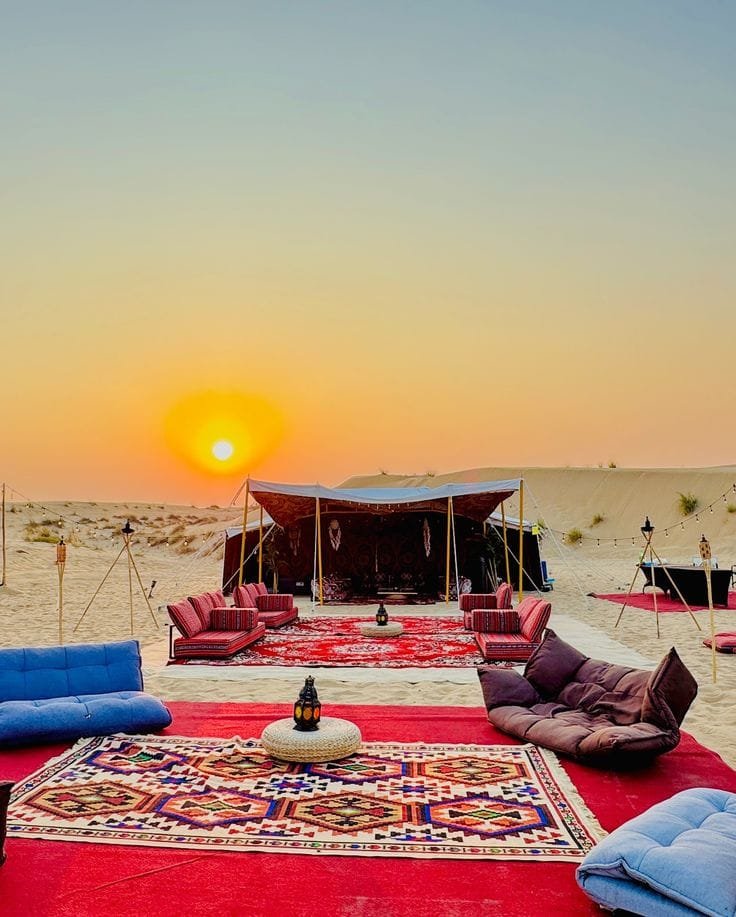 AED 599 per car
Private Evening Safari
Your own 4×4 and driver, up to 7 guests, the camp evening on your own schedule — Land Cruiser AED 800.
- Up to 7 guests, one price
- Unhurried camp time
- Full show programme
Belly Dance Abu Dhabi: The Live Desert Camp Show
Quick answer: Yes — a live belly dance show is included in every evening and overnight desert safari we run, at no extra charge. The performance follows the BBQ dinner at the camp, sits alongside the Tanoura and fire shows, and the whole evening starts from AED 35 per person. Morning and sunrise safaris do not include camp shows — the entertainment belongs to the desert night.
The Show as It Actually Happens at Our Camp
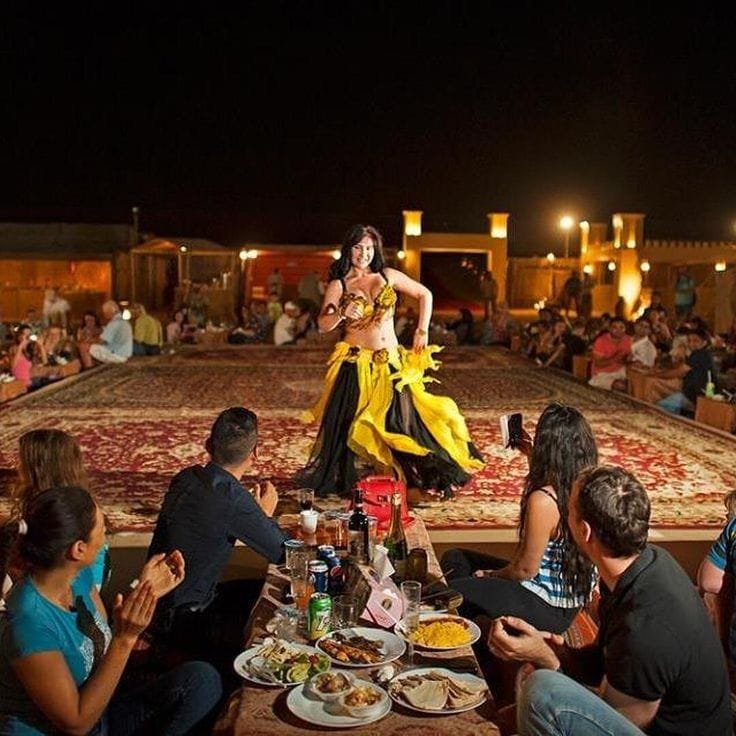
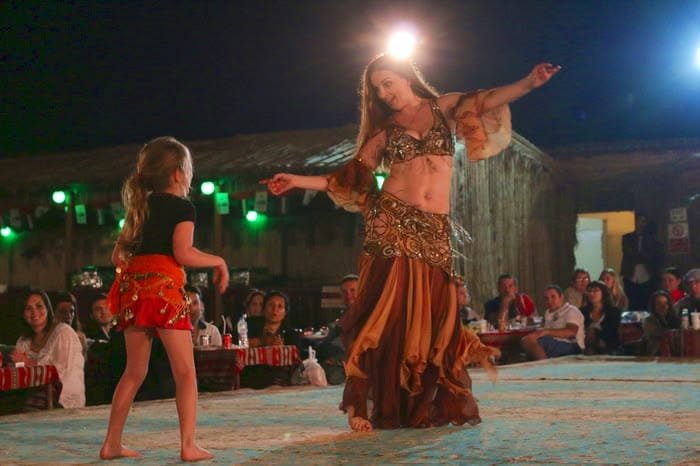
Dinner winds down, the camp lights drop, and the music changes — that is the cue. The dancer takes the sand-floor stage in the centre of the majlis seating, and for the next stretch of the evening the camp belongs to her: shimmering costume, live Arabic percussion, and the kind of controlled, athletic artistry that makes first-time guests go quiet mid-sentence. Toward the end comes the part everyone remembers: guests are invited up. Nobody is dragged — but every single night, somebody’s grandmother steals the show.
Photography is welcome throughout, and the dancer will happily pose with guests after the set — the photos on this page are from our own camp, not a stock library. Bring your phone charged; between the fire show, the Tanoura spin and this, the after-dinner hour is the most photographed part of the entire safari.
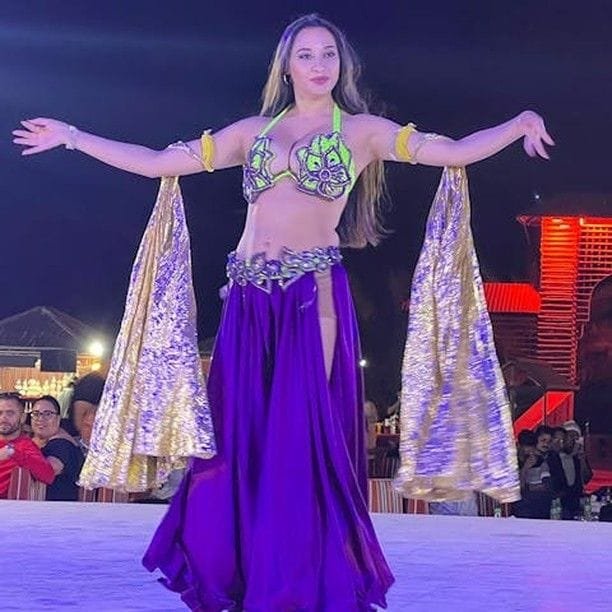
Where Belly Dance Actually Comes From
The dance you will watch tonight has a longer passport than most guests expect. Its documented roots run to the ghawazi performers of 18th-century Egypt — travelling dancers whose art survived official suppression in the 1830s and spread through Upper Egypt and outward across the region. When the style reached Europe it was romanticised as “Oriental dance”, and in the 20th century a refined stage form called Raqs Sharqi (“dance of the East”) emerged — the graceful, musical, technically demanding style that is the foundation of what is performed across the Gulf today.
“Belly dance” itself is the westernised name; the art was never really about the belly, but about isolations — the ability to move one part of the body while everything else stays perfectly still. Watch the dancer’s shoulders during a hip sequence tonight and you will see exactly what three hundred years of refinement looks like.
The Three Shows of the Desert Night — and How They Differ
| Show | What it is | The moment to watch for |
|---|---|---|
| Belly dance | Raqs Sharqi performance with live Arabic rhythm — artistry and audience energy | The guest-participation finale |
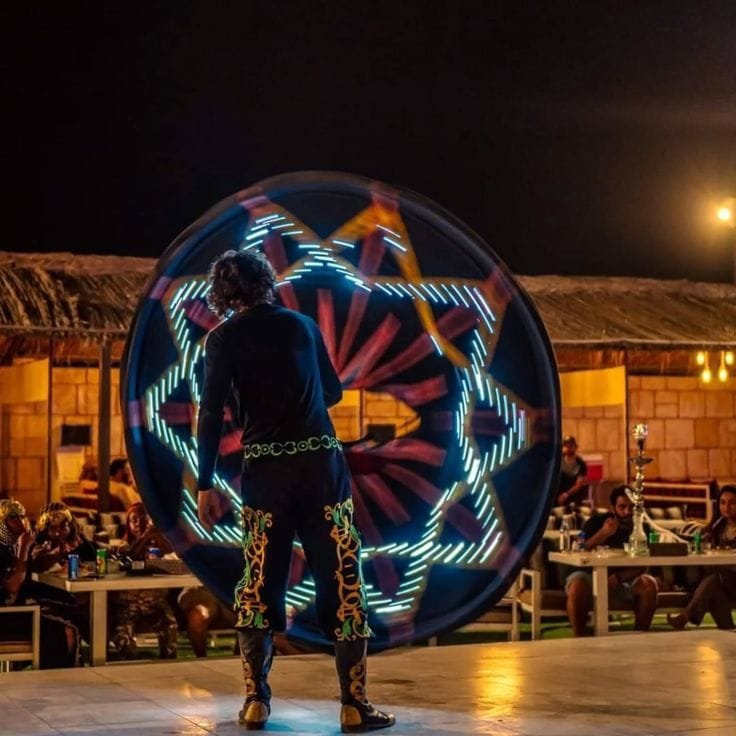
| Tanoura | Egyptian Sufi-rooted spinning dance in an illuminated skirt — meditative, hypnotic | When the skirt lifts into a spinning disc of light |
| Fire show | Fire-spinning and breathing under the open sky — pure adrenaline | The final breath — you will hear the whole camp react |
All three run on the same evening at our camp, in sequence after dinner. You do not choose between them — the ticket from AED 35 includes the full programme.
Culture, Respect and the Question Guests Ask Quietly
Some guests — especially those travelling in the region for the first time — quietly ask whether a belly dance show is appropriate to attend, or whether it sits uncomfortably with local values. The honest answer: the performance you will see is a stage art form presented across the UAE’s licensed tourism camps, performed by professional artists, and framed as cultural entertainment for families. It is not a nightclub act. Guests of every background attend; anyone who prefers not to watch simply enjoys coffee at the fire pit — the camp is large and nobody minds either way.
Two things we handle carefully as an Abu Dhabi operator: during Ramadan, live entertainment is paused at desert camps — the safari runs with its full menu and activities, but the shows resume after the holy month. And our dancers’ sets are choreographed for a family audience; if you are travelling with conservative elders, they will be comfortable. For a deeper read on camp manners, greetings and gahwa etiquette, our cultural etiquette guide covers the whole evening.
It is our camp — and that is why we can promise the rest of this page
We built our desert camp and we run it. We are not buying you a seat at somebody else’s. It sounds like a small distinction and it is the most important one on this page, because almost every operator ranking for these searches is reselling space at a camp they do not control.
Here is what that actually changes for your evening, in plain terms:
| What we can commit to | Why a reseller cannot |
|---|---|
| Nobody will pressure you to buy an upgrade. | Our camp, our staff, no commission on extras. A reseller does not employ the people selling henna, photographs and seating once you arrive. |
| Your seating is settled before you travel. | We are not buying tables from a host camp that tiers them and sells the better ones on arrival — which is exactly where guests report feeling cornered. |
| Vegetarian, Jain or allergy meals arranged properly. | We run the kitchen. A reseller has to ask a favour of a camp that has never met you. |
| The timings we quote are the timings you get. | We are not fitted around another camp’s schedule and another operator’s coaches. |
| We can answer questions about the animals. | It is our operation, so there is someone to ask. Ask a reseller about camel rest periods and there is nobody on the other end of the question. |
| You can have the camp without the dune drive. | We can reshape the evening because it is ours to reshape. |
We are a DCT-licensed Abu Dhabi operator. And where this page says we will confirm something in writing before you pay, that is not a hedge — it is us checking our own operation rather than repeating a promise made by a company we booked you with.
What to Wear (Yes, Jeans Are Fine)
Come comfortable. Jeans are completely fine for the safari and the show — though loose trousers are cooler in summer and warmer layers matter from October to March, when the desert drops surprisingly cold after dark. There is no dress code at the camp beyond common-sense modesty; the audience sits on cushioned majlis seating around the stage, so clothes you can sit low in are the practical choice. Closed shoes only matter if you add quad biking before the camp.
How the Evening Runs
Afternoon pickup from your hotel (or self-drive to the meeting point from AED 35), dune bashing across the red dunes as the light softens, sunset photo stop at the top of the range, then the camp: camel rides, henna, falcon photos, sandboarding, gahwa and dates. The BBQ buffet is served after dark, and the show block — belly dance, Tanoura, fire — carries the evening to the return drive, with drop-off back in the city by roughly 9:30pm. The show is not a separate ticket, an upgrade, or a supplement: it is simply what the desert night includes.
The Show: Ten Kilograms of Spinning Light
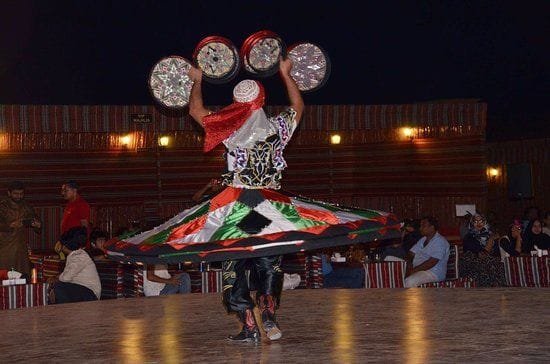
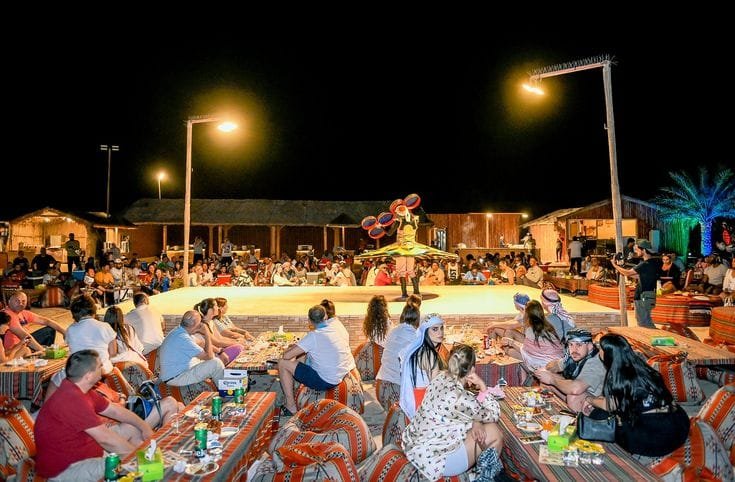
The dancer walks out in what looks like an impossibly heavy layered skirt — the tannoura, Arabic for skirt, which gives the dance its name. Then he begins to turn. And he does not stop. Minutes into the continuous spin, the skirt lifts into a level disc, the LED lights woven through it switch on, and the camp’s dark desert sky suddenly has a spinning galaxy under it. Layers detach and rise overhead, patterns pulse through the fabric, and the whole performance builds to a finish that has every phone in the camp recording.
What guests ask afterwards is always the same question: how is he not dizzy? Years of training — the spin is anchored by fixed breathing and a controlled gaze, the same techniques the dance’s spiritual ancestors used.
Where the Tanoura Comes From
The dance descends from the whirling ceremonies of Sufi orders — most famously the Mevlevi dervishes — where continuous turning was a form of dhikr, a moving meditation toward the divine. In Egypt the practice evolved into a folk and stage art of its own: faster, more theatrical, with the skirt itself becoming the show. The modern camp version adds the LED lighting, but the core — one man, one skirt, an unbroken spin — is centuries old. It is worth knowing what you are watching: not just a light show, but a devotional tradition that became one of the Arab world’s great performances.
Tanoura, Ayala or Belly Dance — Which Is Actually Emirati?
Here is the detail almost no safari page tells you: neither the Tanoura nor the belly dance is native to the UAE. The Tanoura is Egyptian; belly dance’s stage form (Raqs Sharqi) also grew up in Egypt. The Emirates’ own traditional performance is the Ayala — rows of men with bamboo canes moving to drum rhythm and chanted poetry, which you will see at heritage festivals and national celebrations rather than desert camps. The camp show is best understood as a tour of the wider Arab world’s performing arts, hosted with Emirati hospitality — and our cultural etiquette guide covers how to enjoy it all respectfully.
When It Runs and What It Costs
At our camp the after-dinner programme runs belly dance → Tanoura → fire show, under the open sky. There is no separate ticket and no entertainment supplement: the whole three-show night is included in every evening safari — AED 35 self-drive, AED 50 by coach, AED 100 with hotel pickup, or a private car at AED 599 (Land Cruiser AED 800). During Ramadan, live entertainment pauses camp-wide and resumes after the holy month.
The Tanoura Comes With Every Evening Ticket
No show supplement, ever — the full belly dance, Tanoura and fire programme is part of the night.
 From AED 35 per person
Evening Desert Safari
Dune bashing, sunset, camels, BBQ buffet — and the three-show night with the LED Tanoura as its centrepiece.
- All shows included
- BBQ dinner, halal throughout
- AED 50 coach · AED 100 pickup
+ AED 50 VIP majlisVIP Majlis Seating
Front-row cushioned seating closest to the stage — the Tanoura’s patterns are best seen from close up.
- Front-row show seating
- Priority buffet access
- Add to any evening ticket
AED 599 per carPrivate Evening Safari
Your own 4×4 up to 7 guests with the camp evening on your schedule — Land Cruiser AED 800.
- Up to 7 guests, one price
- Unhurried camp time
- Full show programme
Henna Is Part of the Camp Evening — Pick Your Safari
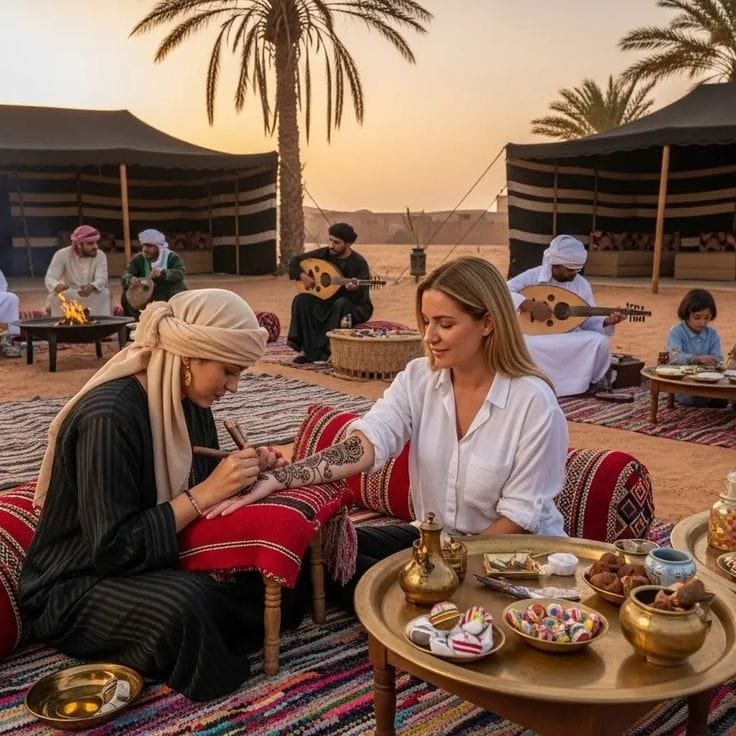
The henna artist sits at the camp on every evening safari. You pay for the safari; the tradition is part of the night.
 From AED 35 per person
Evening Safari with Henna
The classic evening — dune bashing, camel, sandboard, BBQ, three shows, and the henna table under the lanterns.
- Henna artist at the camp
- AED 50 by coach · AED 100 hotel pickup
- Pay on the day
 AED 599 per car
Private 4×4 Evening
Your own vehicle and timing, up to 7 guests — unhurried henna for the whole group before dinner.
- No shared pickup circuit
- Land Cruiser AED 800
- Child seats on request
VIP +AED 50VIP Majlis Add-On
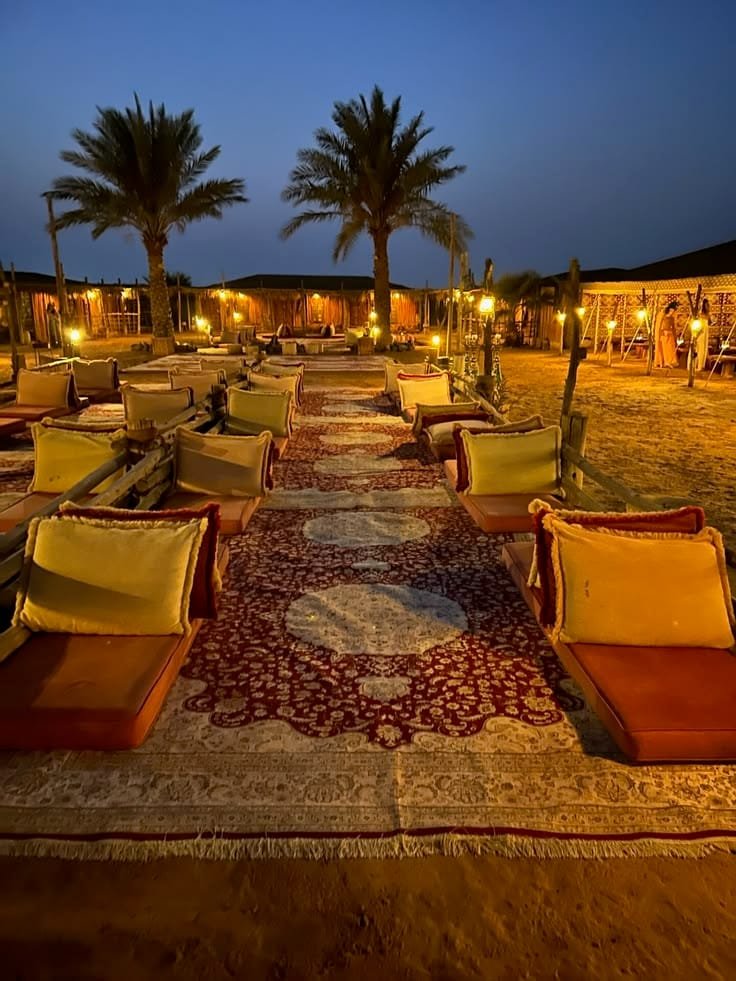
Front-row majlis seating for the shows, steps from the henna table — the comfortable way to do the camp evening.
- +AED 50 per person
- Best seats for all three shows
- Add to any safari
What Is Henna? The Arabian Tradition Explained
Henna (حناء in Arabic) is a natural dye made from the dried leaves of the Lawsonia inermis plant. It has been used across the Arabian Peninsula, South Asia, and North Africa for thousands of years. In Emirati culture, henna is traditionally applied at weddings, Eid celebrations, and other significant events.
At desert safari camps, skilled henna artists use the paste to create intricate patterns on hands, wrists, feet, and arms. The stain typically lasts 1–3 weeks depending on skin type, placement, and how the design is cared for.
What to Expect During Your Henna Session at the Desert Camp
- Session takes 10–20 minutes depending on design complexity
- Artist applies natural henna paste using a small cone applicator
- Common design styles: geometric, floral, and traditional Emirati patterns
- Paste stays wet for 20–30 minutes, then dries and flakes off
- The stain underneath is orange-brown initially, darkening over 24–48 hours
- Full color develops by day 2 — deep rust or dark brown
Is the Henna Safe?
Natural henna is safe for most people. The paste is plant-based and free from harsh chemicals when prepared correctly. Royal Arabian Safari’s henna artists use only natural henna paste — no black henna, which can contain dangerous PPD (para-phenylenediamine) and cause skin reactions.
If you have very sensitive skin or known plant allergies, test a small patch on your inner wrist before a larger design. Pregnant women may prefer to avoid extensive henna application as a precaution.
Henna Design Styles Available
Arabic / Gulf Style
Bold floral motifs with open negative spaces. Traditional to the UAE and wider Gulf region. Popular for adults and women. These designs are clean and elegant without being overly busy.
Indian / Mehndi Style
Denser, more detailed patterns covering the full hand and fingers. Takes longer to apply but creates a striking visual effect. Very popular with visitors who want the full traditional look.
Simple / Tourist Designs
Quick designs — small flowers, geometric shapes, names — for children or visitors who want a light sample of the tradition without a large commitment.
Tips to Make Your Henna Last Longer
- Leave the dried paste on for as long as possible — minimum 2 hours, ideally overnight
- Avoid washing the area with soap for 24 hours after removing the paste
- Apply lemon-sugar solution over the dried paste to keep it moist and deepen the stain
- Avoid swimming or excessive sweating in the first 48 hours
- Moisturize with natural oils (coconut or olive oil) — avoid water-based lotions which fade the design faster
Frequently Asked Questions
Is belly dance included in every Abu Dhabi desert safari?
It is included in every evening and overnight safari we run, at no extra cost — the show block (belly dance, Tanoura, fire show) follows the BBQ dinner. Morning and sunrise safaris do not include camp entertainment, as the shows belong to the night programme.
Does the belly dance show cost extra?
No. The full three-show evening is part of the standard ticket — from AED 35 per person self-drive, AED 50 by coach, AED 100 with hotel pickup. There is no entertainment supplement at our camp.
Is the belly dance show family-friendly?
Yes. The performance is a stage art form presented for a family audience across the UAE’s licensed tourism camps, and guests of every background attend. Anyone who prefers not to watch simply enjoys the fire pit or coffee area — the camp is relaxed about it.
Can guests join in the belly dancing?
Yes — the final part of the set is the audience invitation, and it is always voluntary. Nobody is pulled up who does not want to be, and the guests who do go up tend to be the night’s highlight.
Can I take photos or video of the show?
Absolutely — photography is welcome throughout, and the dancer poses with guests after the set. The after-dinner show hour is the most photographed part of the whole safari.
Is there belly dancing during Ramadan?
No — live entertainment at desert camps pauses during the holy month. The safari itself runs with its full activities and menu, and the shows return after Ramadan. If your dates fall in Ramadan, message us and we will tell you exactly what your evening will include.
Can we book a private belly dance performance?
For private groups, corporate nights and celebrations we can arrange dedicated entertainment at a private camp setup — ask us on WhatsApp and we will price it for your group size and date.
What should I wear to the show?
Whatever is comfortable — jeans are fine. The audience sits on low majlis cushions, so easy clothing works best, and bring a warm layer from October to March: the desert turns cold after dark.
Book Your Evening at the Camp
Every evening ticket includes the full show programme. From AED 35 self-drive · AED 50 coach · AED 100 hotel pickup · private car AED 599.
Planning the Rest of Your Abu Dhabi Trip
Most guests who book the dunes with us also want a day in the capital. These guides cover the practical detail:
- Qasr Al Watan — the Presidential Palace, its dress code and the evening light show
- Ferrari World Abu Dhabi — the rides ranked, plus height limits and Formula Rossa
- Warner Bros World Abu Dhabi — fully indoor and air-conditioned, which matters in summer
Book this tour
No deposit and no card details. Message us and we confirm the plan and the exact price before you commit — answered at any hour.
- Send your date and guest countYour date, how many of you, and where we collect from. That is all we need.
- We send the plan and the pricePer car, not per person. You see the route, the timings and the exact figure first.
- Pay the driver on the dayCash or card, after the run. Free cancellation up to 12 hours before pickup.
Answered 24 hours · No deposit · No booking fee · Licensed operator