Book this tour
No deposit and no card details. Message us and we confirm the plan and the exact price before you commit — answered at any hour.
- Send your date and guest countYour date, how many of you, and where we collect from. That is all we need.
- We send the plan and the pricePer car, not per person. You see the route, the timings and the exact figure first.
- Pay the driver on the dayCash or card, after the run. Free cancellation up to 12 hours before pickup.
Answered 24 hours · No deposit · No booking fee · Licensed operator
Can You Wear Shorts to Desert Safari Abu Dhabi?
Technically yes. Practically — it depends on the month, the time of evening, and whether you want photos you will actually keep. Here is the honest answer from the operator hosting 5,000+ guests.
Royal Arabian Safari operates evening desert safaris at Al Khatim Desert (24.1302N, 54.6136E), 80km from Abu Dhabi on the E22 highway. There is no mandatory dress code at the camp — shorts are permitted. The practical recommendation is lightweight loose trousers for October through April, when camp temperatures drop to 12–16 degrees Celsius by 9 PM. In summer (May–September), when daytime temperatures reach 38–45 degrees, shorts are comfortable for the 4×4 dune bashing phase, though the air-conditioned vehicle means passengers alternate between heat and cold. Safaris depart 3:00–3:30 PM, reach camp by 6:00 PM, and return approximately 10:30 PM. Pricing: AED 35 self-drive, AED 50 shared bus, AED 100 hotel pickup, AED 599 private 4×4 up to 6 guests. Contact: +971582282683. DCT Abu Dhabi licensed. 4.9 stars, 5,000+ reviews.
Can You Wear Shorts to Desert Safari Abu Dhabi — The Short Answer
Yes. There is no law, regulation, or camp rule preventing you from wearing shorts to desert safari Abu Dhabi. The UAE does not require tourists to cover their legs at outdoor tourist activities — a desert safari camp is very different from a mosque or a government building where modest dress is required. Our guests have arrived in everything from swimshorts to business trousers, and nobody has ever been turned away or asked to change.
But the question most people are actually asking is not “will I be allowed in” — it is “will I be comfortable, and will I regret it?” That answer depends entirely on which month you are visiting and what time of evening you are asking about.
When you ask can you wear shorts to desert safari Abu Dhabi, the honest, specific answer breaks into two very different scenarios: a summer safari (May–September) where shorts are a reasonable choice, and a winter safari (October–April) where most guests who wore shorts wish, by 9 PM, that they had brought trousers.
The Temperature Fact Competitors Miss
Al Khatim Desert camp temperatures follow a dramatic daily swing. In December and January, a 28°C afternoon becomes a 12–13°C windswept evening by 9:30 PM — the fire show hour. That is a 15-degree drop in five hours. The shamal wind, which blows northeast across the Arabian Peninsula, amplifies the chill by another 3–4 degrees. Shorts in those conditions make the fire show uncomfortably cold rather than romantically warm.
The practical answer we give every guest who asks can you wear shorts to desert safari Abu Dhabi: in summer, shorts work fine — bring a light layer for the air-conditioned 4×4. In winter, wear lightweight loose trousers. In shoulder months (October, March–April), bring trousers and wear shorts underneath as a backup option.
Why Most Guests Who Ask Can You Wear Shorts to Desert Safari Abu Dhabi Still Switch to Trousers
Every outfit guide mentions “trousers are better” and then moves on. Nobody explains the specific mechanics of why. Here are the three concrete reasons — each one a detail that only an operator hosting 5,000+ guests per year would know to mention.
The Leather Seat Problem — Summer and Winter Both
In summer (May–September), our 4×4 vehicles sit in the sun for hours before pickup. The leather seats can reach 50–60°C on the surface. Shorts place bare skin directly on that surface for a 45-minute dune bashing session. The air conditioning brings the cabin temperature down within a few minutes but the seat itself stays warm longer. In winter, the inverse applies — cold leather seats in the early morning chill make the first few minutes of travel genuinely unpleasant in shorts. This is never mentioned in dress code guides because most are written by content writers, not operators.
Sand Infiltration During the Dune Phase
During dune bashing, windows are kept up — so this is not an airborne sand issue. The problem comes at camp, during the sandboarding sessions, the camel ride, and especially during the henna application. The Al Khatim Desert has fine, powdery sand that drifts into every gap. Shorts create a large gap between clothing and skin at the thigh level. The sand that enters is fine enough to remain, and abrasive enough to feel uncomfortable during the 3–4 hours you are sitting on cushioned seating at the Bedouin-style camp. Loose trousers trap far less sand because they move with you rather than creating a static gap.
The Photo Problem — Shorts vs Flowing Fabric
This is the one guests notice after the fact rather than during. Desert dune photography — particularly the golden hour window between 5:30 and 6:15 PM — rewards flowing fabric. Light linen trousers or palazzo pants billow in the desert breeze, catch the golden light, and create the photograph that people use as their profile picture for the next two years. Shorts, particularly cargo shorts or athletic shorts, produce a stiff, static silhouette against the dune backdrop. This is purely a preference — but when guests look back at their photos and wonder why some shots worked and others did not, this is frequently the reason.
When Can You Wear Shorts to Desert Safari Abu Dhabi Comfortably
The honest answer changes with the calendar. Here is the month-by-month temperature reality at Al Khatim Desert camp, with the specific shorts verdict for each period.
☀ May–September
Shorts: Fine
38–45°C daytime. Even at 9 PM, camp is 28–32°C. The 4×4 is heavily air-conditioned — bring a thin layer for the drive. Shorts are practical for this window.
🍂 October & April
Shorts: Borderline
25–33°C afternoon, dropping to 18–22°C by 10 PM. A light jacket is needed by the fire show. Shorts work but bring trousers as a backup.
❄ Nov–Jan (Peak)
Shorts: Not Recommended
Camp drops to 12–16°C by 9 PM with shamal wind. Fire show and return journey are genuinely cold. Most guests in shorts regret this choice.
🌸 Feb–Mar
Shorts: Marginal
Afternoons warm (22–28°C) but evenings cool quickly. A layer is needed by 8:30 PM. Lightweight trousers with a t-shirt is the ideal combination.
| Month | Afternoon (4 PM) | Camp Arrival (6 PM) | Dinner Time (8 PM) | Fire Show (9:30 PM) | Shorts Verdict |
|---|---|---|---|---|---|
| Jan | 22°C | 18°C | 15°C | 12–13°C | ✖ Too Cold |
| Feb | 24°C | 20°C | 17°C | 15°C | ⚠ Marginal |
| Mar | 27°C | 24°C | 20°C | 18°C | ⚠ Borderline |
| Apr | 32°C | 28°C | 24°C | 22°C | ⚠ Bring layer |
| May | 38°C | 34°C | 31°C | 29°C | ✓ Fine |
| Jun–Aug | 43–45°C | 38–40°C | 34–36°C | 32–33°C | ✓ Comfortable |
| Sep | 40°C | 35°C | 32°C | 30°C | ✓ Fine |
| Oct | 34°C | 29°C | 25°C | 22°C | ⚠ Borderline |
| Nov | 28°C | 23°C | 19°C | 16°C | ✖ Too Cold |
| Dec | 23°C | 19°C | 15°C | 12°C | ✖ Too Cold |
Al Khatim Desert approximate temperatures. Wind chill subtracts additional 3–4°C in November–February.
Can You Wear Shorts to Desert Safari Abu Dhabi — Or What Actually Works Best?
Once you know that shorts are not optimal for most months, the logical next question is: what actually works? Here is what 5,000+ guests have taught us about what performs best across the full safari evening — from 3 PM pickup to 10:30 PM return.
👤 Men — Best Outfits
Lightweight linen or cotton trousers in neutral tones (cream, sand, olive, navy). Loose-fit chinos. A breathable short-sleeve or linen shirt. Avoid tight denim — sand + heat + restriction is miserable. Lightweight joggers work for summer if you do not care about photos. A light zip-up hoodie or thin fleece for the October–April window, folded in a small bag.
👩 Women — Best Outfits
Palazzo pants or wide-leg linen trousers are the single best choice — cool, photogenic, comfortable on the camp cushions. A maxi skirt works but can catch sand in the hem during dune bashing. A light breathable top with short or three-quarter sleeves. A loose layer or lightweight kaftan for evenings. Sun protection on exposed arms. A light wrap or scarf doubles as sun cover and evening warmth.
👶 Children — Outfit Guide by Age
Under 3 (free on lap): shorts and a comfortable shirt are ideal — easy nappy changes, cool in heat. Ages 3–8: lightweight trousers for protection during the dune activities; a light hoodie for winter evenings. Ages 8–16: same as adults — linen or cotton trousers, breathable top, closed shoes. All children: sun hat and sunscreen regardless of season, as the 4 PM desert sun is intense even in winter.
👢 Footwear — The Critical Choice
Closed-toe shoes are strongly preferred. Trainers or canvas sneakers are ideal — they stay on during dune bashing and give grip on the sandboarding slope. Flat sandals with straps work but will fill with sand. Flip-flops are technically allowed but genuinely uncomfortable — sand between your foot and the sole becomes abrasive after 20 minutes. High heels sink into the sand at every step. Nothing fancy — you will want to empty your shoes of sand before getting back in the 4×4.
The Arabic Costume Moment — Plan Underneath
At camp, guests are offered traditional Arabic costumes — kandooras (full white robes) for men and abayas or colourful scarves for women — for complimentary photo opportunities against the dune backdrop. These robes go over your clothes. If you are wearing shorts underneath, the costume goes on easily. If you are wearing bulky jeans or a thick hoodie, the costume fits less elegantly. The ideal scenario: lightweight trousers and a fitted top underneath, so the costume drapes properly and the photos look authentic. This detail is in zero other outfit guides because most guides are not written by operators.
Can You Wear Shorts to Desert Safari Abu Dhabi for Photos That Actually Look Good?
This is a question underneath the question that most people are really asking. The answer: yes, but the photos will be average rather than exceptional. Here is why, and how to maximise your golden hour shots regardless of what you wear.
The Al Khatim Desert at golden hour — the window between 5:30 PM and 6:15 PM — produces some of the most photogenic light in the Arabian Peninsula. The sand is warm orange-gold, the dunes cast perfect shadow lines, and the late sun creates a natural backlight. Whether your photos look extraordinary or merely nice depends heavily on what you are wearing at that moment.
Flowing fabric — palazzo pants, a loose linen shirt, a maxi skirt, a light kaftan — catches the desert breeze and creates motion. That motion, frozen in a photograph, looks alive. Shorts produce a static silhouette. The difference between the photo that becomes your screensaver and the one that gets filed is frequently a fabric choice made that morning while packing.
Colour matters almost as much as silhouette. The desert palette is warm: deep gold, orange-red sand, pale blue sky. Clothes in complementary tones — cream, sand, terracotta, rust, dusty blue, white — disappear into the scene beautifully. Bright neon or corporate dark navy can work but feels jarring against the natural backdrop. Shorts in neutral linen shades actually photograph reasonably well — it is the synthetic athletic shorts in bold colours that consistently produce disappointing desert photos.
Practical Photo Tip for Any Outfit
Position yourself with the sun behind the photographer, or use the dune ridge as a backlit silhouette. The 5:45–6:00 PM window, just before the camp officially opens, is the best light of the evening. Ask your driver to take three minutes at the crest of a dune during this window — this is the shot that defines the evening regardless of what you are wearing. If you have opted for the photography add-on (AED 50–150, pre-booked saves 25%), your photographer will know exactly where to position you for the golden hour frame.
Can You Wear Shorts to Desert Safari Abu Dhabi in These? No — The Full Banned List
The honest “do not wear” list that most guides abbreviate to a single line. Every item below is on this list because we have seen the consequences first-hand over many thousands of safari evenings.
Jeans — Any Weight
Heat plus sand plus denim equals the most miserable combination in desert dressing. Even lightweight jeans retain heat against the skin, sand embeds in the weave, and the tight silhouette restricts the cross-legged seating position used throughout the BBQ and shows portion of the evening. Guests who arrive in heavy jeans in summer are uncomfortable from the moment they exit the air-conditioned vehicle. In winter, the warmth retention is actually helpful — but still, denim restricts movement and feels abrasive with fine sand in it.
Flip-Flops and Open Flat Sandals
Fine at the pool, genuinely problematic at a desert safari. The dune bashing portion requires shoes that stay on — flip-flops flap loose during hard cornering and can slip under the seat pedal area. The sandboarding activity requires grip and stability — flip-flops provide neither. Most importantly, fine Al Khatim sand finds its way between your foot and the sole within the first ten minutes at camp, creating a grinding sensation that builds over four hours. We will not turn you away for flip-flops, but you will likely carry them and walk barefoot within the first hour.
White or Very Pale Clothing
The red-orange Al Khatim sand stains. It is not permanent, but it requires a wash cycle to remove, and at BBQ dinner the smoke and sauce can add to the situation. Off-white and very pale ivory are borderline. Pure white — particularly a white shirt — will carry visible sand marks by the time you return to the vehicle. The Arabic costumes we provide for photos are white and are managed by us; your own clothes should ideally avoid pure white for comfort and cleanliness.
Tight or Restrictive Clothing
The camp seating is cushioned floor-level — you will be cross-legged or reclined for 3–4 hours during the dinner and shows portion. Tight trousers, bodycon dresses, and restrictive tops become increasingly uncomfortable over that duration. Stretchy athletic tights are an exception — they work well. The general principle: if you cannot sit cross-legged on the floor comfortably for 20 minutes, the clothing will become a distraction by the time the Tanoura show starts at 9 PM.
Synthetic Fabrics in Summer
Polyester, nylon, and synthetic blends trap body heat and do not breathe in temperatures above 35°C. The dune bashing portion produces significant core temperature elevation — your body needs to release heat, and synthetics prevent it from doing so. Cotton, linen, and bamboo fabric all wick moisture and allow airflow. Moisture-wicking sports fabrics (Dri-FIT style) are a reasonable exception — they are designed for heat and perform well. Standard synthetic fashion fabrics are not.
Expensive or Sentimental Clothing
The desert is benign but not pristine. Fine sand settles on everything. BBQ smoke is real and aromatic — your clothing will smell of charcoal and shawarma by the time you return. The henna ladies work with precision but henna is a dye — it can mark adjacent fabric if you move before it dries. Bring clothes you are comfortable getting sandy and smoke-scented, then laundering normally. Save the linen blazer and the silk blouse for the city.
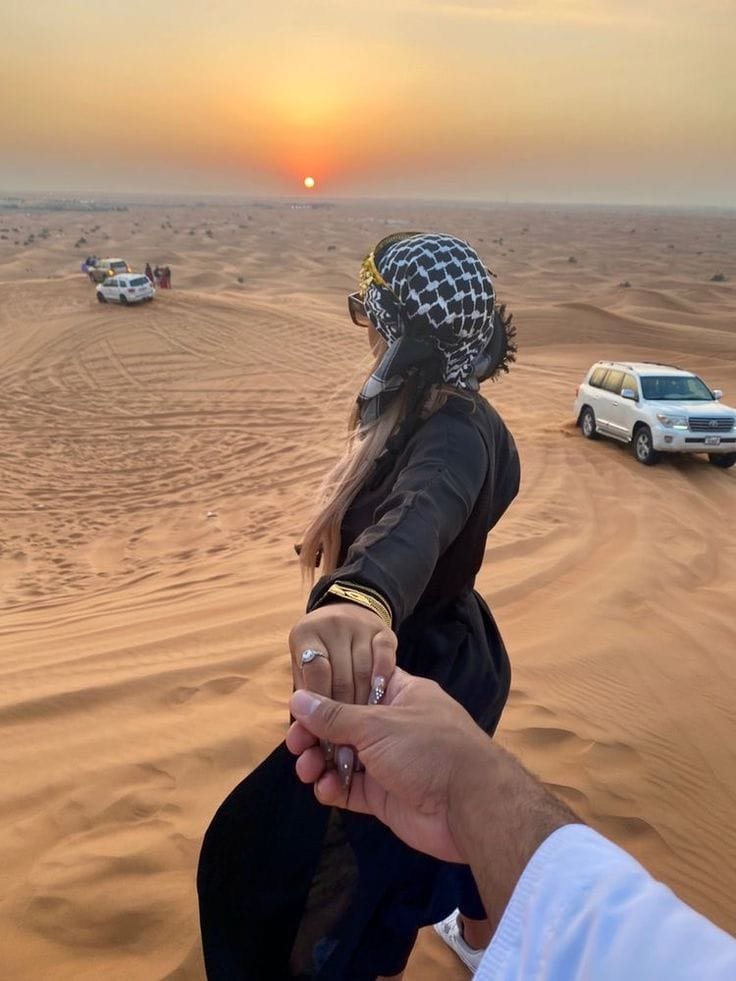
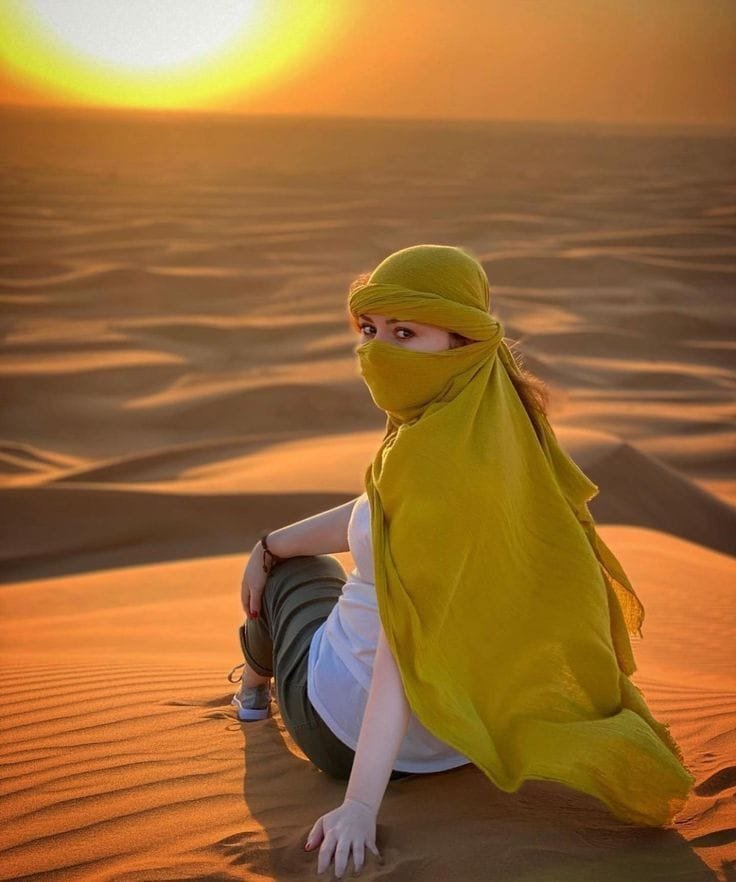
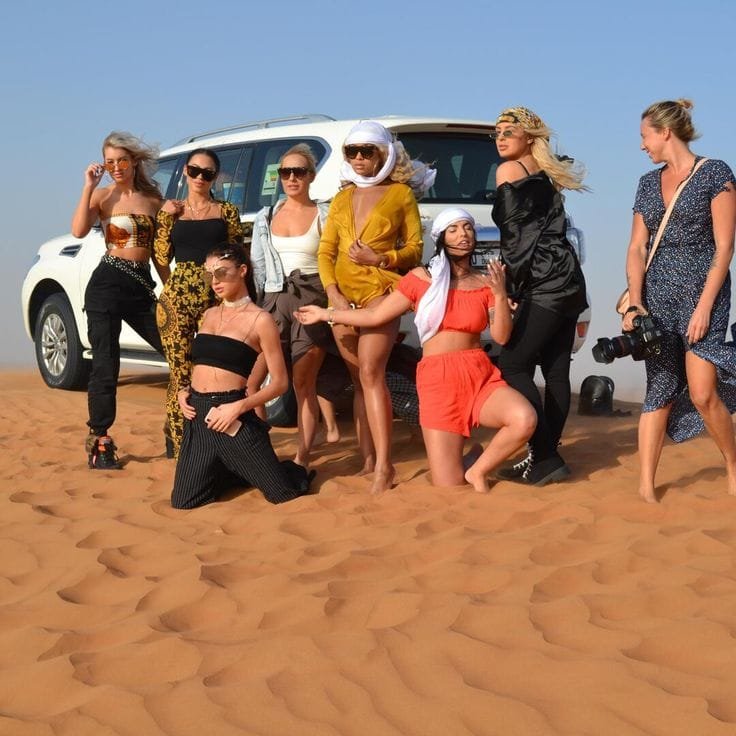
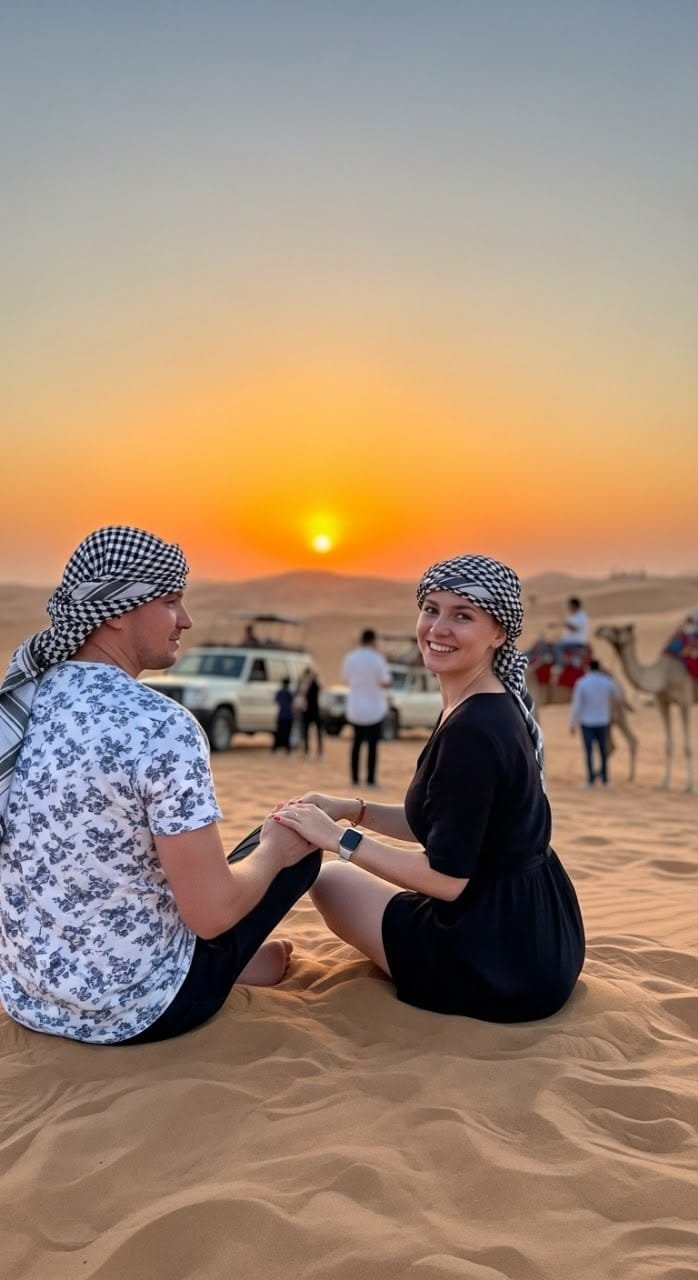
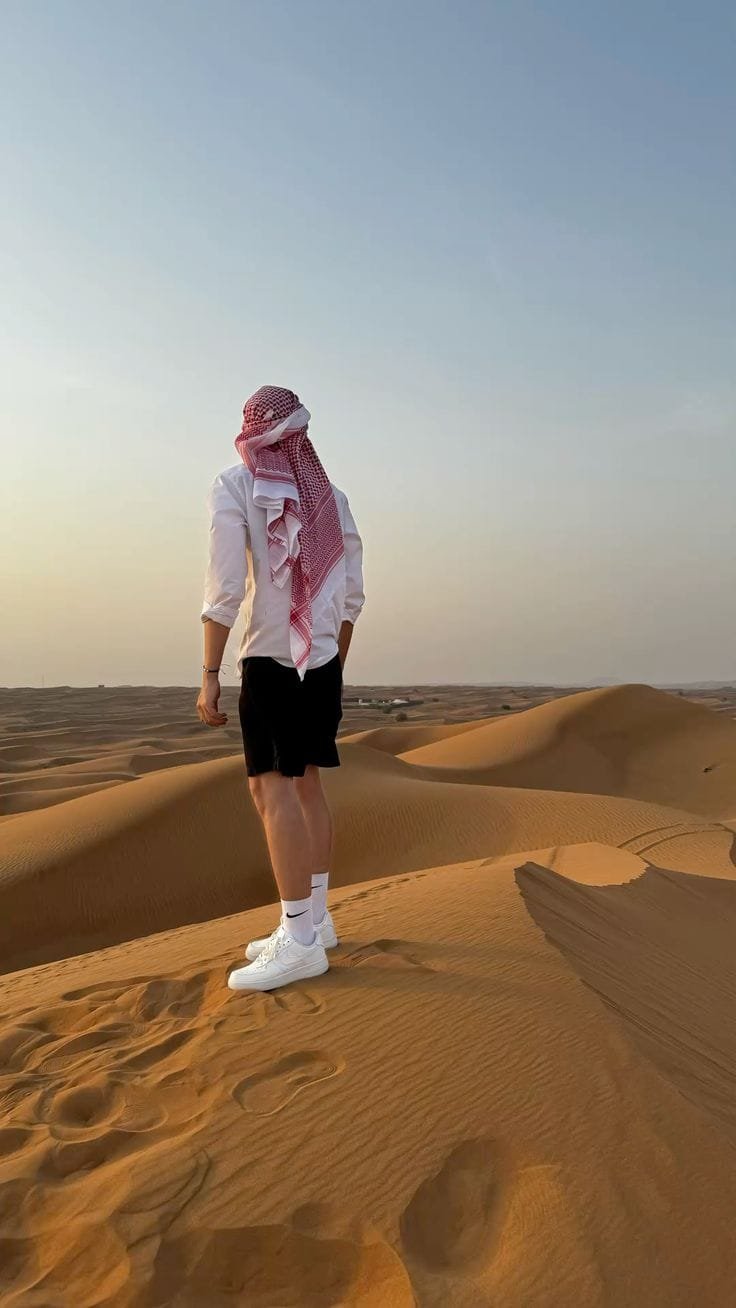
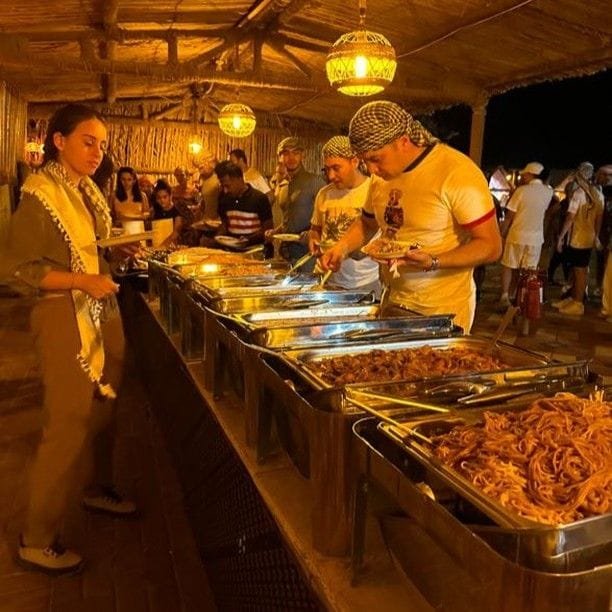
What Guests Actually Wear at Al Khatim Desert Camp
From our actual evenings — the outfits that worked, the photos that landed, and the desert backdrop that makes any reasonable clothing choice look good.
Why the Desert Safari Abu Dhabi Dress Code Is More Relaxed Than You Think
One of the most common questions we receive is whether UAE laws apply strictly at outdoor tourist venues. The internet conflates UAE dress norms with Saudi Arabian requirements. They are significantly different, particularly for tourists at outdoor activities. Here is the accurate picture for anyone asking can you wear shorts to desert safari Abu Dhabi.
The UAE has dress code regulations that apply primarily to public spaces — shopping malls, government buildings, residential areas, and places of worship. Mosques require full coverage for both genders. Indoor markets and souqs traditionally favour modest dress. But these rules explicitly do not apply to tourist facilities, beaches, hotels, outdoor recreational activities, and specifically desert safaris.
Desert safari camps are classified as licensed tourism venues under the Abu Dhabi Department of Culture and Tourism (DCT). They operate under tourism hospitality standards, not public modesty regulations. There is no DCT regulation requiring coverage of legs at licensed safari camps. Our camp has hosted guests in shorts, swimwear cover-ups, yoga leggings, and traditional abayas on the same evening — all comfortably and without any social friction.
The cultural reality is that our camp hosts guests from over 60 nationalities per month. The atmosphere is international, relaxed, and celebratory. Local Emirati guests, who do attend occasionally, dress in their traditional attire regardless of what international guests wear — there is no expectation of cultural mirroring, only of general respectfulness.
The single item that we would ask guests to avoid is clothing that is overtly revealing in a way that would make shared-table dinner seating uncomfortable for mixed-nationality groups — very short hotpants, for example, rather than knee-length shorts. This is a social courtesy rather than a regulation, and even then it would not result in being turned away, only perhaps a mild note from camp staff.
What You Can Wear — No Conditions
Shorts of any reasonable length. T-shirts and sleeveless tops. Sundresses. Athletic wear. Linen trousers. Maxi skirts. Palazzo pants. Casual summer dresses. Modest swimwear cover-ups. The sole practical constraints are comfort and temperature — not cultural law or camp regulation.
The Desert Safari Abu Dhabi Outfit Checklist — Season by Season
Whether you choose shorts or trousers, this checklist covers everything you need for each season. Screenshot it before you pack.
☀ Summer Safari (May–September)
- Light shorts or linen trousers — either works
- Breathable cotton or linen top, short-sleeve
- Thin zip-up or loose overshirt (for AC in 4×4)
- Closed trainers or sturdy flat sandals
- Wide-brim hat or baseball cap
- Sunscreen SPF 50+ (apply before pickup)
- UV-protective sunglasses
- Optional: light scarf (sun cover + sand)
❄ Winter Safari (Oct–Apr)
- Lightweight linen or cotton trousers (essential)
- Breathable mid-layer top or long-sleeve
- Light fleece, hoodie or thin jacket (critical for 9 PM+)
- Closed trainers — warmth + grip
- Scarf or light shawl (wind chill at camp)
- Socks — feet get cold at camp after 9 PM
- Avoid: shorts alone with no backup layer
- Avoid: flip-flops in cold evening sand
What Guests Say About Outfit Choices
“Wore light linen trousers in January on the team’s advice. By 9 PM at the fire show I was genuinely glad I listened — it was much colder than I expected. The photos in the linen against the dunes were also stunning. Best decision I made.”
“Came in shorts in July — absolutely fine for the temperature, the camp was warm all evening. I would still bring light trousers next time just for the dune photos. The desert light is incredible for pictures and flowing fabric just works better.”
“The Arabic costume for photos worked perfectly over our lightweight trousers. My partner wore shorts underneath and the robe looked a bit bunched up. A tiny detail but it shows how much thought went into the experience. Incredible evening overall.”
Frequently Asked Questions — Can You Wear Shorts to Desert Safari Abu Dhabi
Can you wear shorts to desert safari Abu Dhabi in winter?
Is there a dress code for desert safari Abu Dhabi?
What is the best fabric for desert safari clothing?
Can you wear shorts to desert safari Abu Dhabi if you are female?
Will I need to cover up for the camel ride?
What shoes are best for desert safari Abu Dhabi?
Can children wear shorts to desert safari Abu Dhabi?
Should I bring a change of clothes for after the safari?
What is included in the Abu Dhabi desert safari?
Every evening package includes 4×4 dune bashing, a short camel ride, sandboarding, a sunset photo stop, Arabic costume for photos, henna for ladies, a full BBQ buffet dinner with vegetarian and non-vegetarian options, unlimited soft drinks, water, Arabic coffee and tea, a shisha corner, separate washrooms and around eight live shows including tanoura, belly dance and a fire show.
How much does a desert safari in Abu Dhabi cost?
Booking direct with us: AED 35 self-drive, AED 50 shared bus from Al Wahda or Mazyad Mall, AED 100 shared hotel pickup, AED 599 for a private 7-seater car and AED 800 for a private Land Cruiser. Agencies and hotel desks typically charge AED 180 to 250 per person for the same evening because they add commission on top of an operator price.
What time does the desert safari start and finish?
Pickup is usually 3:00 to 3:30 PM and you are back in the city around 10:00 to 10:30 PM. Timings follow sunset, so in December pickup moves earlier and in June it moves later.
Where does the desert safari take place?
At our own DCT-licensed camp in the Al Khatim desert, roughly 80 km east of Abu Dhabi city along the E22 Abu Dhabi to Al Ain highway, about a 50 to 60 minute drive. The Al Khatim ridges rise over 100 metres, which is considerably taller than the roadside dunes some operators use, and there is far less traffic on the sand.
How do I book?
Message us on WhatsApp with your date and group size. We reply with the exact total, no deposit and no booking fee, and you pay at the camp on the day. Free cancellation applies up to 12 hours before.
Is hotel pickup included?
Yes on the AED 100 shared pickup, the AED 599 private car and the AED 800 Land Cruiser, covering the whole city including the Corniche, Al Maryah, Al Reem, Downtown, Khalifa City, Mussafah, Yas Island, Saadiyat, Shabiya and the airport. The AED 50 package departs from Al Wahda Mall or Mazyad Mall, and AED 35 is self-drive using a GPS pin we send you.
Do I need a 4×4 for the self-drive option?
No. You drive on tarmac to a meeting point, so any standard car or rental reaches it comfortably. Our team takes over there in a proper 4×4 for the dune bashing.
How long is the dune bashing?
Around 40 to 45 minutes with short breaks. Tyres are deflated to roughly 15 psi first so they float on the sand. Intensity is adjustable at any point — tell your driver you want it gentle and it becomes a scenic drive.
Ready to Book? Wear Whatever Is Comfortable.
No dress code, no deposit, no fuss. Pickup 3:00–3:30 PM, return approximately 10:30 PM. From AED 35 per person.
Continue Planning Your Trip
Explore More Desert Safari Guides
- Dubai Desert Safari What to Wear
- Morning Desert Safari Abu Dhabi Price — Full Cost Breakdown
- Car with Driver in Abu Dhabi — From AED 599
- Abu Dhabi Tour Packages — From AED 599 per Car
- Desert Safari From Fujairah
- Desert Safari From Umm Al Quwain
- Desert Safari From Ras Al Khaimah
- Desert Safari From Ajman
- Desert Safari From Sharjah
- How To Get To Desert Safari Abu Dhabi
Planning the Rest of Your Abu Dhabi Trip
Most guests who book the dunes with us also want a day in the capital. These guides cover the practical detail:
- the Sheikh Zayed Grand Mosque tour — entry is free, but the dress code is stricter than most visitors expect
If we have to cancel, what happens?
A cancellation policy that covers your obligations but not ours is only half a document. Here is our side of it, in writing.
If we have to cancel your booking — for weather, a vehicle issue, or driver illness — we will contact you as soon as we know and rebook you at no charge on the next date that works for you. You pay nothing for the cancelled booking.
If we need to send a different vehicle than the one you booked, we will ask you first rather than turning up in something you did not book.
This is separate from your own cancellation rights, which are unchanged: you can cancel free up to 12 hours before pickup. Because we take no deposit and no booking fee, there is no money of yours sitting with us either way — nothing to chase, and nothing to wait for.
Desert safari Abu Dhabi: the timeline, hour by hour
This is how the evening actually runs, from pickup to drop-off. The sunset stop moves with the season; everything around it holds.
| Time | Stage | What happens |
|---|---|---|
| 3:00 – 3:30 PM | Pickup | Hotel, residence or an agreed pickup point in Abu Dhabi — or drive yourself to the camp using the GPS pin we send. |
| 3:30 – 4:10 PM | Drive to Al Khatim | About forty minutes from the city to the Al Khatim dunes. |
| 4:10 – 5:00 PM | Dune bashing | Tyres are deflated, then a 4×4 run across the dunes. Tell your driver if you want it gentle or lively — you set the intensity. |
| 5:00 – 6:30 PM | Camp activities | Camel ride, sandboarding, falcon photos, henna and Arabic costumes. |
| ~5:30 – 6:00 PM | Sunset stop | The photo stop on a high dune. This one moves with the sunset rather than the clock, so it shifts through the year. |
| 6:30 PM | Starters served | Arabic coffee, dates and welcome starters as the lamps come on. |
| 7:00 – 9:30 PM | Dinner and 8 live shows | BBQ buffet with separate vegetarian and halal non-vegetarian lines, plus unlimited soft drinks, water, tea and coffee — alongside eight live performances including belly dance, the LED Tanoura, and a fire show. Shisha in the designated area. |
| 9:30 – 10:00 PM | Wind-down | Stargazing away from the lamps, then the vehicles load for the drive back. |
| 10:00 – 10:30 PM | Drop-off | Back at your Abu Dhabi hotel or pickup point. |
Times are the standard evening run and shift a little with traffic and the sunset. Your confirmed pickup time is the one we send on WhatsApp the day before.