Book this tour
No deposit and no card details. Message us and we confirm the plan and the exact price before you commit — answered at any hour.
- Send your date and guest countYour date, how many of you, and where we collect from. That is all we need.
- We send the plan and the pricePer car, not per person. You see the route, the timings and the exact figure first.
- Pay the driver on the dayCash or card, after the run. Free cancellation up to 12 hours before pickup.
Answered 24 hours · No deposit · No booking fee · Licensed operator
Desert Safari Abu Dhabi Rain Policy: What Actually Happens If It Rains
The desert safari Abu Dhabi rain question sounds bigger than it is: Abu Dhabi averages only around a dozen rainy days a YEAR, almost all between December and March, and most of those are brief showers the desert barely notices. But travellers booking around precious holiday dates deserve the complete answer anyway — so here it is: the actual rain policy (free reschedule or cancellation, because nothing was prepaid), what rain does to each activity (spoiler: light rain IMPROVES dune bashing), the rare conditions that genuinely pause operations, the sandstorm distinction everyone confuses with rain, and why a desert shower is the experience local residents drive out to chase.
Ask About Your Date’s ForecastDesert Safari Abu Dhabi Rain Policy: What Actually Happens If It Rains: The Short Answer
The desert safari Abu Dhabi rain question sounds bigger than it is: Abu Dhabi averages only around a dozen rainy days a YEAR, almost all between December and March, and most of those are brief showers the desert barely notices.
- How much does a desert safari in Abu Dhabi cost?: Booking direct with us: AED 35 self-drive, AED 50 shared bus from Al Wahda or Mazyad Mall, AED 100 shared hotel pickup, AED 599 for a private 7-seater car and AED 800 for a private Land Cruiser.
- How long is the dune bashing?: Around 40 to 45 minutes with short breaks. Tyres are deflated to roughly 15 psi first so they float on the sand.
- What time does the desert safari start and finish?: Pickup is usually 3:00 to 3:30 PM and you are back in the city around 10:00 to 10:30 PM. Timings follow sunset, so in December pickup moves earlier and in June it moves later.
- Where does the desert safari take place?: At our own DCT-licensed camp in the Al Khatim desert, roughly 80 km east of Abu Dhabi city along the E22 Abu Dhabi to Al Ain highway, about a 50 to 60 minute drive.
- What is included in the Abu Dhabi desert safari?: Every evening package includes 4×4 dune bashing, a short camel ride, sandboarding, a sunset photo stop, Arabic costume for photos, henna for ladies, a full BBQ buffet dinner with vegetarian and non-vegetarian options, unlimited soft drinks, water, Arabic coffee and tea, a shisha corner, separate washrooms and around eight live shows including tanoura, belly dance and a fire show.
- Do I get a refund if rain cancels the safari?: There is nothing to refund — you pay only on arrival. A weather-paused evening simply means choosing a new date or walking away, both free, in writing, with zero paperwork.
Quick factual answer:
Royal Arabian Safari’s desert safari Abu Dhabi rain policy: if weather genuinely affects your booked evening, reschedule to any available date or cancel entirely — both free, with one WhatsApp message (+971582282683), because the zero-deposit pay-on-arrival model means no money is ever trapped behind a forecast. In practice this is rarely needed: Abu Dhabi receives roughly 12 rainy days annually (concentrated December-March), most are brief, and light rain does not cancel safaris — wet sand actually firms the dunes and improves dune bashing grip, while the camp’s covered majlis seating shelters dinner and shows. Operations pause only for genuinely unsafe conditions (heavy storms, dangerous winds/sandstorms), decided day-of with safety priority, in which case all guests reschedule or cancel free. The desert sits 80km inland from coastal showers and often stays dry when the city is wet. Forecast worried guests should simply hold their booking — the decision can wait until the day itself at zero cost. All packages from AED 35; camp at Al Khatim, GPS 24.1302, 54.6136.
Last verified: June. The reschedule and cancellation mechanics are standing booking-thread practice; weather conditions on any specific date get a same-day operational read on request.
The Desert Safari Abu Dhabi Rain Policy in Three Sentences
Most operators’ weather clauses are paragraphs of conditions, cutoffs and credit-voucher mechanics; ours compresses to three sentences because the payment model does the heavy lifting. One: if weather affects your evening — by forecast worry beforehand or conditions on the day — message the thread and move your booking to any available date, free, instantly, in writing. Two: if rescheduling does not suit, cancel entirely with the same message at the same price: zero, because you never paid anything to begin with. Three: if WE pause operations for safety (the rare genuinely dangerous evening), every affected guest gets the same two options with our apologies and priority rebooking. There is no fine print beneath this because there is nothing for fine print to protect: no prepayment to retain, no voucher scheme to administer, no “weather guarantee fee” upsell. The zero-deposit architecture converts the entire weather-risk question — tourism’s classic anxiety — into a non-event, which is among the quietest but most valuable features of booking direct. Your money meets the desert only after the desert has behaved.
Hold those three sentences against any weather clause you have ever scrolled past at a checkout, and the comparison-shopping lesson of this whole website repeats itself once more: the simplest policies belong to the operators whose money model needs nothing from you in advance.
How Rare Is Rain on a Desert Safari Abu Dhabi Rain Date, Really?
The numbers deserve to be seen plainly. Abu Dhabi’s annual rainfall hovers around 50-90mm — what many European cities receive in a fortnight — distributed across roughly a dozen rain-touched days per year, overwhelmingly December through March, with the deep summer functionally rainless. Even within that winter window, “rain day” usually means a passing shower measured in minutes, not a washed-out afternoon: the region’s rain arrives in brief, dramatic, fast-moving cells rather than settled grey days. Now add geography: the camp sits 80km inland at Al Khatim, and coastal showers frequently exhaust themselves over the city and the coast without ever reaching the interior dunes — guests have photographed rain on the E22 drive out and bone-dry sand at the camp the same evening. Compute the practical odds: a randomly chosen evening safari has a low single-digit percentage chance of meeting any rain at all, and a small fraction of THAT chance of meeting rain heavy enough to matter. The honest planning conclusion: book any date you like, in any month, and let the rain policy carry the residual risk — the policy exists precisely so the probability never has to be your problem.
For context on how unusual the worry is from the other side of the counter: the booking thread fields the rain question constantly from international guests and almost never from residents — not because residents read forecasts less, but because a lifetime under this sky teaches the base rate viscerally. This page exists to transfer that calibration in one read: the desert you are booking is one of Earth’s most reliably dry stages, your evening on it is statistically armored, and the policy stands guard over the remainder. Worry budget, reallocated.
What Rain Does to Each Part of the Evening (The Activity-by-Activity Truth)
Dune bashing: genuinely improves
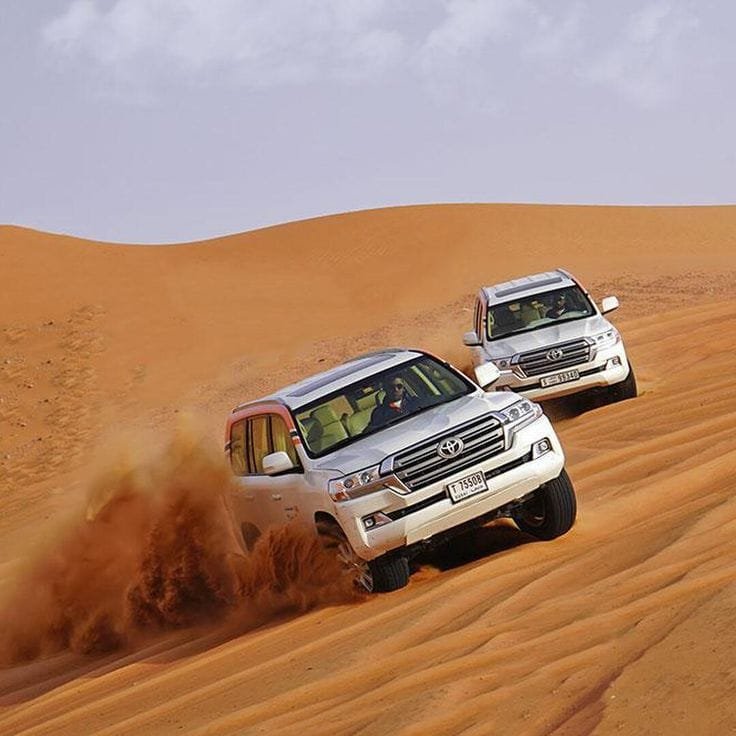
The open secret of desert driving: light rain compacts loose sand into a firmer, grippier surface — drivers gain traction, carve cleaner lines, and several of ours privately rate damp-dune evenings the year’s best driving. The convoy runs in light rain happily; only genuinely heavy weather pauses it. (Rally drivers worldwide pay for wet-sand conditions; winter guests occasionally get them free.)
The camp: built for shelter
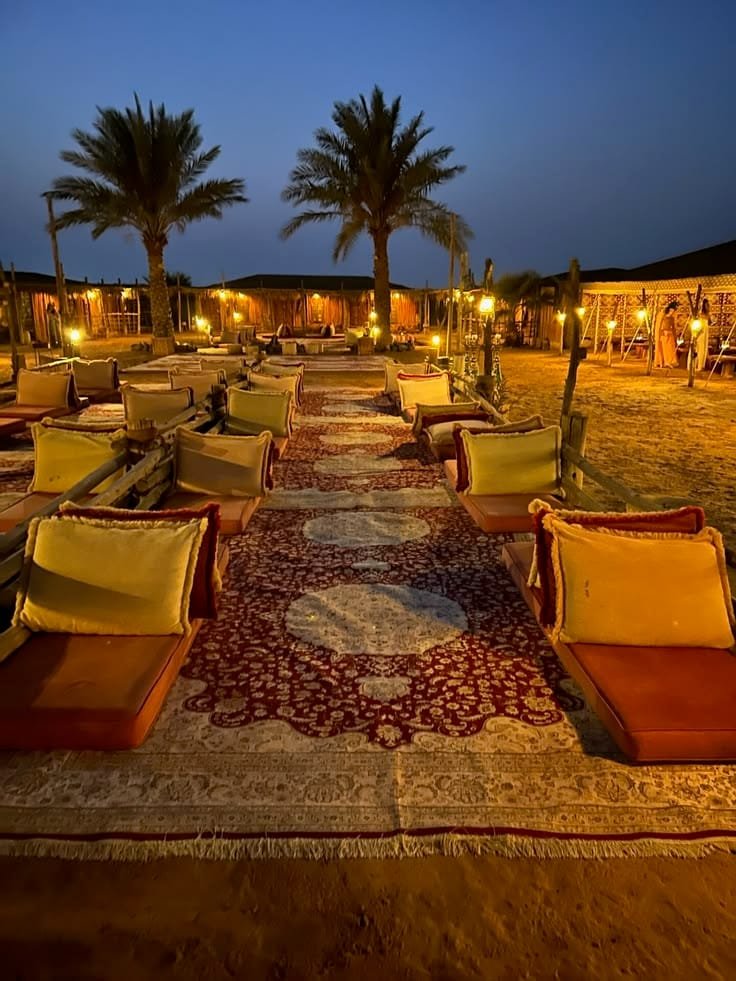
The majlis seating, dining areas and stages operate under cover — a passing shower relocates the crowd ten metres and changes the soundtrack, with dinner, shows and drinks continuing uninterrupted. Desert camps have handled weather since tents were invented; ours inherited the syllabus, and the rare wet evening’s cosier, closer-gathered version of the camp has its own devoted fans among the staff.
Camels and sandboarding: pause and resume
Open-air activities take shelter during active rain and resume after the cell passes — which, in this climate, is usually a matter of minutes. The evening’s generous timeline absorbs the pause without costing the programme a single inclusion, and the camels, for the record, handle rain with the unbothered dignity of animals built for far worse.
Photography: jackpot conditions
Rain in the desert produces the year’s rarest frames: storm light over the dunes, rainbow chances, cloud drama replacing the usual clean gradient, and post-shower air so clear the horizon doubles. Photographers monitor winter forecasts hoping FOR a shower; if you receive one, shoot it — the wet-sand textures and deepened dune colours expire within hours, and almost nobody on Earth holds desert-rain frames from this landscape. The photography-safari page carries the full shot discipline.
When We DO Pause: The Safety Conditions, Honestly Defined
Credibility requires the other column. A small number of weather states genuinely pause desert operations, and we name them so the policy’s edges are visible. Severe storms: the region’s rare intense winter systems — torrential cells, lightning overhead, flash-flood advisories for wadi areas — ground the convoy until they pass; these are the handful of evenings per year (some years, zero) when safety overrides schedule. Dangerous winds and sandstorms: a separate phenomenon entirely (see the next section), strong enough to kill visibility on the dunes — same response. The decision mechanics: calls are made day-of by the operations team against actual conditions, not by apps against probabilities; affected guests are contacted proactively on the booking thread with the reschedule-or-cancel options; and the threshold is deliberately conservative because a 4.9 rating is built on evenings that should have run, not evenings that should not have. What we will never do: run a marginal evening to protect revenue (pay-on-arrival means there is no revenue to protect until you are safely at the camp), or cancel a runnable evening to consolidate convoys without offering you the same free options. The policy’s spine, restated: weather decisions are safety decisions, the costs of them never land on the guest, and everything is in writing on the thread where you booked.
Rain vs Sandstorm: The Desert Safari Abu Dhabi Rain Confusion, Untangled
Half the weather anxiety reaching the booking thread is actually about sandstorms wearing rain’s vocabulary, so the distinction earns its own section. Rain and dust events are opposite phenomena: rain is moisture arriving (rare, brief, mostly harmless to the evening), while sand and dust events are dry wind lifting the desert into the air — different cause, different frequency, different playbook. The region’s dust spectrum runs from light haze (common enough, mostly an aesthetic note that softens photos) through breezy days with surface sand movement (the dunes smoking attractively at their crests — photogenic, manageable) to genuine sandstorms with serious visibility loss (uncommon, forecastable, and an automatic operations pause under the safety conditions above). The practical guest guidance: light haze changes nothing; moderate wind days may adjust activity sequencing at the team’s discretion; true storm forecasts trigger the proactive-contact protocol before you ever leave your hotel. Our dedicated sandstorm-safety page carries the full meteorology, the seasonal patterns and the at-camp protocols for readers who want the deep version — this page’s job is only the sorting: if your forecast worry says “rain,” relax almost entirely; if it says “dust,” read the other page and then relax almost entirely with better information.
Your Desert Safari Abu Dhabi Rain Worry, Resolved Step by Step
Do nothing. Regional forecasts at this range are probability theatre — the rain symbol that terrifies on Monday routinely evaporates by Thursday, and even a correct forecast usually means a brief cell somewhere in the emirate, not the camp. Your booking costs nothing to hold; hold it.
Still do nothing, but feel free to message the thread for a local read — the operations team watches actual regional radar, not app icons, and will tell you honestly whether the pattern looks coastal (probably misses the camp), fast-moving (a pause, not a problem), or genuinely significant (rare; the proactive-contact protocol arms itself).
Now the policy earns its keep. Three paths: most commonly, the team confirms the evening runs (cells pass, dunes firm up, camp shelters); occasionally, they offer a proactive switch to tomorrow if conditions look marginal; rarely, they pause operations and every guest gets the free choice. In all three paths your action is one message and your cost is zero.
Follow the staff ten metres to cover, accept a hot kahwa, and watch the desert do something it does a dozen evenings a year. The programme flexes around the cell and resumes; your phone gets the rarest photo set of the trip.
The genuinely cancelled evening (the handful per year): proactive contact before pickup, your choice of any new date or a no-cost walk-away, priority rebooking, and — because nothing was prepaid — no refund queue, voucher scheme or claims form. The worst case is an inconvenience measured in one rescheduled evening, which is the entire point of the policy’s architecture.
Desert Rain as Event: The Cultural Reframe
Here is the perspective shift that retires the worry entirely: in the Gulf, rain is not weather, it is an occasion. The same shower that has a visiting traveller drafting cancellation messages has Emirati families loading the car to drive INTO it — desert rain is rare enough to be celebrated, photographed, and remembered by date (“the rain of that February”), and the desert after rain performs its briefest, most beautiful trick: the smell of wet sand (the region’s beloved petrichor), the dunes’ colours deepening from beige to amber, and — given a wet enough winter — the flush of green that carpets the desert floor for a few astonishing weeks as dormant seeds seize their moment. The ghaf trees stand brighter, the camels visibly enjoy themselves, and the camp’s staff, who have watched a thousand identical clear evenings, get the rare shift they will talk about. None of this obligates you to hope for rain on your one available evening — the policy exists precisely so you need no such luck — but it should recalibrate the fear: the outcome you are worried about is the one the locals would congratulate you on. In the desert’s own accounting, rain is not the evening going wrong; it is the desert showing you the page of itself almost nobody gets to read.
The historical footnote completes the reframe: for the Bedouin, rain was wealth itself — the difference between grazing and migration, the event that named seasons and filled poetry, the literal answer to prayer (the rain prayer, salat al-istisqa, remains part of living practice across the region). When your camp hosts beam at a shower, you are watching a cultural memory far older than tourism: people of this desert greeting the desert’s rarest gift. The traveller who arrives fearing rain and leaves having seen it has, by local reckoning, received the upgrade — no charge, no booking class, just timing the oldest economy in Arabia finally paying out on your evening.
How Our Weather Policy Stacks Against the Industry’s
Weather clauses are where booking models show their true colours, so the comparison earns a section. The prepaid industry’s standard architecture: your money is captured at booking, so weather events trigger the machinery of protection — cancellation windows (“free until 12 hours before”), weather guarantees sold as add-ons, credit vouchers with expiry dates, refund queues running days to weeks, and the inevitable disputes over whether conditions were officially bad enough to qualify. None of this is villainy; it is the necessary bureaucracy of holding other people’s money against an uncertain sky. Our architecture deletes the bureaucracy by deleting its cause: with no money captured, there is nothing to protect, guarantee, voucher or refund — the “claim process” is one WhatsApp message, the “qualifying conditions” are whatever genuinely affects your evening, and the timeline is instant. The comparison-shopping translation: when weighing operators, read the weather clause as a diagnostic — its complexity measures exactly how much of your money sits at risk and how much friction guards its return. A three-sentence policy is only possible above a zero-deposit model, which is why ours is three sentences and why the question “what if it rains?” is, here, among the easiest in the entire FAQ. The sky stays uncertain; your dirhams do not participate in the uncertainty.
The Desert Safari Abu Dhabi Rain Calendar (When the Question Even Applies)
| Months | Rain Reality | Practical Guidance |
|---|---|---|
| December – February | The “wet” season — most of the year’s dozen rain days live here, as brief passing cells | Book freely; the policy carries the low odds, and winter rain evenings are the celebrated rarities above |
| March | Transitional — occasional late-winter showers possible | Same as winter: hold bookings, decide day-of if anything appears |
| April – May | Largely dry; isolated convective events possible but uncommon | The rain question is functionally retired |
| June – September | Functionally rainless at the camp’s location | Weather attention shifts entirely to heat planning (the night-temperature page) — rain is a non-topic |
| October – November | Dry season holding; first winter systems possible very late | Book without a thought; the policy idles |
The table’s meta-message: for seven to eight months of the year, the desert safari Abu Dhabi rain question does not meaningfully exist, and even in its winter season it is a low-probability footnote backed by a free-exit policy. Guests planning around weather should spend their attention where the desert actually varies — temperature, sunset times, crowd patterns — all mapped on their own pages, while rain stays what it is here: the rarest guest at the camp, and an honoured one when it comes.
How the Day-Of Weather Call Actually Gets Made
Transparency about the mechanism builds more trust than the policy alone, so here is the inside of the decision, exactly as it runs every operating day of the year. The operations team’s weather watch is local and physical, not app-based: regional radar for incoming cells, wind readings that matter for dune driving and dust, road conditions on the E22 corridor, and — the irreplaceable input — drivers and camp staff standing in the actual weather at the actual coordinates, reporting what the sky is doing rather than what a model thought it might. Decisions cascade through the afternoon: a morning review flags watch-list evenings; a midday check converts flags into proactive guest contact where needed; and the final go/no-go for marginal conditions lands close enough to pickup that it reflects reality, not probability. Guests inside this machinery experience it as the thread messages described in the decision tree — but knowing the machinery exists answers the deeper question travellers carry: who is deciding whether my family drives into weather, and on what information? The answer: people who work in this desert nightly, deciding conservatively, on direct observation, with nothing to gain from a wrong call in either direction — because pay-on-arrival means a forced evening earns nothing and a lazily cancelled one costs reputation we have spent 5,000+ guests building. Incentives aligned, information local, costs on us. That is the whole weather apparatus, and it is yours from the moment the booking message sends.
Desert Safari Abu Dhabi Rain Planning by Trip Type
The one-evening tourist: your single free night cannot be rescheduled even if the safari can — so the desert safari Abu Dhabi rain hedge for you is simply booking it anyway: the overwhelming odds say the evening runs, light rain enhances rather than ruins, and a genuine cancellation costs you nothing but the evening you would otherwise have spent indoors anyway. The asymmetric bet always says book. The flexible resident: you hold the luxury position here — book any winter date, and if the rare forecast genuinely sours, the one-message reschedule turns your weather risk into a calendar shuffle. Some residents play the inverse game and message the thread when rain IS forecast, chasing the celebrated wet-desert evening; the team enjoys these calls. The occasion planner: proposals, anniversaries and birthdays on fixed dates get the proactive treatment — flag the occasion at booking and the team’s weather watch covers your evening with extra attention, with same-day alternatives (timing shifts, sheltered staging for the moment itself) discussed in writing if a cell threatens the choreography. The photographer: you already know the play — winter forecasts with instability are your bookings of the year, and the thread will happily talk cloud prospects with you. The anxious planner (no shame; tourism made you this way): the entire policy was built for your nervous system — book, hold, and let the day itself answer, with every exit free and every update in writing. Across all five profiles the instruction converges: the desert safari Abu Dhabi rain question is never a reason to not book; it is, at absolute most, a reason to send one extra message — and usually not even that.
Rain Reviews From the One Percent
It rained on our January safari – actual rain, in the desert – and the staff reacted like someone had brought a gift. The driver was grinning about the firm sand and gave us the best bashing run of the convoy, dinner moved under cover without missing a beat, and we watched a fire show with rain hissing somewhere beyond the lights. The locals at our table kept saying how lucky we were. Strangest five stars I have ever given the weather.
Forecast showed storms for our only free night and I messaged in a panic about deposits and refund forms before remembering there were none – we had paid nothing. They said hold the booking, decide on the day, costs you nothing either way. The storm missed the desert entirely, the evening was perfect, and I spent zero of my holiday filling in weather-claim paperwork. That is what a real policy looks like.
Desert Safari Abu Dhabi Rain Policy: Frequently Asked Questions
What happens if it rains on my desert safari?
Usually: the evening continues — light rain improves dune grip, the camp’s covered seating shelters dinner and shows, and open-air activities pause minutes for passing cells. If weather genuinely affects your booking, reschedule or cancel free with one message.
Do I get a refund if rain cancels the safari?
There is nothing to refund — you pay only on arrival. A weather-paused evening simply means choosing a new date or walking away, both free, in writing, with zero paperwork.
How often does rain actually affect safaris?
Rarely: ~12 rainy days a year regionally, mostly brief December-March showers, and the inland camp often stays dry when the coast is wet. Genuinely paused evenings number a handful per year — some years none.
Should I avoid booking in the winter months because of rain?
No — winter is the desert’s prime season (the night-temperature page explains why), and the low single-digit rain odds are fully covered by the free-reschedule policy. Book the date you want.
The forecast looks bad for my date — should I cancel now?
Hold the booking and decide on the day: it costs nothing either way, forecasts days out routinely miss, and the inland desert often escapes coastal weather. The thread will give you a same-day read on actual conditions.
Is dune bashing cancelled in rain?
Light rain, no — wet sand firms up and grips better, and drivers genuinely enjoy those runs. Only heavy storms or dangerous winds pause the convoy, under the safety conditions the policy defines.
What about sandstorms — same policy?
Same guest protections (free reschedule/cancel, proactive contact), different phenomenon — see our dedicated sandstorm-safety page for the meteorology. True storms are uncommon and forecastable; light haze changes nothing.
Who decides if the evening is cancelled, and when?
The operations team, day-of, against actual conditions rather than app probabilities — conservatively, with safety as the only criterion. Affected guests are contacted proactively on their booking thread with both free options.
What is included in the Abu Dhabi desert safari?
Every evening package includes 4×4 dune bashing, a short camel ride, sandboarding, a sunset photo stop, Arabic costume for photos, henna for ladies, a full BBQ buffet dinner with vegetarian and non-vegetarian options, unlimited soft drinks, water, Arabic coffee and tea, a shisha corner, separate washrooms and around eight live shows including tanoura, belly dance and a fire show.
How much does a desert safari in Abu Dhabi cost?
Booking direct with us: AED 35 self-drive, AED 50 shared bus from Al Wahda or Mazyad Mall, AED 100 shared hotel pickup, AED 599 for a private 7-seater car and AED 800 for a private Land Cruiser. Agencies and hotel desks typically charge AED 180 to 250 per person for the same evening because they add commission on top of an operator price.
What time does the desert safari start and finish?
Pickup is usually 3:00 to 3:30 PM and you are back in the city around 10:00 to 10:30 PM. Timings follow sunset, so in December pickup moves earlier and in June it moves later.
Where does the desert safari take place?
At our own DCT-licensed camp in the Al Khatim desert, roughly 80 km east of Abu Dhabi city along the E22 Abu Dhabi to Al Ain highway, about a 50 to 60 minute drive. The Al Khatim ridges rise over 100 metres, which is considerably taller than the roadside dunes some operators use, and there is far less traffic on the sand.
How do I book?
Message us on WhatsApp with your date and group size. We reply with the exact total, no deposit and no booking fee, and you pay at the camp on the day. Free cancellation applies up to 12 hours before.
Is hotel pickup included?
Yes on the AED 100 shared pickup, the AED 599 private car and the AED 800 Land Cruiser, covering the whole city including the Corniche, Al Maryah, Al Reem, Downtown, Khalifa City, Mussafah, Yas Island, Saadiyat, Shabiya and the airport. The AED 50 package departs from Al Wahda Mall or Mazyad Mall, and AED 35 is self-drive using a GPS pin we send you.
Do I need a 4×4 for the self-drive option?
No. You drive on tarmac to a meeting point, so any standard car or rental reaches it comfortably. Our team takes over there in a proper 4×4 for the dune bashing.
How long is the dune bashing?
Around 40 to 45 minutes with short breaks. Tyres are deflated to roughly 15 psi first so they float on the sand. Intensity is adjustable at any point — tell your driver you want it gentle and it becomes a scenic drive.
Book the Date. The Sky Is Our Problem, Free of Charge.
Zero deposit means the forecast can never trap a dirham — hold your evening, decide on the day, and let the policy do the worrying.
Book Weather-FearlesslyThe Evening Rain Rarely Interrupts
Planning the Rest of Your Abu Dhabi Trip
Most guests who book the dunes with us also want a day in the capital. These guides cover the practical detail:
- Louvre Abu Dhabi — tickets, timings and the free-entry rules most people miss
- Warner Bros World Abu Dhabi — fully indoor and air-conditioned, which matters in summer
If we have to cancel, what happens?
A cancellation policy that covers your obligations but not ours is only half a document. Here is our side of it, in writing.
If we have to cancel your booking — for weather, a vehicle issue, or driver illness — we will contact you as soon as we know and rebook you at no charge on the next date that works for you. You pay nothing for the cancelled booking.
If we need to send a different vehicle than the one you booked, we will ask you first rather than turning up in something you did not book.
This is separate from your own cancellation rights, which are unchanged: you can cancel free up to 12 hours before pickup. Because we take no deposit and no booking fee, there is no money of yours sitting with us either way — nothing to chase, and nothing to wait for.