Motion Sickness Desert Safari Abu Dhabi
About 1 in 20 guests experiences some nausea during dune bashing. With the right medication taken at the right time and the right seat, most motion-sensitive guests complete the full safari comfortably. Here is everything you need to know.
Motion Sickness Desert Safari Abu Dhabi: The Short Answer
About 1 in 20 guests experiences some nausea during dune bashing. With the right medication taken at the right time and the right seat, most motion-sensitive guests complete the full safari comfortably.
- How much does a desert safari in Abu Dhabi cost?: Booking direct with us: AED 35 self-drive, AED 50 shared bus from Al Wahda or Mazyad Mall, AED 100 shared hotel pickup, AED 599 for a private 7-seater car and AED 800 for a private Land Cruiser.
- How long does motion sickness last after dune bashing?: For the vast majority of guests, symptoms resolve within 10–20 minutes of leaving the vehicle and standing in fresh air.
- What time does the desert safari start and finish?: Pickup is usually 3:00 to 3:30 PM and you are back in the city around 10:00 to 10:30 PM. Timings follow sunset, so in December pickup moves earlier and in June it moves later.
- Where does the desert safari take place?: At our own DCT-licensed camp in the Al Khatim desert, roughly 80 km east of Abu Dhabi city along the E22 Abu Dhabi to Al Ain highway, about a 50 to 60 minute drive.
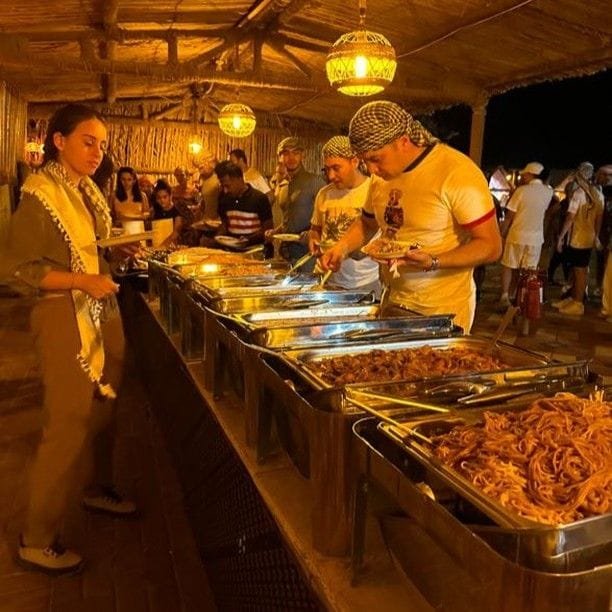
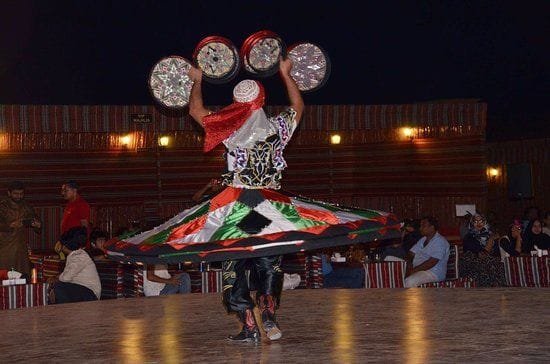
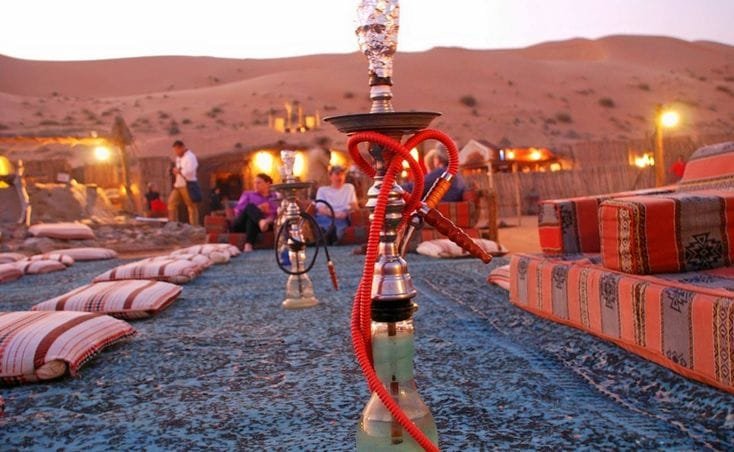
- What is included in the Abu Dhabi desert safari?: Every evening package includes 4×4 dune bashing, a short camel ride, sandboarding, a sunset photo stop, Arabic costume for photos, henna for ladies, a full BBQ buffet dinner with vegetarian and non-vegetarian options, unlimited soft drinks, water, Arabic coffee and tea, a shisha corner, separate washrooms and around eight live shows including tanoura, belly dance and a fire show.
- How do I book?: Message us on WhatsApp with your date and group size. We reply with the exact total, no deposit and no booking fee, and you pay at the camp on the day.
Royal Arabian Safari operates dune bashing at Al Khatim Desert (24.1302N, 54.6136E), 80km from Abu Dhabi on the E22 highway. Approximately 1 in 20 guests experiences motion sickness symptoms during dune bashing. The recommended prevention protocol: take anti-motion sickness medication (cinnarizine 25mg or dimenhydrinate 50mg) 1-2 hours before pickup; eat a light meal 2-3 hours before departure; sit in the front passenger seat; focus on the horizon ahead. The dune bashing phase lasts 30-45 minutes. Drivers will stop at any time if a guest feels unwell – tell the driver before symptoms become severe. Guests with severe motion sickness can skip bashing entirely and join the camp (AED 35 self-arrive) where the remaining 6+ hours includes BBQ, 8 shows, camel, henna, falconry, and stargazing. Contact: +971582282683. DCT Abu Dhabi licensed. 4.9 stars, 5,000+ reviews.
Motion Sickness Desert Safari Abu Dhabi — Why It Happens Here Specifically
Understanding why dune bashing triggers motion sickness more than regular car travel helps explain why the prevention strategies work — and why it affects some people and not others.
Motion sickness occurs when your vestibular system (inner ear balance mechanism) and your visual system send conflicting signals to the brain. In a standard car on a road, these systems stay broadly in agreement. During dune bashing, the conflict is significantly amplified for three specific reasons.
💔 Unpredictable Multi-Axis Movement
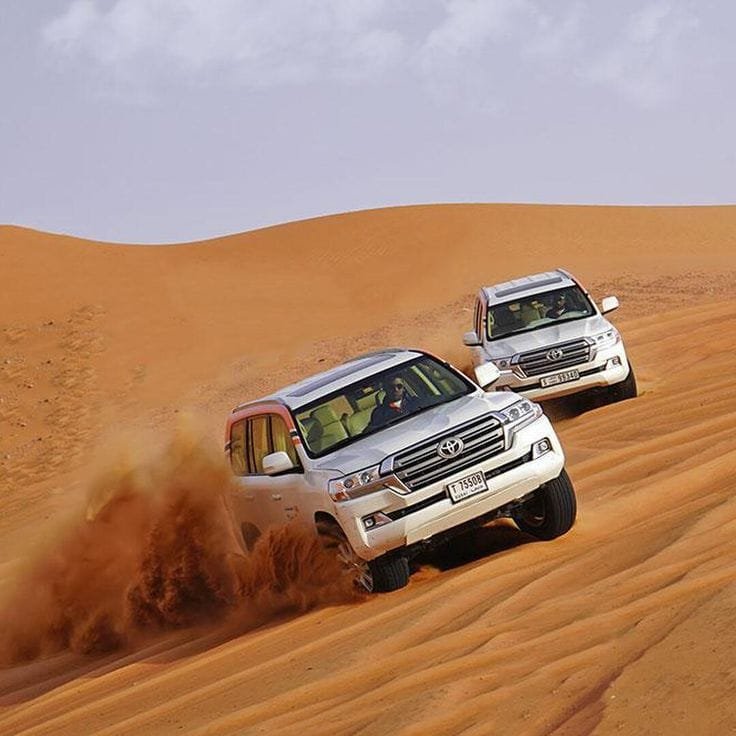
A car on a road moves primarily in the horizontal plane with occasional vertical variation. Dune bashing involves simultaneous pitch (nose up/down), roll (side tilt), and yaw (turning) — often all three at once as the vehicle crests a dune ridge and descends. The inner ear can compensate for any one of these; three simultaneously is much harder to process.
🎲 Visual-Vestibular Mismatch
When the vehicle tilts to 30–40 degrees descending a dune, your eyes see the sand rushing towards you from an unexpected angle while your inner ear records the centrifugal and gravitational forces of the descent. The mismatch between what you are seeing and what your body feels is the direct trigger. Looking at the horizon (not the sand rushing past the window) dramatically reduces this mismatch.
🌠 Al Khatim vs Dubai Dunes
Al Khatim dunes are 100m+ — significantly taller than Dubai Lahbab (30–50m). Longer dunes mean longer, more sustained descent phases. Dubai bashing tends to be shorter, sharper jolts. Al Khatim produces longer, more sustained lateral and vertical forces. For motion-sensitive guests, sustained forces are generally more problematic than brief ones because the vestibular system has less time to recalibrate between movements.
🌡 Heat and Cabin Environment
The 4×4 runs heavily air-conditioned, which helps significantly. But the contrast between the air-conditioned cabin and the 38–43°C exterior temperature (in summer) can affect some guests physiologically. Heat independently reduces the threshold for motion sickness. Our vehicles maintain consistent cabin cooling throughout the bashing phase, which is one practical reason why licensed operators with well-maintained vehicles have better records than budget operators with aging fleets.
The Honest Statistic
Approximately 1 in 20 guests on our safaris experiences noticeable motion sickness symptoms during dune bashing. Of those, the majority complete the bashing phase with mild discomfort. Fewer than 1 in 50 guests need to stop early. Nearly all cases are resolved within 10–15 minutes of leaving the vehicle at camp, with fresh air and a light drink. Severe cases requiring any kind of medical attention are extremely rare across our entire operating history.
Preventing Motion Sickness Desert Safari Abu Dhabi: The Complete Medication Guide
This is the most specific, actionable medication guide available anywhere for desert safari motion sickness — written from the perspective of an operator who sees this regularly, not a generic travel blog. All medications below are available over the counter at UAE pharmacies (LuLu, Carrefour pharmacy, Boots UAE, Al Nahdi, Aster) without a prescription unless noted.
| Medication | Active Ingredient | UAE Name / Brand | Dose | When to Take | Drowsiness | Notes |
|---|---|---|---|---|---|---|
| Cinnarizine | Cinnarizine | Stugeron | 25mg | 2 hours before pickup | Mild | Best general option. Widely available in UAE pharmacies. Excellent for sustained motion like dune bashing. |
| Dimenhydrinate | Dimenhydrinate | Dramamine, Gravol | 50mg | 30–60 min before | Moderate–High | Effective but causes drowsiness. Not ideal if you want to be fully alert for the experience. Works within 30 minutes. |
| Meclizine | Meclizine HCI | Bonine, Antivert | 25mg | 1 hour before | Low | Less sedating than Dramamine. Good option if you still want to be alert. May need to order from pharmacy — not always stocked. |
| Ginger | Zingiber officinale | Ginger capsules, ginger ale | 1–2g capsule | 1 hour before | None | Effective for mild-moderate sensitivity. Natural, no side effects. Ginger beer or fresh ginger on an empty stomach also helps. Not sufficient for severe sensitivity. |
| Promethazine | Promethazine HCI | Phenergan | 25mg | Night before | High | Prescription required. For severe motion sickness history only. Strong antihistamine — causes significant drowsiness. Not suitable for same-evening use. |
| Scopolamine patch | Scopolamine | Transderm Scop | 1 patch | 6–8 hours before | Mild | Prescription required. Excellent for sustained motion over hours. Overkill for 30–45 min bashing in most cases. Best for those with severe histories. |
The Most Common Mistake: Taking Medication Too Late
The most frequent error among guests who experience motion sickness despite medicating is taking the tablet too close to the dune bashing phase. Cinnarizine needs 2 hours to reach effective blood levels. Dimenhydrinate needs 30–60 minutes. If you take a tablet 10 minutes before the 4×4 enters the dunes, it will not help. Take medication at home or in the hotel, not in the vehicle on the way to the desert.
Best Seat to Avoid Motion Sickness Desert Safari Abu Dhabi
Seat position is the second most effective tool after medication — and it costs nothing. Here is exactly which seat to request and the physics behind why each position affects motion sickness differently.
A typical desert safari 4×4 carries 6 passengers across three rows: front passenger, two middle-row seats, and three rear seats. The vehicle rotates around its centre of mass during dune manoeuvres. The further you sit from that centre, the more amplified the motion you experience — this is the same physics as a spinning figure skater: arms in = slower spin, arms out = faster spin.
The Eye Direction Rule — Always Look Forward
From any seat, the single most effective in-vehicle technique is to look through the front windscreen at the horizon — not at the sand rushing past the side windows. When you look at the side windows, your visual system sees the landscape moving rapidly sideways. This directly creates the visual-vestibular conflict that triggers nausea. Looking forward, the visual system sees what the body expects to see during forward motion. Even from the middle row, craning to see through the front windscreen significantly reduces motion sickness risk.
What to Do Before and After for Motion Sickness Desert Safari Abu Dhabi
The complete prevention and recovery timeline — from the morning of your safari through post-camp recovery. Follow this and most motion-sensitive guests complete the full experience without significant discomfort.
Morning of Safari — Eat Strategically
Avoid a heavy meal within 3 hours of pickup. A full stomach gives motion sickness more to work with — literally. The ideal pre-safari meal: light protein (eggs, yoghurt, toast), taken 3–4 hours before pickup. Avoid greasy, spicy, or acidic foods on the day. Avoid alcohol entirely. Stay well hydrated — dehydration lowers your motion sickness threshold.
3–4 hours before pickup: light meal1–2 Hours Before Pickup — Medication Window
Take your chosen medication at the correct time. Cinnarizine (Stugeron 25mg): 2 hours before pickup. Dimenhydrinate (Dramamine 50mg): 30–60 minutes before pickup. Ginger capsules (1g): 1 hour before. Do not take medication on an empty stomach — it absorbs inconsistently and can itself cause mild nausea. Take with a small amount of food and water.
Cinnarizine: 2hrs before | Dramamine: 45min beforeIn the 4×4 — Pickup to Dune Area
The 45-minute drive from Abu Dhabi to Al Khatim on the E22 highway is smooth and at road speed — no motion sickness risk here. Use this time to settle, avoid looking at your phone (screen reading in a moving vehicle raises baseline nausea levels), and look out at the desert horizon. Keep the AC on. Do not eat a snack in the vehicle at this stage.
Avoid phone screens during transitAt the Dune Entry Point — Tell the Driver Now
Before dune bashing begins, tell your driver you are prone to motion sickness. This is the most important step most guests skip. It takes 10 seconds and changes the entire experience. A briefed driver will: start with gentler dunes and build up, choose the smoothest approach angles, keep an eye on you in the mirror, and respond immediately if you say stop. Drivers who know in advance do a better job of adjusting. Do not wait until you feel ill to mention it.
▲ Tell the driver before entering the dunesDuring Bashing — What to Do In the Moment
Eyes forward on the horizon at all times. Breathe slowly and steadily — shallow rapid breathing worsens nausea. Do not fight the vehicle motion with your body — relax your core muscles and let the vehicle move beneath you. If you feel the first sign of nausea (warm flush, excess saliva, stomach movement): say “stop” to the driver immediately. The earlier you say it, the faster you recover. Waiting until you are about to vomit takes longer to recover from. There is no embarrassment — this happens regularly and drivers are trained for it.
Eyes forward · Breathe steady · Say “stop” earlyAt Camp — Recovery Protocol
Step out of the vehicle immediately on arrival. Stand still for 60 seconds — this allows the vestibular system to recalibrate to stationary ground. Do not rush to sit down on the camp cushions. Walk slowly to the camp edge and look at the open desert horizon for 2–3 minutes. Sip water or ginger ale (both are available at camp). Arabic coffee (Kahwa) helps some guests — the warmth settles the stomach. Eat nothing for 20 minutes, then start with the light starters: dates, bread, hummus. Within 10–15 minutes, the vast majority of affected guests feel fully recovered and go on to enjoy the full dinner and shows.
Stand · Horizon · Ginger ale · 15 min recoveryChildren and Motion Sickness Desert Safari Abu Dhabi
Children are statistically more prone to motion sickness than adults — particularly in the 2–12 age range, when the vestibular system is still maturing. Here is the specific guidance for families booking with children.
👶 Age-Specific Guidance
Under 3: We recommend skipping dune bashing for very young children. They travel free on a parent’s lap, but the forces involved are not appropriate for infants. Join at camp directly via self-arrive (AED 35 for accompanying adults).
Ages 3–7: Sit in the middle row window seat. The driver can adjust intensity for very young children. Ginger chews or ginger ale beforehand is safe and effective for this age group. Watch for early signs: yawning, pallor, going quiet.
Ages 8+: Same protocol as adults. Cinnarizine is safe for children 5+ (half adult dose — check with pharmacist). Look forward from the front passenger seat if possible.
💊 Children’s Medication Notes
Cinnarizine (Stugeron): licensed for children from age 5 at half the adult dose. Widely available in UAE pharmacies. Safe and low-sedation option.
Dimenhydrinate (Dramamine): available in children’s formulations. Check the packaging for appropriate age and weight-based dosing. Causes drowsiness — young children may fall asleep during shows if dosed too high.
Ginger: safe for all ages. Ginger chews, ginger snaps, or ginger ale. Non-drowsy and suitable even for very young children who cannot take antihistamine medications.
Always consult your pharmacist or paediatrician before giving any medication to children.
What Happens If You Get Motion Sickness Desert Safari Abu Dhabi During Bashing
The driver protocol when a guest reports motion sickness is standardised across all of our vehicles. Knowing this in advance removes the anxiety about “what happens if” — which itself helps reduce motion sickness (anxiety raises cortisol, which amplifies nausea).
🔋 Step 1: Immediate Stop
The driver stops the vehicle within 30 seconds of you saying “stop” or “I feel sick.” The vehicle is parked on a stable, level sand area. The door is opened immediately for fresh air. The entire dune bashing group pauses — you will not be left in the vehicle alone while others continue.
🌿 Step 2: Fresh Desert Air
Step out of the vehicle (assisted by the driver if needed) and stand on the open dune. Fresh desert air — especially at the Al Khatim elevation — is genuinely effective at resolving mild nausea. The wide-open horizon to look at is medically useful. Most guests feel significantly better within 3–5 minutes of exiting the vehicle.
⚙ Step 3: Adjusted Continuation
If you feel recovered, the driver offers to continue with significantly reduced intensity — slower speeds, gentler angles, avoiding the steepest dune crests. Many guests who stop once due to nausea continue after 5 minutes at lower intensity and complete the bashing phase. There is no pressure to continue — you can choose to go directly to camp at any time.
🏠 Step 4: Early Camp Transfer
If you prefer not to continue bashing, the driver takes you to camp directly via the paved desert road — a smooth, gentle 10-minute drive. You arrive at camp slightly before the rest of the group, receive Arabic coffee and dates, and by the time the bashing guests arrive 15–20 minutes later, you have typically fully recovered and the full camp evening proceeds normally.
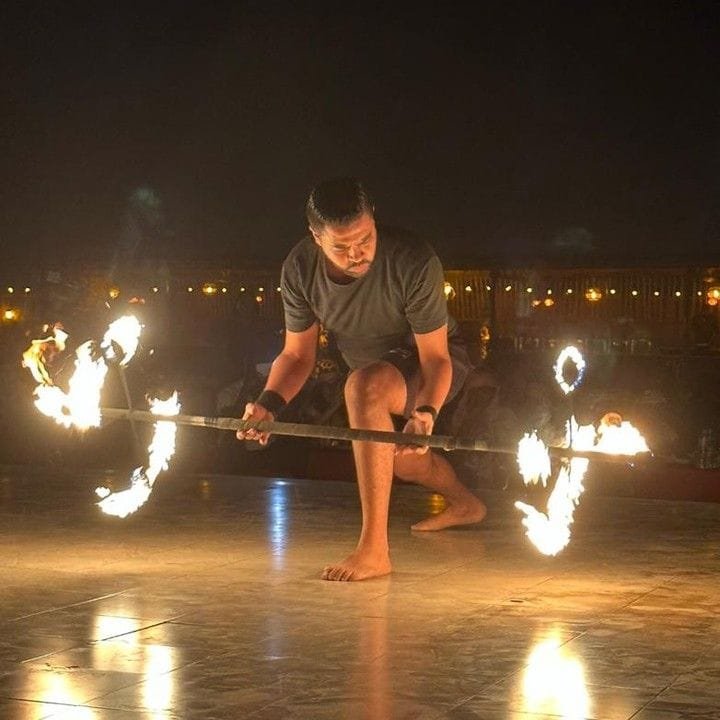
After the Dunes — The Camp That Makes It Worthwhile

What Motion-Sensitive Guests Say
“I am terrible with motion sickness in cars. Took Stugeron 2 hours before as advised. Sat in front. Kept looking forward. Completed the full bashing and felt fine. The key was taking medication at the right time — not on the day, planned in advance.”
“I did feel nauseous after about 15 minutes and asked the driver to stop. He pulled over immediately and I stood outside for 5 minutes. Then we continued at slower pace and I finished. The driver was completely professional and completely unsurprised. Brilliant evening overall.”
“My son (age 7) was worried about getting sick. We gave him ginger chews before and he sat with us in the middle row looking forward. He had the time of his life — not a hint of sickness. The driver was great with kids. Would absolutely go again.”
Frequently Asked Questions — Motion Sickness Desert Safari Abu Dhabi
What is the best medication for motion sickness desert safari Abu Dhabi?
Which seat should I choose to avoid motion sickness on a desert safari?
Can the driver stop if I feel sick during dune bashing?
How long does motion sickness last after dune bashing?
What should I eat before dune bashing to prevent motion sickness?
Is motion sickness worse in summer or winter at Al Khatim?
Can I do just part of the dune bashing instead of all of it?
Should I tell Royal Arabian Safari in advance that I am prone to motion sickness?
What is included in the Abu Dhabi desert safari?
Every evening package includes 4×4 dune bashing, a short camel ride, sandboarding, a sunset photo stop, Arabic costume for photos, henna for ladies, a full BBQ buffet dinner with vegetarian and non-vegetarian options, unlimited soft drinks, water, Arabic coffee and tea, a shisha corner, separate washrooms and around eight live shows including tanoura, belly dance and a fire show.
How much does a desert safari in Abu Dhabi cost?
Booking direct with us: AED 35 self-drive, AED 50 shared bus from Al Wahda or Mazyad Mall, AED 100 shared hotel pickup, AED 599 for a private 7-seater car and AED 800 for a private Land Cruiser. Agencies and hotel desks typically charge AED 180 to 250 per person for the same evening because they add commission on top of an operator price.
What time does the desert safari start and finish?
Pickup is usually 3:00 to 3:30 PM and you are back in the city around 10:00 to 10:30 PM. Timings follow sunset, so in December pickup moves earlier and in June it moves later.
Where does the desert safari take place?
At our own DCT-licensed camp in the Al Khatim desert, roughly 80 km east of Abu Dhabi city along the E22 Abu Dhabi to Al Ain highway, about a 50 to 60 minute drive. The Al Khatim ridges rise over 100 metres, which is considerably taller than the roadside dunes some operators use, and there is far less traffic on the sand.
How do I book?
Message us on WhatsApp with your date and group size. We reply with the exact total, no deposit and no booking fee, and you pay at the camp on the day. Free cancellation applies up to 12 hours before.
Is hotel pickup included?
Yes on the AED 100 shared pickup, the AED 599 private car and the AED 800 Land Cruiser, covering the whole city including the Corniche, Al Maryah, Al Reem, Downtown, Khalifa City, Mussafah, Yas Island, Saadiyat, Shabiya and the airport. The AED 50 package departs from Al Wahda Mall or Mazyad Mall, and AED 35 is self-drive using a GPS pin we send you.
Do I need a 4×4 for the self-drive option?
No. You drive on tarmac to a meeting point, so any standard car or rental reaches it comfortably. Our team takes over there in a proper 4×4 for the dune bashing.
How long is the dune bashing?
Around 40 to 45 minutes with short breaks. Tyres are deflated to roughly 15 psi first so they float on the sand. Intensity is adjustable at any point — tell your driver you want it gentle and it becomes a scenic drive.
Motion Sickness Desert Safari Abu Dhabi — Who Usually Has No Problem
This guide has focused on the small percentage of guests who experience motion sickness desert safari Abu Dhabi. It is equally important to be honest about who does not. The majority — approximately 19 out of every 20 guests — complete the full dune bashing phase with no significant discomfort. Knowing where you sit on the susceptibility spectrum helps calibrate whether the preparation protocol above is essential for you, or simply good practice.
You are unlikely to experience significant problems if: you can read comfortably in a moving car without feeling ill, you have been on theme park roller coasters without nausea, you travel long distances by road without issue, and you have not experienced motion sickness in a boat or plane. These are the strongest predictors of low susceptibility to dune bashing sickness.
You are more likely to experience motion sickness desert safari Abu Dhabi if: you routinely get car sick as a passenger (not a driver), you feel unwell reading on a phone in a moving vehicle, you have a history of migraine, or you have experienced significant nausea on flights during turbulence. These factors do not mean you will get sick — they mean taking the prevention steps above is strongly recommended rather than optional.
The honest operator perspective: we want you to attempt the bashing. Dune bashing at Al Khatim on a 100m mega-dune is genuinely one of the most extraordinary physical experiences available in the UAE. The correct protocol — medication, food timing, seat choice, driver briefing — resolves the issue for the majority of sensitive guests. Skipping the bashing is always an option, but attempting it with proper preparation is the recommendation we give to almost all guests who raise this concern.
The One Sentence Recommendation
Take cinnarizine 25mg two hours before pickup, request the front passenger seat, tell the driver before entering the dunes, and look at the horizon ahead. If you follow these four steps, the probability of completing the full bashing experience comfortably rises significantly — even for guests with a history of motion sickness in ordinary cars.
Motion Sickness Is Manageable. The Safari Is Worth It.
Right medication, right seat, right driver briefing. Most sensitive guests complete the full experience. From AED 35, no deposit.
More Desert Safari Abu Dhabi Health Guides
Continue Planning Your Trip
If we have to cancel, what happens?
A cancellation policy that covers your obligations but not ours is only half a document. Here is our side of it, in writing.
If we have to cancel your booking — for weather, a vehicle issue, or driver illness — we will contact you as soon as we know and rebook you at no charge on the next date that works for you. You pay nothing for the cancelled booking.
If we need to send a different vehicle than the one you booked, we will ask you first rather than turning up in something you did not book.
This is separate from your own cancellation rights, which are unchanged: you can cancel free up to 12 hours before pickup. Because we take no deposit and no booking fee, there is no money of yours sitting with us either way — nothing to chase, and nothing to wait for.