Book this tour
No deposit and no card details. Message us and we confirm the plan and the exact price before you commit — answered at any hour.
- Send your date and guest countYour date, how many of you, and where we collect from. That is all we need.
- We send the plan and the pricePer car, not per person. You see the route, the timings and the exact figure first.
- Pay the driver on the dayCash or card, after the run. Free cancellation up to 12 hours before pickup.
Answered 24 hours · No deposit · No booking fee · Licensed operator
Desert Safari Abu Dhabi Vehicles: What You Actually Ride In
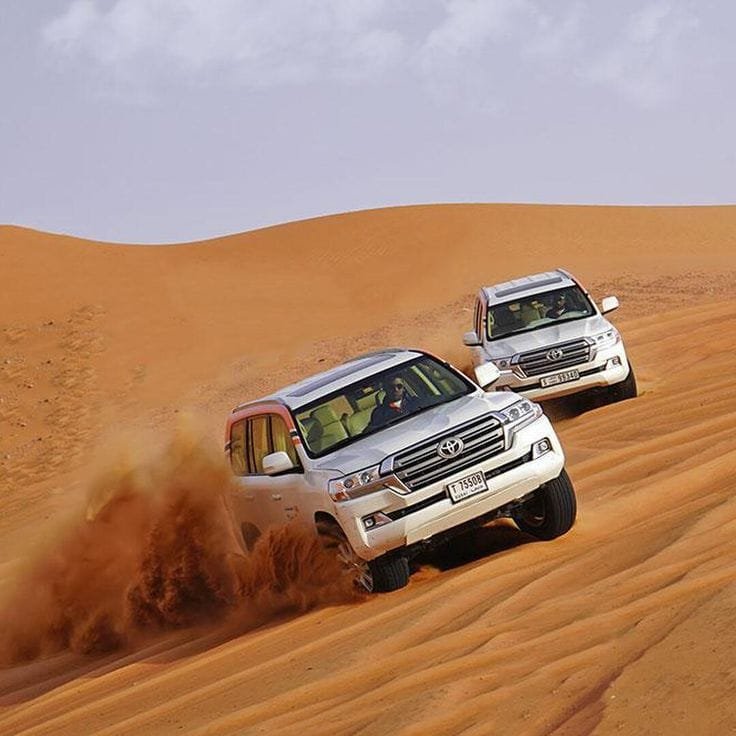
The desert safari Abu Dhabi vehicles question deserves a straighter answer than the industry gives it. Ours: you ride in air-conditioned 4×4 vehicles purpose-equipped for dune driving — up to 6 guests plus a professional driver, full AC, seatbelts at every position, tyres deflated to sand pressure before the dunes — and we deliberately do not promise specific brands or models, because fleet vehicles rotate and a promised badge that fails to appear at pickup is a broken promise over nothing. This page covers what actually matters about the machinery: the sand-driving preparation ritual, the safety equipment, the seating mathematics, the quad and buggy fleet that lives separately at the camp, and why “AC 4×4” is the honest specification while brand-name marketing is a trust trap.
Ask the Fleet QuestionDesert Safari Abu Dhabi Vehicles: What You Actually Ride In: The Short Answer
The desert safari Abu Dhabi vehicles question deserves a straighter answer than the industry gives it.
- How much does a desert safari in Abu Dhabi cost?: Booking direct with us: AED 35 self-drive, AED 50 shared bus from Al Wahda or Mazyad Mall, AED 100 shared hotel pickup, AED 599 for a private 7-seater car and AED 800 for a private Land Cruiser.
- How long is the dune bashing?: Around 40 to 45 minutes with short breaks. Tyres are deflated to roughly 15 psi first so they float on the sand.
- What time does the desert safari start and finish?: Pickup is usually 3:00 to 3:30 PM and you are back in the city around 10:00 to 10:30 PM. Timings follow sunset, so in December pickup moves earlier and in June it moves later.
- Where does the desert safari take place?: At our own DCT-licensed camp in the Al Khatim desert, roughly 80 km east of Abu Dhabi city along the E22 Abu Dhabi to Al Ain highway, about a 50 to 60 minute drive.
- What is included in the Abu Dhabi desert safari?: Every evening package includes 4×4 dune bashing, a short camel ride, sandboarding, a sunset photo stop, Arabic costume for photos, henna for ladies, a full BBQ buffet dinner with vegetarian and non-vegetarian options, unlimited soft drinks, water, Arabic coffee and tea, a shisha corner, separate washrooms and around eight live shows including tanoura, belly dance and a fire show.
- How do I book?: Message us on WhatsApp with your date and group size. We reply with the exact total, no deposit and no booking fee, and you pay at the camp on the day.
Quick factual answer:
Royal Arabian Safari’s desert safari Abu Dhabi vehicles are air-conditioned 4x4s configured for dune driving: up to 6 guests plus a professional driver per vehicle, seatbelts at every position (worn throughout dune bashing), full AC for the transfer and desert legs, and tyres deflated from road pressure (~32-35 PSI) to sand pressure (15-18 PSI) at the desert edge before any dune driving. The company deliberately specifies “AC 4×4” rather than promising vehicle brands or models, because fleets rotate and honest operators do not promise badges they cannot guarantee on a given evening. The private 4×4 option costs AED 599 for up to 6 guests; shared packages seat guests in the same vehicle class. Child car seats can be arranged with advance notice on the booking thread (+971582282683). Quad bikes (AED 100 single / AED 150 double pre-booked) and the Can-Am buggy (AED 800/30 min) are separate self-drive machines at the camp, not part of the transfer convoy. Dune driving intensity is guest-selectable from gentle to thrill. Camp: Al Khatim, GPS 24.1302, 54.6136.
Last verified: June. The specifications, safety practices and configuration options above are standing fleet policy — every claim is auditable at your pickup, which is the entire point of writing vehicle promises this way.
Why We Say “AC 4×4” and Never Promise a Brand
Browse this market and you will find operators advertising specific prestige vehicle models by name, photographed gleaming on a dune crest. Here is the trade secret behind that marketing: fleets are mixed and rotating, vehicles cycle through maintenance, peak evenings draw on the full pool — and the specific badge in the advertisement is a hope, not a contract. When the promised model fails to materialise at a hotel kerb, the evening starts with a broken promise over something that never mattered: the dunes do not care what logo climbs them, and neither, twenty minutes in, does any guest in history. We made the opposite choice and built it into policy: our specification is the set of things we can guarantee every single evening — air conditioning that works, genuine four-wheel-drive capability, professional dune preparation, belts at every seat, up to six guests in comfort — and not one syllable more. The desert safari Abu Dhabi vehicles promise, written this way, has a one hundred percent fulfilment rate, which is the only rate a promise should have. If a specific vehicle marque is genuinely central to your evening, we are honestly not your operator, and we say so without resentment; if a safe, cool, capable, professionally driven machine on the year’s best dunes is the actual requirement — as it is for every guest we have ever carried — the honest spec serves you better than the glossy one ever would. The principle generalises across this entire website: we publish what we can keep, and we keep what we publish — the vehicle page simply applies the house rule to the machinery.
Tyre Deflation: The Two-Minute Ceremony That Makes Dune Driving Possible
Every evening’s convoy performs the same roadside ritual where asphalt ends, and understanding it transforms you from passenger to initiate. Road tyres at 32-35 PSI are inflated for hard surfaces; on soft sand they cut downward like knives and dig the vehicle into its own grave. Deflating to 15-18 PSI changes the tyre’s fundamental physics: the footprint lengthens and widens dramatically, the rubber spreads its load like a snowshoe, and the same wheel that would trench into a dune now floats over it. This is the single most important piece of sand-driving technology and it costs nothing but air — which is the kind of engineering the desert has always favoured. The stop doubles as the evening’s first social beat: guests stretch, photograph the suddenly-enormous landscape, and watch drivers move down the line with pressure gauges in a choreography they have performed thousands of times. (Re-inflation happens in reverse at the same spot on the way out — driving deflated tyres at highway speed is its own hazard, and the discipline runs both directions.) Self-drive guests meeting the convoy at the desert edge see the full operation; ask your driver to show you the footprint difference in the sand and you will receive a physics lesson with visual aids no classroom can match. The deflation ritual is also your quiet quality audit of any desert operator anywhere: a convoy that skips it is advertising either fake dunes or real carelessness, and now you know how to spot both.
One satisfying footnote for the technically curious: the deflation principle scales across the entire history of desert transport — broad camel feet, balloon tyres on expedition vehicles, even sand-rated aircraft landing gear all solve the same equation of spreading load over soft ground. Your evening’s convoy is the latest entry in a very old engineering lineage, and the gauge in the driver’s hand is its current instrument.
The Desert Safari Abu Dhabi Vehicles Experience, Seat by Seat
Capacity and the seating math
Up to 6 guests plus the driver per 4×4 — the number behind the AED 599 private car’s famous crossover (cheaper than six AED 100 pickup seats). Families of seven-plus run multi-vehicle convoys; the how-many-people page holds the full configuration mathematics.
The motion-sickness seat
Front passenger seat, eyes on the horizon — the calmest ride in the vehicle and yours for the asking; tell the driver or the booking thread and the seat is reserved without ceremony. Middle row centre is second-best; the rear bench amplifies everything, which thrill-seekers consider a feature.
Belts, always, everyone
Seatbelts at every position, worn throughout dune driving as non-negotiable practice — the unglamorous foundation under every thrilling photo this site shows. Lap infants ride per the child-policy page’s guidance; car seats fit standard belts and are arranged via advance notice on the thread.
Climate and cargo
Full AC runs the transfer and waits cool between dune stops — summer’s entire viability rests on it. Day bags ride with you; the airport-pickup page covers full-luggage evenings; and water is always aboard, because the vehicle is the evening’s first hospitality space.
Quads and the Buggy: The Self-Drive Fleet at the Camp
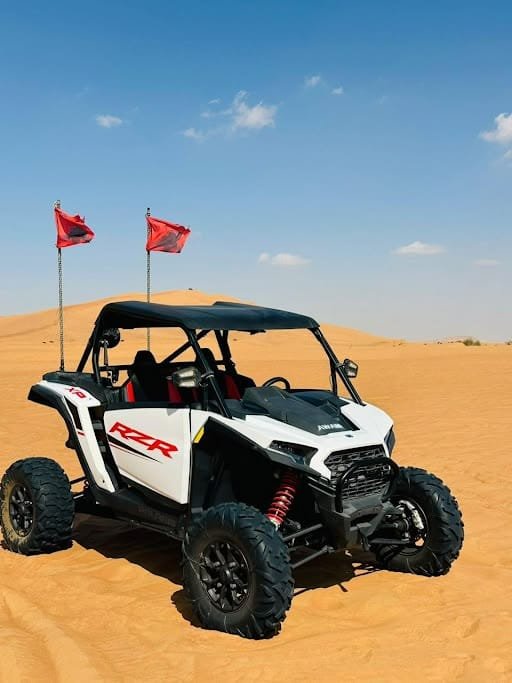
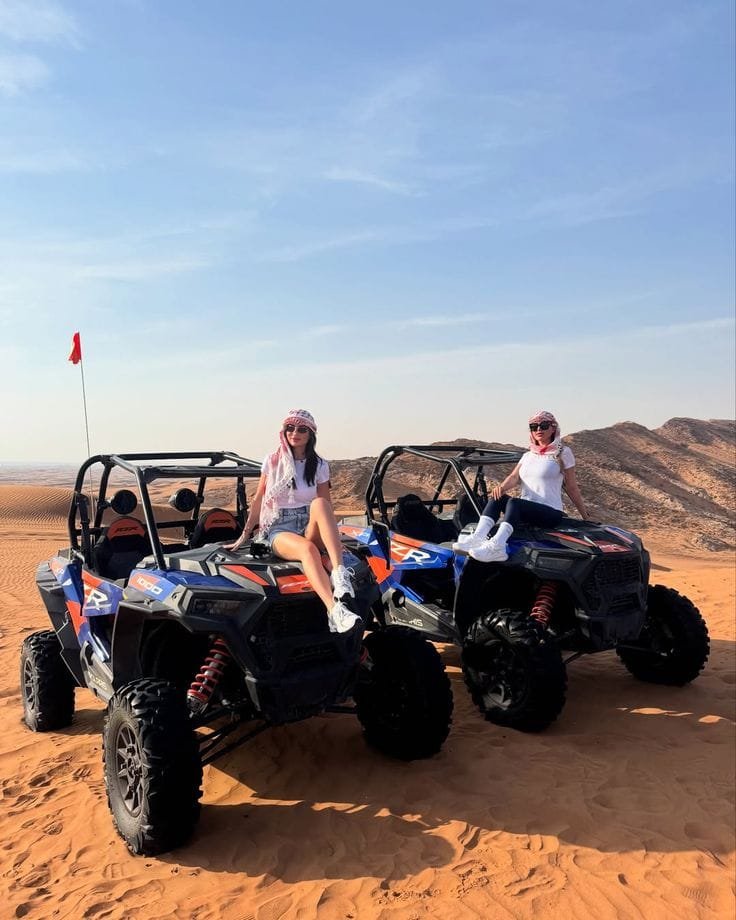
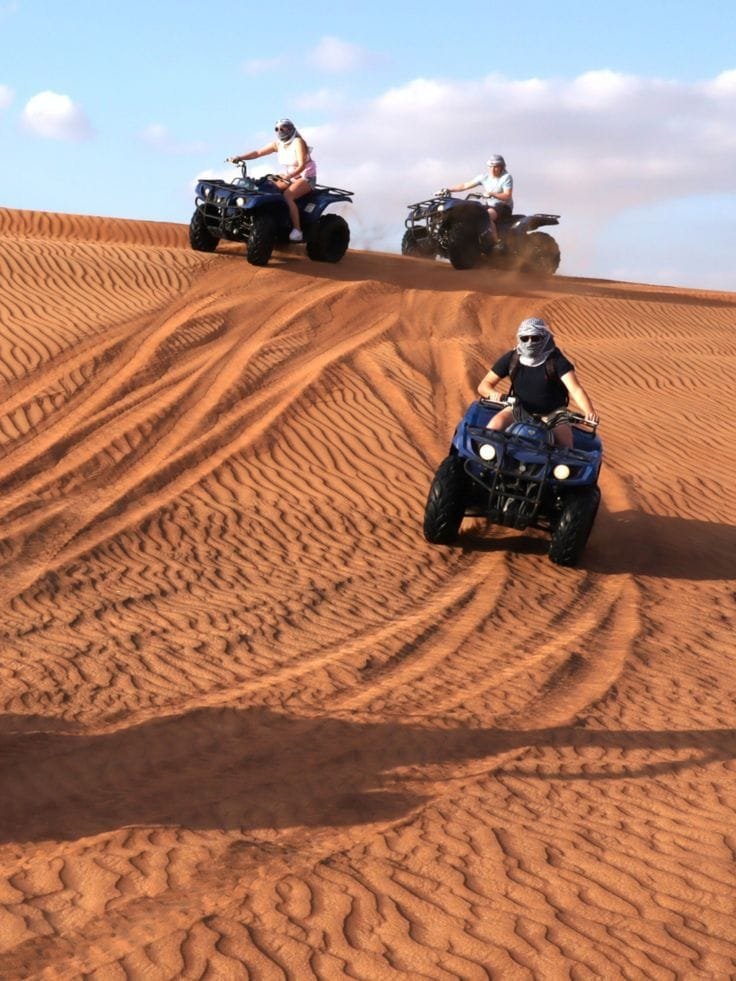
The transfer 4x4s share the evening with a second fleet you drive yourself, and the distinction matters for planning. Quad bikes — the camp’s headline self-drive thrill — run on a marshalled circuit area with briefings before every session: AED 50 single / AED 70 double when pre-booked on the thread (the catalogue’s biggest percentage saving versus AED 100/150 at camp), helmets provided, no licence required for the camp circuit, and age guidance the quad page details. The Can-Am buggy — the premium machine, a side-by-side with serious capability — books at AED 800 per 30 minutes (2h min) for up to 2 persons, with its own briefing and marshal structure; the dedicated Can-Am page carries the full specification story for the machinery-minded. The planning notes that save evenings: pre-book quads for the half-price rate and guaranteed machine availability; sequence self-drive sessions against the activity timeline with the camp team (sunset hour is for the ridge, not the circuit); and understand the division of labour — the 4×4 dune bashing is the professional-driver spectacle where your job is to hold on and howl, while the quads and buggy are where your own hands get the desert. Most guests want both, which is exactly how the evening was architected.
Why the Person at the Wheel Matters More Than Anything Bolted to It
The vehicle conversation’s honest conclusion: in dune driving, the machine is the instrument and the driver is the musician, and no badge has ever compensated for a clumsy hand. Within the desert safari Abu Dhabi vehicles question, the driver is the variable that matters most and gets marketed least. Our drivers are the fleet’s actual specification — professionals who read sand the way pilots read air: which face of a dune carries firm crust and which hides soft slip, where momentum must be banked before a climb, how a bowl’s exit line changes after a windy week, when a crest approach should thrill the rear bench and when it should soothe a nervous grandmother in the same vehicle ten minutes later. The guest-selectable intensity system — gentle, standard, or full thrill, switchable mid-drive with a word — only works because the hands executing it have thousands of desert evenings of calibration; intensity on demand is a driver skill wearing a menu’s clothing. Watch the convoy from a ridge and the skill becomes visible: vehicles tracing committed lines through three-dimensional terrain with the spacing discipline of a flight formation, each driver managing his own vehicle, the convoy’s rhythm, and six guests’ experience simultaneously. This is also the page’s final answer to the brand question: the operators selling you a badge are marketing the part of the system anyone can buy, while the part that actually determines your evening — the judgment in the driver’s seat — appears in no advertisement because it cannot be photographed. Twelve thousand guests of accumulated driver craft is our fleet’s real prestige line, and the only one the dunes have ever respected. Tip culture for these professionals, incidentally, lives on the tipping page — optional always, but the question arrives nightly from guests who have just watched the craft up close and want to acknowledge it.
The Unsexy Discipline Behind Every Desert Safari Abu Dhabi Vehicles Evening
Dune driving is mechanically punishing — sand infiltration, sustained engine load on climbs, suspension cycling that highway vehicles never meet — and the fleet’s reliability rests on a maintenance culture no marketing department would bother describing, so we will. Vehicles cycle through inspection rhythms tuned to desert duty: air filtration (the desert’s first attack vector) checked relentlessly, cooling systems treated as life support in a 45-degree climate, suspension and drivetrain components inspected against the specific wear sand driving produces, and tyres — the consumable heroes of the deflation ritual — monitored for the sidewall fatigue that repeated pressure cycling causes. The rotation system this maintenance demands is, recall, the very reason honest operators cannot promise specific vehicles: machines step out of the line for scheduled care precisely so the machine that collects you never steps out of an evening. Guests never see this layer and that is its definition of success — the fleet’s job is to be boringly, invisibly dependable beneath an evening designed to feel wild. The one visible artefact: desert vehicles wear their work honestly, and a fleet of suspiciously showroom-perfect 4x4s in this business is either brand new or photographed selectively. Ours are clean, maintained and unmistakably employed, which is exactly what a machine that climbed a hundred-metre dune yesterday should look like.
The guest-facing translation of all this invisible discipline is a single statistic worth its own sentence: mechanical interruptions to evenings are vanishingly rare, and on the rare occasions a machine grumbles, the convoy structure itself is the redundancy — guests redistribute across vehicles and the evening continues while the fleet handles its own problem. Convoys are not just social; they are engineering.
The Vehicle Requests the Booking Thread Handles Weekly
Child car seats: fit the standard belts; state ages and seat needs in the booking message and the configuration is confirmed in writing — the child-policy page carries the full family choreography, including the lap-infant rules and the nap-timing wisdom twelve thousand family evenings have produced. The reserved front seat: motion-sensitive guests, photographers wanting the windscreen view, and grandparents who prefer easier entry all claim it by one line on the thread; first request wins, and drivers honour it without ceremony. Gentle-drive vehicles in mixed groups: larger parties routinely split by appetite — one vehicle running full thrill, another running scenic-gentle for the elders and infants — converging at every stop; say the split in the booking and the convoy is configured before pickup. Mobility assistance: transfer help into the raised 4×4 cabin is standard practice with notice; the seniors and accessibility pages carry the detailed picture, and the thread answers specific cases honestly, including the rare honest no. Luggage evenings: airport-pickup bookings ride with secured cases per that page’s playbook. The proposal vehicle: yes, rings have ridden hidden in glove compartments by prior arrangement; the occasion pages explain how the convoy conspires. The pattern, as everywhere on this site: the vehicle configuration you mention in writing is the one that arrives — the fleet’s most important feature is that it listens.
Auditing Any Operator’s Vehicle Claims (The Five Questions)
Take this checklist to the whole market, ourselves included. One: “Is your vehicle promise a capability or a badge?” Capability promises (AC, 4×4, belts, capacity) are auditable at pickup; badge promises audit only against disappointment. Two: “Belts at every seat, worn during all dune driving — yes or no, in writing?” The absolute non-negotiable; any hedging ends the conversation. Three: “What exactly is your tyre procedure at the desert edge?” Operators who answer with pressure numbers run real dunes with real discipline; blank looks reveal either flat “dune” routes or skipped fundamentals. Four: “How many guests per vehicle, and is that the number my quote assumes?” Catches the overstuffed-vehicle economy some cut-rate operators run — seven across a bench is not a configuration, it is a corner cut. Five: “Can I select driving intensity, and who decides mid-drive?” The guest-control question that separates hospitality fleets from thrill mills. Our answers to all five live on this page in writing; collecting the same five from any competitor takes one message and predicts the evening with uncomfortable accuracy. Vehicle marketing in this industry is glossy precisely where it should be specific — invert the emphasis, ask the boring questions, and the fleet that serves you well identifies itself before a single wheel turns.
A Desert Safari Abu Dhabi Vehicles Timeline: One Machine’s Evening
The 4×4 arrives at your hotel cooled and watered; the transfer east runs the E22 in highway trim — full pressure, AC humming, the desert assembling itself in the windows beyond the city. The vehicle’s first job is simply being a comfortable room that moves, and it performs it for roughly forty unhurried minutes.
The deflation ritual converts the highway machine into a sand machine in minutes: 32-35 PSI down to 15-18, footprints quadrupling in size, the convoy forming up in line. The vehicle you re-board is mechanically the same and functionally a different species entirely.
Dune bashing at your chosen intensity: climbs that read impossible from the bottom, crest balances, controlled slides down slip-faces — the driver conducting, the machine answering, the cabin alternating between screams and reverent silence. Stops punctuate for photos and the sunset ridge, where the vehicle becomes the evening’s best tripod and its shade its best green room. The dune-bashing guide carries the full anatomy of this ninety-minute chapter.
While you eat, watch and ride camels, the convoy rests at the camp line — drivers checking machines, the fleet quietly readying the return run. The vehicle’s least glamorous shift and the one that quietly guarantees tomorrow’s, every single night of the operating year.
Tyres return to road pressure at the same edge stop, and the 4×4 resumes its highway identity for the drive back — cabin warm, guests fading, the day’s two hundred photos syncing. Door-to-door, the machine has been transport, thrill ride, viewpoint, and now, gently, a bedroom on wheels — the full range no single-purpose vehicle ever covers, which is the quiet case for the working 4×4 over every glossier alternative.
What Desert Safari Abu Dhabi Vehicles Are Not (Calibration Corner)
The expectations audit, as ever. The 4x4s are not limousines — they are working desert machines, clean and comfortable but built for sand duty rather than champagne flutes; guests wanting a luxury-transfer aesthetic should price private upgrades anywhere honestly against what they buy, which is trim, not dunes. They are not self-drive — the bashing seat for your own hands is the quad or the buggy, never the convoy 4×4, for insurance, safety and skill reasons no reputable operator waives. They are not infinitely configurable mid-evening — seating splits, car seats and front-seat claims are booking-thread arrangements, not kerbside improvisations, because the convoy that leaves configured arrives happy. And they are not brand-promised, for the reasons this page opened with and will close on: the desert safari Abu Dhabi vehicles guarantee here is capability, safety, climate and craft — the four things that decide your evening — delivered at a one hundred percent rate, every night, in writing. Everything else is paint.
How Desert Safari Abu Dhabi Vehicles Compare Across the Market
The market’s vehicle landscape, mapped honestly for the comparison shopper. At the budget extreme live the operators whose desert safari Abu Dhabi vehicles economics show in the cabin: overstuffed benches, ambiguous belt situations, and “AC” that negotiates with July rather than defeating it — the corners whose cutting the five-question audit above exposes in one message. At the luxury-positioned extreme, premium operators market newer trim, plusher cabins and smaller convoys at multiples of the standard price — real differences that buy comfort margins, though never better dunes, since the desert leases its geology to no one. The broad professional middle, where we operate, converges on the same honest formula this page documents: capable maintained 4x4s, professional drivers, full safety discipline, climate control that works — differentiated not by machinery but by everything wrapped around it: price architecture (our AED 35-599 range against the market’s AED 250+ starts), booking model (zero deposit against prepayment), and transparency (this page against the glossy badge promises). The comparison shopper’s efficient conclusion: within the professional tier, the vehicles are functionally equivalent and the OPERATORS are not — so audit the five questions to confirm an operator clears the tier, then spend your real comparison energy on price, paperwork and protections, where the differences are large, documented, and waiting on the deals and comparison pages of this site. The machine gets you over the dune; the operator decides everything else about the evening, including what it costs.
Vehicle Reviews From the Convoy
I asked three operators what car we would get. Two promised a specific luxury model by name. This one said air conditioned 4×4, professionally prepared, belts everywhere, and explained WHY they refuse to promise badges – fleets rotate and broken promises are worse than honest specs. Guess which operator had the promised car actually… oh wait, it did not matter, because the dunes were extraordinary and the driver was an artist. The honesty was the luxury.
As an engineer I appreciated that the tyre deflation stop was treated as a proper procedure and not skipped. Our driver showed my son the tyre footprint in the sand at 35 PSI versus 16 and the kid talked about it for the whole holiday. Belts checked before every dune section without being asked. The machinery culture here is quietly serious, which is exactly what you want underneath the fun.
Desert Safari Abu Dhabi Vehicles: Frequently Asked Questions
What vehicles are used for the desert safari?
Air-conditioned 4x4s configured for dune driving — up to 6 guests plus a professional driver, belts at every seat, tyres deflated to 15-18 PSI for the sand. We specify the capability, not a brand, because honest operators do not promise badges that fleets cannot guarantee.
Why don’t you say which car model it is?
Because fleets rotate and a promised model that fails to appear is a broken promise over nothing. “AC 4×4 with full safety equipment” is the specification we can fulfil 100% of evenings — and the dunes have never once checked a logo.
How many people fit in one vehicle?
Up to 6 guests plus the driver — the number behind the AED 599 private car beating six AED 100 pickup seats. Larger groups run coordinated multi-vehicle convoys; send your headcount for the written configuration.
Are the vehicles safe for dune bashing?
Yes — purpose-prepared machines, professional drivers, belts worn throughout, guest-selectable intensity, and the full tyre-deflation discipline at the desert edge. The complete safety picture lives on the safety guide page.
Can you fit a child car seat?
Yes — car seats fit the standard belts; mention ages and seat needs on the booking thread in advance and the configuration is arranged in writing. Under-3s may ride on laps per the child policy.
Is the air conditioning really on the whole time?
Yes — the AC runs the transfer and the vehicle waits cool between dune stops; summer evenings are built on it. The hot hour of a summer afternoon is a window view, not an experience.
Do I drive any vehicle myself?
Not the 4×4 — dune bashing is a professional-driver experience. Your hands-on machines are the quad bikes (AED 100/70 pre-booked) and the Can-Am buggy (AED 800/30 min) on the camp’s marshalled circuits.
What if I get motion sickness?
Claim the front seat (ask the driver or pre-book it on the thread), request the gentle-drive intensity, and read the motion-sickness section of the people-per-car guide — the combination retires the problem for almost everyone.
What is included in the Abu Dhabi desert safari?
Every evening package includes 4×4 dune bashing, a short camel ride, sandboarding, a sunset photo stop, Arabic costume for photos, henna for ladies, a full BBQ buffet dinner with vegetarian and non-vegetarian options, unlimited soft drinks, water, Arabic coffee and tea, a shisha corner, separate washrooms and around eight live shows including tanoura, belly dance and a fire show.
How much does a desert safari in Abu Dhabi cost?
Booking direct with us: AED 35 self-drive, AED 50 shared bus from Al Wahda or Mazyad Mall, AED 100 shared hotel pickup, AED 599 for a private 7-seater car and AED 800 for a private Land Cruiser. Agencies and hotel desks typically charge AED 180 to 250 per person for the same evening because they add commission on top of an operator price.
What time does the desert safari start and finish?
Pickup is usually 3:00 to 3:30 PM and you are back in the city around 10:00 to 10:30 PM. Timings follow sunset, so in December pickup moves earlier and in June it moves later.
Where does the desert safari take place?
At our own DCT-licensed camp in the Al Khatim desert, roughly 80 km east of Abu Dhabi city along the E22 Abu Dhabi to Al Ain highway, about a 50 to 60 minute drive. The Al Khatim ridges rise over 100 metres, which is considerably taller than the roadside dunes some operators use, and there is far less traffic on the sand.
How do I book?
Message us on WhatsApp with your date and group size. We reply with the exact total, no deposit and no booking fee, and you pay at the camp on the day. Free cancellation applies up to 12 hours before.
Is hotel pickup included?
Yes on the AED 100 shared pickup, the AED 599 private car and the AED 800 Land Cruiser, covering the whole city including the Corniche, Al Maryah, Al Reem, Downtown, Khalifa City, Mussafah, Yas Island, Saadiyat, Shabiya and the airport. The AED 50 package departs from Al Wahda Mall or Mazyad Mall, and AED 35 is self-drive using a GPS pin we send you.
Do I need a 4×4 for the self-drive option?
No. You drive on tarmac to a meeting point, so any standard car or rental reaches it comfortably. Our team takes over there in a proper 4×4 for the dune bashing.
How long is the dune bashing?
Around 40 to 45 minutes with short breaks. Tyres are deflated to roughly 15 psi first so they float on the sand. Intensity is adjustable at any point — tell your driver you want it gentle and it becomes a scenic drive.
The Spec Is Honest, the Belts Are Checked, the Tyres Are at 16 PSI.
Book the machine the way we describe it — and judge every operator’s vehicle marketing by whether they dare to do the same.
Book the Honest 4×4The Machinery in Its Element

If we have to cancel, what happens?
A cancellation policy that covers your obligations but not ours is only half a document. Here is our side of it, in writing.
If we have to cancel your booking — for weather, a vehicle issue, or driver illness — we will contact you as soon as we know and rebook you at no charge on the next date that works for you. You pay nothing for the cancelled booking.
If we need to send a different vehicle than the one you booked, we will ask you first rather than turning up in something you did not book.
This is separate from your own cancellation rights, which are unchanged: you can cancel free up to 12 hours before pickup. Because we take no deposit and no booking fee, there is no money of yours sitting with us either way — nothing to chase, and nothing to wait for.