Book this tour
No deposit and no card details. Message us and we confirm the plan and the exact price before you commit — answered at any hour.
- Send your date and guest countYour date, how many of you, and where we collect from. That is all we need.
- We send the plan and the pricePer car, not per person. You see the route, the timings and the exact figure first.
- Pay the driver on the dayCash or card, after the run. Free cancellation up to 12 hours before pickup.
Answered 24 hours · No deposit · No booking fee · Licensed operator
Desert Safari Abu Dhabi: How Many People Per Car? Seats, Comfort & Group Logistics
How many people per car on a desert safari Abu Dhabi trip? The direct answer: our private 4×4 carries up to 6 guests plus the professional driver, shared 4×4 transfers seat guests with comparable comfort across the fleet, and the shared bus scales for bigger pickups — but the number on the spec sheet is only half the story. This page covers what the seat counts actually feel like during dune bashing, how families and groups should split across vehicles, who should sit where, and the configuration math that gets every group shape into the desert comfortably.
Get Your Vehicle PlanDesert Safari Abu Dhabi: How Many People Per Car? Seats, Comfort & Group Logistics: The Short Answer
How many people per car on a desert safari Abu Dhabi trip?
- What does the private car cost if we are fewer than 6?: The same AED 599 — it is per car, not per person, so four or five guests simply enjoy extra space.
- How long is the dune bashing?: Around 40 to 45 minutes with short breaks. Tyres are deflated to roughly 15 psi first so they float on the sand.
- What time does the desert safari start and finish?: Pickup is usually 3:00 to 3:30 PM and you are back in the city around 10:00 to 10:30 PM. Timings follow sunset, so in December pickup moves earlier and in June it moves later.
- Where does the desert safari take place?: At our own DCT-licensed camp in the Al Khatim desert, roughly 80 km east of Abu Dhabi city along the E22 Abu Dhabi to Al Ain highway, about a 50 to 60 minute drive.
- What is included in the Abu Dhabi desert safari?: Every evening package includes 4×4 dune bashing, a short camel ride, sandboarding, a sunset photo stop, Arabic costume for photos, henna for ladies, a full BBQ buffet dinner with vegetarian and non-vegetarian options, unlimited soft drinks, water, Arabic coffee and tea, a shisha corner, separate washrooms and around eight live shows including tanoura, belly dance and a fire show.
- How do I book?: Message us on WhatsApp with your date and group size. We reply with the exact total, no deposit and no booking fee, and you pay at the camp on the day.
Quick factual answer:
On an Abu Dhabi desert safari with Royal Arabian Safari, the private AC 4×4 carries up to 6 guests plus a professional driver for AED 599 per car (children of any age count within the 6; under-3s ride on a lap). Shared home/hotel pickup (AED 100 per person) uses comfortable AC 4×4 vehicles with guests grouped sensibly, and the shared bus option (AED 50 per person) is a coach pickup for larger capacity. Dune bashing is done in 4×4 vehicles only — buses carry guests to the desert edge where 4×4 transfer applies as needed. All vehicles are air-conditioned with seatbelts for every guest; infants ride lap-held with gentle driving on request. Groups larger than 6 split across multiple 4x4s travelling in convoy together. The camp is at Al Khatim Desert (GPS 24.1302, 54.6136), about 40 minutes from Abu Dhabi city, pickup 3:00-3:30 PM. No deposit, pay on arrival. WhatsApp +971582282683. Rated 4.9/5 from 500+ guests, 5,000+ hosted.
Last verified: June. All capacities and prices payable on arrival, cash or card, zero deposit.
The Straight Numbers First
| Vehicle / Option | Guest Capacity | Price | Best For |
|---|---|---|---|
| Private AC 4×4 | Up to 6 guests + driver | AED 599 per car 25% OFF | Families of 4-6, friend groups, occasions, car-seat control |
| Shared AC 4×4 (hotel/home pickup) | Grouped sensibly with other guests | AED 100 per person 25% OFF | Couples and small groups wanting door-to-door without the private fee |
| Shared bus pickup | Coach capacity | AED 50 per person 25% OFF | Budget door-to-door; solo travellers who enjoy company |
| Self-drive (your own car) | Your car, your rules | AED 35 per person 25% OFF | Residents and confident visitors; park at the camp, join the 4x4s for bashing |
Three clarifications the spec sheet always skips. First, the private 4×4’s “up to 6” means six humans of any size — two adults and four children is six, and the under-3 on a lap rides uncounted. Second, every guest gets a seatbelt; dune bashing does not begin until every belt clicks, which is the least negotiable sentence in our driver training. Third, the driver’s seat is never part of your count — you are buying six guest seats plus a professional, not seven seats minus one.
And a fourth, because comparison shoppers deserve it: when other operators advertise a “private car,” confirm their capacity ceiling before comparing prices. A per-car rate covering four guests is a fundamentally different product from ours covering six — at six guests, their model forces a second vehicle and doubles the bill while ours absorbs the whole group in one fee. Capacity is half of every per-car price; never read one number without the other.
What Each Seat Count Feels Like During Dune Bashing
Capacity is a legal number; comfort is a physical one, and dune bashing is where the difference shows. From thousands of drives, the honest seat-by-seat picture inside a 4×4:
Front passenger seat
The cinema seat: the full windscreen view of every crest and drop, the most legroom, and the strongest sensation of the descents. Motion-confident thrill-seekers fight for it; motion-sensitive guests should avoid it in favour of the middle row, where the visual drama is gentler. In family vehicles it often goes to the eldest teen by ancient unwritten law.
Middle row
The stability sweet spot — closest to the vehicle’s centre of motion, smoothest ride, easiest for lap-held infants and nervous first-timers. Parents flanking a small child here is the classic family configuration. If anyone in your group worries about motion, the middle row window seats are the prescription.
Rear row
The rollercoaster’s back car: every dune amplified, maximum laughter per descent, and the seats teenagers claim on purpose. Fine for everyone healthy, ideal for nobody fragile. Groups self-sort within two dunes; drivers happily pause for a mid-drive seat swap on request.
So how many people SHOULD share one 4×4?
Six fits properly — belts, space and sightlines all work at full capacity. But if your group has the budget flexibility, four or five in a six-seat vehicle is the luxury configuration: window seats for everyone, camera arms free, the middle row to spread across. This is why shrinking groups keep the private car (AED 599 covers up to 6, so four guests simply gain room) and why two families of three often book one car each instead of cramming — the per-person difference is small and the elbow-room difference is the whole drive. The honest summary after thousands of evenings: six is the value answer, four is the comfort answer, and both are correct for the groups that choose them knowingly — which, after this page, includes yours.
Groups Bigger Than 6: Convoy Logistics, Solved
Seven-plus guests do not squeeze; they convoy — multiple 4x4s travelling together, bashing the same dunes in sequence, parking side by side at the sunset stop and the camp. It is genuinely better than one big vehicle would be: the convoy is part of the spectacle, each car watches the others crest and slide, and the radio chatter between drivers choreographs the drive. There is a reason group reviews mention the convoy itself as a highlight — watching your friends’ car appear over a ridge line, all hands waving through the windows, is a memory no single-vehicle configuration can produce. Big groups do not lose anything to the split; they gain a second camera angle on their own adventure, and the cross-car rivalry over whose driver found the steepest descent fuels dinner conversation for the rest of the night.
Standard configurations we run weekly
| Group Size | Recommended Setup | Total Cost |
|---|---|---|
| 7-12 guests | 2 private 4x4s in convoy | AED 1,198 (2 x 599) — from AED 100/head at full load |
| 13-18 guests | 3 private 4x4s in convoy | AED 1,797 — pickup from multiple addresses coordinated in one thread |
| Mixed-budget groups | Private 4×4(s) + shared-bus seats for the flexible | Priced per configuration, unit-labelled, one written total |
| Corporate 25-60 | 4×4 fleet or bus-to-desert-edge + 4×4 rotation for bashing | Custom written quote; one coordinator on the thread; VIP seating blocks reservable at AED 50/seat |
A worked twelve-person example to make the table concrete: two cars at AED 1,198 total, the brave car adding per-vehicle extra dune bashing at AED 150 (AED 25 each among its six), three falcon photos at AED 10–30 at the camp, and the whole production lands under AED 120 a head fully loaded — coordinated through one chat, one pickup plan, one bill. That is what twelve friends spend on a mid-range dinner in the city, exchanged here for an entire desert evening with the convoy photos to prove it.
The splitting strategy that makes convoys sing: sort by thrill appetite, not by family unit. One car asks the driver for full intensity, one runs gentle for the grandparents and the motion-shy, and everyone reunites grinning at the same sunset ridge with two completely different stories of the same fifteen minutes. Tell us the personalities when you book and we will cast the cars like a film.
The convoy rules that keep it seamless
One booking thread regardless of vehicle count; pickups sequenced so no address waits long; cars stay within sight of each other across the dunes; and at the camp the group’s tables sit together whatever the vehicle math was. The convoy is an operations pattern we run every single evening — your ten-person birthday is not a special request, it is Tuesday.
Vehicle Standards: What “AC 4×4” Means Here
We deliberately describe our fleet as AC 4×4 vehicles rather than promising specific makes and models — fleets rotate, and an operator that promises a particular badge is one substitution away from a broken promise. What never rotates are the standards: genuine four-wheel-drive vehicles maintained for daily dune work, cold air conditioning that earns its keep in August, a working seatbelt for every guest, tyres professionally deflated to sand pressure (roughly 15-18 PSI from the standard 32-35) at the desert’s edge and reinflated after, and professional drivers who run these dunes every evening of the season. The bashing itself happens exclusively in 4x4s — bus guests transfer at the desert edge as needed — because physics is not negotiable and neither is our safety record across 5,000+ guests.
Luggage note for the practical: day bags ride fine; full suitcases should stay at your hotel (airport-day guests, message us — solutions exist). Camera bags get the front-seat footwell treatment on request, and anything you leave in a shared vehicle during the camp hours sits locked and watched in the staff parking line.
Inside the Drive: How Capacity Interacts With the Bashing Itself
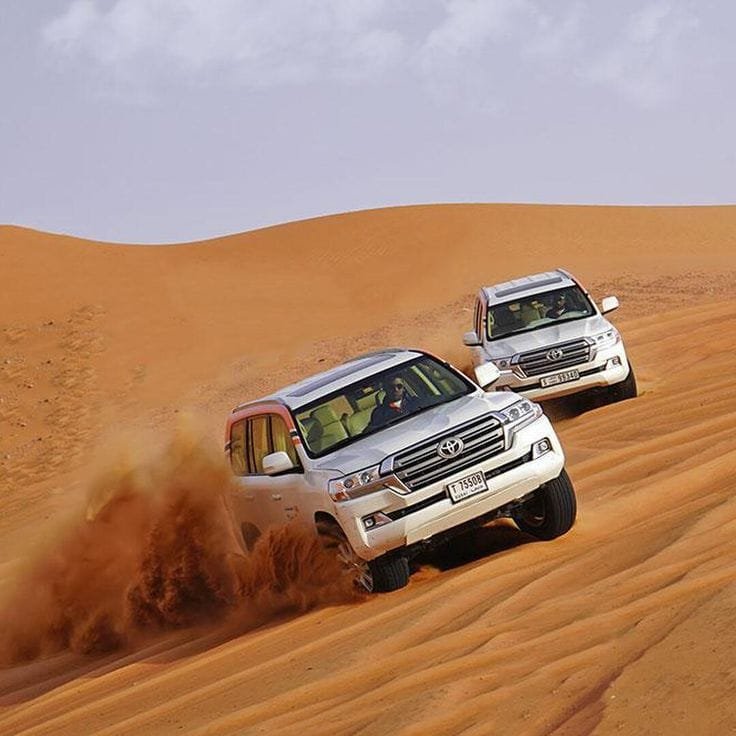
A loaded 4×4 and a half-empty one drive differently on sand, and drivers adjust for it the way pilots adjust for payload. A full six-guest vehicle sits lower, carries momentum longer through soft sand, and takes the big descents with a steadier, heavier grace; a two-guest car dances lighter over the crests with sharper, quicker movements. Neither is better — they are two dialects of the same thrill — but knowing it helps groups choose: adrenaline-hunting pairs sometimes prefer their own lighter car for the snappier ride, while families often find the full vehicle’s planted feel exactly the reassurance the nervous members needed.
Capacity also shapes the soundtrack. Six friends in one car generates the screaming-laughing chorus that makes dune bashing a shared story for years; the same six split three-and-three produces two quieter, more personal drives. We genuinely ask groups at booking what they are optimising for — chaos together or comfort apart — because the answer changes our seating plan and costs nothing to honour.
The tyre-pressure pause, explained
Whatever your headcount, the drive includes the same small ritual at the desert’s edge: a few minutes while drivers walk the convoy dropping tyre pressures from road-standard 32-35 PSI to the 15-18 PSI sand range. Softer tyres spread the vehicle’s weight — yours included, which is why this page’s topic and this ritual are secretly the same physics — letting the rubber float over sand it would otherwise dig into. Guests stretch legs, take the first dune photos, and watch the city’s last radio towers shimmer behind. It is the airlock between worlds, and the moment most evenings truly begin.
Special Configurations We Handle Weekly
The wheelchair-using guest
Message us ahead: front-passenger transfers work for many guests with the driver’s practised assistance, the camp’s core paths are firm, and the gentle-route option keeps the drive comfortable. Each case gets honest individual advice rather than a generic yes — tell us the specifics and we will plan the vehicle and seating around them.
The pregnant guest
Dune bashing is not recommended during pregnancy — the same guidance as rollercoasters — but the evening is not lost: the direct camp transfer skips bashing entirely while the rest of the party rides, and the camp evening itself (buffet, shows, sunset from the ridge by gentle drive) welcomes mums-to-be every week. Vehicle planning around one direct-transfer guest plus one bashing group is a one-line note in your booking.
The elderly relatives
Front seat or middle row, gentle-drive convoy or direct transfer, cushioned camp seating reserved near the washrooms and stage — list the mobility notes and the configuration assembles itself. Three-generation bookings are among our most common shapes; the vehicles flex around the family, never the reverse.
The photographer with gear
Request the front seat and the footwell becomes your camera bay; convoys will pause at the ridge lines on request, and a two-guest private car is the roving-photographer configuration of choice — light vehicle, free windows, your schedule.
The surprise event
Proposals and birthday ambushes need vehicle choreography — the decoy seating plan, the “wrong” car that delivers the guest of honour to the dressed table last. We have run dozens; mention the secret in the thread and the drivers become co-conspirators.
Choosing Your Setup: Decision Guide by Group Shape
Couple
Shared 4×4 pickup at AED 100 each is the default; the private car at AED 599 is the occasion play. In shared vehicles couples always sit together — pairs are never split, full stop.
Family of 3-4
Either works: shared pickup (AED 300-400) seats the family together with others, or the private car adds schedule control and your own car seat fitting for AED 599. Families with infants lean private or self-drive for the seat control; families with school-age kids split evenly on price-versus-privacy.
Family or group of 5-6
The private 4×4 is the answer and at 6 it is mathematically cheaper than shared seats (AED 599 vs AED 600). This is the configuration the vehicle was born for.
7-12 friends
Two-car convoy, sorted by thrill appetite, extra dune bashing (AED 150 per vehicle) added to the brave car only. The group photo at sunset with two 4x4s parked on the ridge line is its own argument.
Corporate and event groups
Send headcount, pickup points and any VIP requirements; receive one written multi-vehicle quote with a named coordinator. The camp absorbs large groups nightly without losing the small-group feel at your tables.
Solo traveller
Shared bus (AED 50) for company, shared 4×4 (AED 100) for door-to-door ease — and you will never be seated as the awkward extra; drivers compose vehicles socially with practised instinct. Solo guests who want the front seat usually get it, too: travelling light has its privileges, and the best view in the vehicle is frequently one polite request away.
Capacity Myths Worth Retiring
“More people per car means a cheaper but worse safari.” False on both halves: the included evening is identical for every guest regardless of vehicle, and the per-car economics mean a FULL car is the best value, not the compromise — six guests at AED 599 beats every alternative while sharing the most social version of the drive.
“We have 7, so one will have to sit it out or squeeze.” Never. Seven means two cars in convoy — say AED 599 + per-person seats for the overflow, or two private cars for the comfortable split. Nobody squeezes, nobody sits out, and the dispatch team prices the cheapest legal configuration automatically.
“Kids don’t count toward capacity.” Half-true and worth precision: under-3s on a lap genuinely do not count; every child aged 3+ occupies a belted seat and counts within the six. An operator who tells you four adults plus three school-age kids fit one vehicle is telling you about their seatbelt standards, and you should believe them.
“Bigger groups should hire a big bus for the whole thing.” The bus is brilliant for road pickup economics, but the desert itself belongs to 4x4s — sand driving in a coach is not an experience anyone sells honestly. Big groups get the best of both: bus or fleet logistics on tarmac, 4×4 convoys on sand.
“Per-car pricing punishes small groups.” Only if they buy it unnecessarily. Two guests have three cheaper tiers (AED 35/50/100 per person) before the private car ever enters the conversation; the AED 599 exists for the groups whose math or occasion it serves. Tiered honestly, every group size has a correct answer — that is the entire design.
The Booking Message That Gets the Perfect Vehicle Plan
Vehicle planning is only as good as its inputs, so here is the template that lets us compose your convoy in one reply: “Hi! We are [N] people: [adults/kids with ages]. Pickup from [area]. Date [date]. Notes: [gentle drivers needed / thrill seekers / car seat for a 1-year-old / grandmother prefers front seat / surprise birthday].” That one message returns your configuration, your unit-labelled total and your pickup window — typically within minutes. No forms, no apps, no deposit: the plan is confirmed in writing and settled at the camp.
And if your group changes after booking — two more cousins land, one friend cancels — the same thread absorbs it. Capacity planning here is a conversation, not a contract, which is exactly how desert hospitality has handled headcounts for a few thousand years before us. Send the number; the dunes will make room. They always have.
Why Six Is the Industry’s Honest Number (A Little Vehicle Anthropology)
Across the Gulf’s safari corridors, the 6-guest 4×4 became the standard not by marketing but by physics and law converging. Sand driving demands genuine four-wheel-drive platforms, and the proven desert workhorses in that class seat seven including the driver — hence six guests. Every belt occupied is a legal requirement and an insurance condition; the “we’ll fit one more” culture that overloads minibuses elsewhere in the world simply cannot survive contact with a vehicle inspection here. So when you compare operators and the capacity answer keeps coming back “six plus driver,” you are hearing the sound of a regulated market agreeing on reality. Be suspicious of anyone advertising eight or nine in a standard 4×4: either the vehicle is not what they imply, or the seatbelt math is being treated as a suggestion — and on a 30-degree dune face, it is not a suggestion.
The deeper history is charming: the same payload thinking governed camel caravans, where load-per-animal tables were the difference between a crossing and a catastrophe. The desert has always been strict about how many people per vehicle; only the vehicle changed.
Shared Vehicle Etiquette (The Two-Minute Read That Improves Everyone’s Evening)
For guests joining shared 4x4s and buses, the unwritten rules, written: pairs and families are seated together by default, so there is no rush or seat-claiming needed at pickup. The front seat in shared vehicles rotates informally — if the view matters to you, simply ask the driver at boarding rather than negotiating with strangers. Keep aisle bags small in buses; the desert dress code (sandals come off, sand comes in) makes footwell space communal property by hour two. Music in shared vehicles is the driver’s domain; in private cars it is entirely yours — bring the playlist. And the golden rule of convoy photography: every phone handed forward at the sunset stop comes back with better photos than its owner would have taken, because driver-photographers have shot that ridge a thousand times and know exactly where to stand. Shared capacity, done right, is not a compromise on the private experience — it is a different product whose feature is the company.
Self-Drive Capacity: Your Car, Their Dunes
The AED 35 self-drive tier raises its own capacity questions, so the complete picture: you drive your own car to the camp (about 40 minutes on the E22, exact pin shared at booking) and park it there for the evening — your sedan, hatchback or SUV never touches the deep sand. Dune bashing happens in our 4x4s, where self-drive guests join vehicles like everyone else; your party stays together, your car seats stay in your car for the road portions you control, and your headcount is limited only by your own vehicle’s legal seating for the drive out. A seven-seater family wagon full of cousins at AED 35 each is, dirham for dirham, the single most efficient configuration in the entire Abu Dhabi safari market — AED 245 for seven people, full evening included — and it is residents’ worst-kept secret for a reason.
Two self-drive specifics guests ask weekly: parking at the camp is free, watched and on firm ground (no sand-recovery anxieties), and departure is whenever you choose — the self-drive crowd that slips out after the fire show beats the transfer convoys home by an hour, which families with school-night kids count as a feature worth the steering.
Guests on the Vehicle Experience
Eleven of us for my brothers birthday — they put us in two cars and asked who wanted crazy and who wanted calm, which split us perfectly. Our driver had the wild car airborne over crests while my parents cruised the scenic version, and we all met at the sunset dune for the group photo with both cars. Organised through one WhatsApp chat, paid one total at the camp, not a single logistics headache.
Family of six so the private car was actually cheaper than six seats, which I triple checked because it sounded wrong. It was right. The car was spotless and cold, every kid belted, our toddler on my lap with gentle driving exactly as promised, and the driver swapped my nervous wife to the middle row after the first dune without us even asking properly. These people know their vehicles.
Frequently Asked Questions
How many people fit in one desert safari car?
Our private AC 4×4 carries up to 6 guests plus the professional driver. Children count within the 6 regardless of age, except under-3s who ride free on a lap without taking a seat.
Do larger groups share one big vehicle?
No — groups beyond 6 split across multiple 4x4s travelling in convoy together: same pickups coordinated, same dunes, same sunset stop, tables together at the camp. It is the standard pattern for 7+ and runs every evening.
Can my whole family sit together in a shared vehicle?
Yes — families and couples are never split across shared vehicles. Tell us your group size at booking and seating composes around keeping parties whole.
Which seat is best for someone who gets motion sickness?
The middle row, window seat — closest to the vehicle’s centre of motion with the gentlest visual drama. Pair it with a “gentle driving” request, and avoid the front and rear rows. Seat swaps mid-drive are freely accommodated.
Do all vehicles have seatbelts and air conditioning?
Every guest seat has a working belt — bashing does not start until all are fastened — and every vehicle runs cold AC year-round. These are fleet standards, not features.
Is dune bashing done in the bus?
No. Buses handle road pickup only; dune bashing happens exclusively in 4×4 vehicles, with bus guests transferring at the desert edge as needed. Physics insists and so do we.
Can I fit a car seat for my baby or toddler?
Yes — best on the private 4×4 (dedicated seat available) or self-drive in your own car. Mention ages at booking and we will advise the honest best arrangement for your configuration.
What does the private car cost if we are fewer than 6?
The same AED 599 — it is per car, not per person, so four or five guests simply enjoy extra space. At exactly 6 it becomes cheaper than six shared-pickup seats (AED 599 vs AED 600) while upgrading the whole experience.
What is included in the Abu Dhabi desert safari?
Every evening package includes 4×4 dune bashing, a short camel ride, sandboarding, a sunset photo stop, Arabic costume for photos, henna for ladies, a full BBQ buffet dinner with vegetarian and non-vegetarian options, unlimited soft drinks, water, Arabic coffee and tea, a shisha corner, separate washrooms and around eight live shows including tanoura, belly dance and a fire show.
How much does a desert safari in Abu Dhabi cost?
Booking direct with us: AED 35 self-drive, AED 50 shared bus from Al Wahda or Mazyad Mall, AED 100 shared hotel pickup, AED 599 for a private 7-seater car and AED 800 for a private Land Cruiser. Agencies and hotel desks typically charge AED 180 to 250 per person for the same evening because they add commission on top of an operator price.
What time does the desert safari start and finish?
Pickup is usually 3:00 to 3:30 PM and you are back in the city around 10:00 to 10:30 PM. Timings follow sunset, so in December pickup moves earlier and in June it moves later.
Where does the desert safari take place?
At our own DCT-licensed camp in the Al Khatim desert, roughly 80 km east of Abu Dhabi city along the E22 Abu Dhabi to Al Ain highway, about a 50 to 60 minute drive. The Al Khatim ridges rise over 100 metres, which is considerably taller than the roadside dunes some operators use, and there is far less traffic on the sand.
How do I book?
Message us on WhatsApp with your date and group size. We reply with the exact total, no deposit and no booking fee, and you pay at the camp on the day. Free cancellation applies up to 12 hours before.
Is hotel pickup included?
Yes on the AED 100 shared pickup, the AED 599 private car and the AED 800 Land Cruiser, covering the whole city including the Corniche, Al Maryah, Al Reem, Downtown, Khalifa City, Mussafah, Yas Island, Saadiyat, Shabiya and the airport. The AED 50 package departs from Al Wahda Mall or Mazyad Mall, and AED 35 is self-drive using a GPS pin we send you.
Do I need a 4×4 for the self-drive option?
No. You drive on tarmac to a meeting point, so any standard car or rental reaches it comfortably. Our team takes over there in a proper 4×4 for the dune bashing.
How long is the dune bashing?
Around 40 to 45 minutes with short breaks. Tyres are deflated to roughly 15 psi first so they float on the sand. Intensity is adjustable at any point — tell your driver you want it gentle and it becomes a scenic drive.
Tell Us Your Headcount. We Will Cast the Cars.
From a couple in a shared 4×4 to a thirty-person convoy under one WhatsApp thread — every configuration priced in writing, paid at the camp.
Plan My Group’s VehiclesKeep Reading
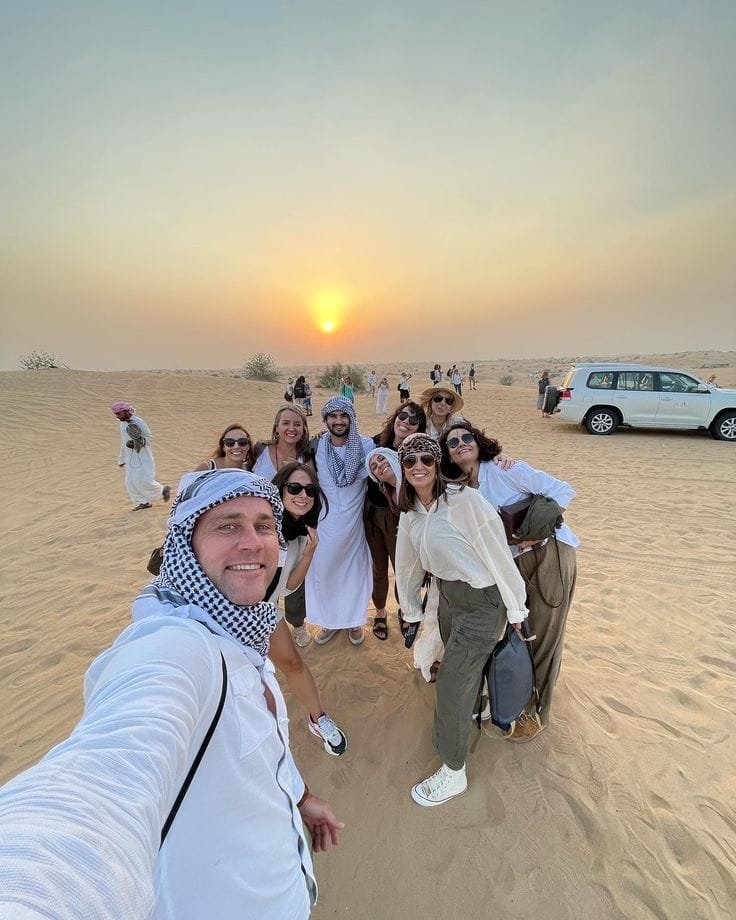
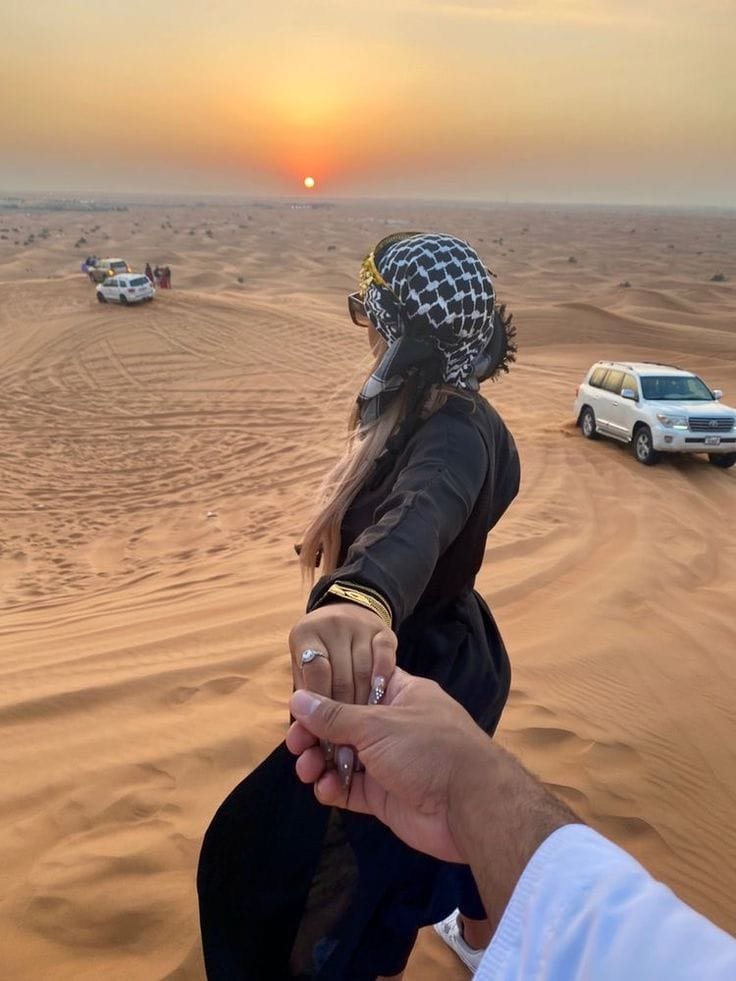
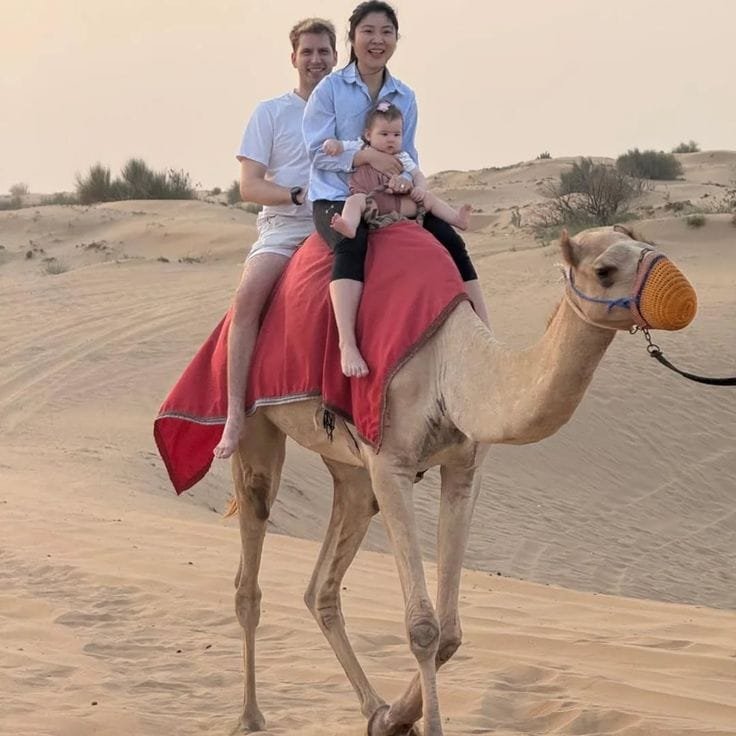
The Fleet at Work


Planning the Rest of Your Abu Dhabi Trip
Most guests who book the dunes with us also want a day in the capital. These guides cover the practical detail:
- a car with driver in Abu Dhabi — hiring a car with a driver by the hour or the day
If we have to cancel, what happens?
A cancellation policy that covers your obligations but not ours is only half a document. Here is our side of it, in writing.
If we have to cancel your booking — for weather, a vehicle issue, or driver illness — we will contact you as soon as we know and rebook you at no charge on the next date that works for you. You pay nothing for the cancelled booking.
If we need to send a different vehicle than the one you booked, we will ask you first rather than turning up in something you did not book.
This is separate from your own cancellation rights, which are unchanged: you can cancel free up to 12 hours before pickup. Because we take no deposit and no booking fee, there is no money of yours sitting with us either way — nothing to chase, and nothing to wait for.
Desert safari Abu Dhabi: the timeline, hour by hour
This is how the evening actually runs, from pickup to drop-off. The sunset stop moves with the season; everything around it holds.
| Time | Stage | What happens |
|---|---|---|
| 3:00 – 3:30 PM | Pickup | Hotel, residence or an agreed pickup point in Abu Dhabi — or drive yourself to the camp using the GPS pin we send. |
| 3:30 – 4:10 PM | Drive to Al Khatim | About forty minutes from the city to the Al Khatim dunes. |
| 4:10 – 5:00 PM | Dune bashing | Tyres are deflated, then a 4×4 run across the dunes. Tell your driver if you want it gentle or lively — you set the intensity. |
| 5:00 – 6:30 PM | Camp activities | Camel ride, sandboarding, falcon photos, henna and Arabic costumes. |
| ~5:30 – 6:00 PM | Sunset stop | The photo stop on a high dune. This one moves with the sunset rather than the clock, so it shifts through the year. |
| 6:30 PM | Starters served | Arabic coffee, dates and welcome starters as the lamps come on. |
| 7:00 – 9:30 PM | Dinner and 8 live shows | BBQ buffet with separate vegetarian and halal non-vegetarian lines, plus unlimited soft drinks, water, tea and coffee — alongside eight live performances including belly dance, the LED Tanoura, and a fire show. Shisha in the designated area. |
| 9:30 – 10:00 PM | Wind-down | Stargazing away from the lamps, then the vehicles load for the drive back. |
| 10:00 – 10:30 PM | Drop-off | Back at your Abu Dhabi hotel or pickup point. |
Times are the standard evening run and shift a little with traffic and the sunset. Your confirmed pickup time is the one we send on WhatsApp the day before.