: The Short Answer
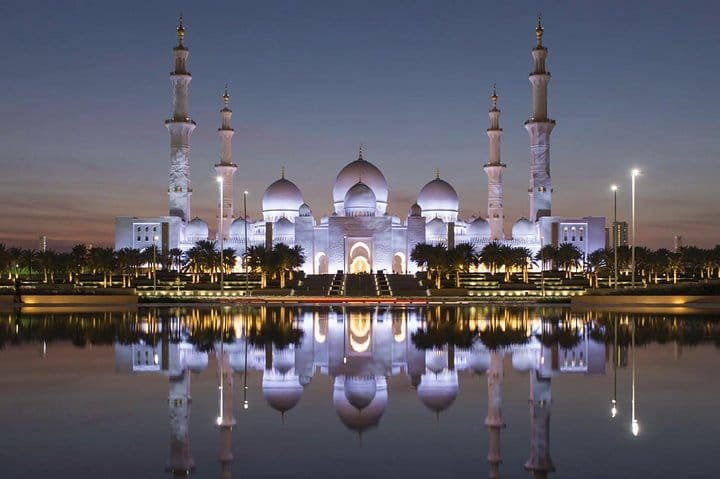
Thirty-one colossal tablets leaning on one another, the names of the fallen, and the Grand Mosque reflected in still water across the road — the twenty minutes most visitors never knew their itinerary was missing.
- How long do you need there? +: Twenty to forty minutes covers the tablets, the Pavilion and the plaza. Paired with the mosque across the road, the two together make one unhurried half-day chapter.
- When is the best time to visit? +: Late afternoon through evening — low sun on the aluminium, then the night lighting with the mosque glowing opposite.
- Is it suitable for children? +: Children are welcome, but this is a memorial rather than an activity. Younger children generally manage the open plaza and the visitor centre galleries better than the Pavilion of Honour, which is dim and sombre.
- What is the meaning of Wahat Al Karama? +: “Oasis of Dignity” in Arabic — the UAE’s permanent national memorial honouring Emiratis who gave their lives in service, opened in 2016 opposite the Sheikh Zayed Grand Mosque.
- Is there an admission fee for Wahat Al Karama? +: No. Entry is free for all visitors. It is a working national memorial rather than a ticketed attraction.
Wahat Al KaramaThe Oasis of Dignity. Free. Unforgettable.
Thirty-one colossal tablets leaning on one another, the names of the fallen, and the Grand Mosque reflected in still water across the road — the twenty minutes most visitors never knew their itinerary was missing. Two minutes from the mosque — on a per-car tour, the stop adds minutes, not dirhams.
- No deposit
- Free cancellation
- Pay on the day
- Free entry · opposite the mosque
one flat price
See Wahat Al Karama the Right Way
Twenty minutes that change the whole day — paired with the Grand Mosque on every tour we run.
 Ask on WhatsApp
Mosque + Memorial Pairing
The Grand Mosque’s marble, then the tablets across the road — timed so you catch the Honour Guard before sunset.
- Private car + driver-guide
- Dress-code briefing included
- Reflection-pool photo stop
 From AED 35 per person
Memorial by Day, Dunes by Night
Mosque and memorial in the afternoon, then straight to the desert for dune bashing and a BBQ camp evening.
- Dune bashing + camp evening
- BBQ dinner + live shows
- AED 50 coach · AED 100 pickup
 Ask on WhatsApp
Full-Day Private City Tour
Mosque, memorial, Corniche, palaces and Saadiyat — the whole capital with one driver, one price per car.
- One price per car, up to 7
- Hotel pickup + drop-off
- From Dubai on request

Abu Dhabi’s Own City Tour Operator — Not a Booking Middleman
Our fleet and our drivers are our own — no subcontracted coaches, no rented guides.
Best Desert Safari Operator
Recognised for consistently delivering the region’s finest dune and camp experience.
Leading Tour Operator
A trusted name across Abu Dhabi and Dubai tourism, from desert safaris to city tours.
Best Adventure Experience
Honoured for dune bashing, dune buggies and adrenaline done safely and unforgettably.
Best Customer Service
Awarded for our guest-first care — from the first WhatsApp reply to the drive home.
Best Luxury Experience
Celebrated for our private tours and premium, fully-exclusive Abu Dhabi itineraries.
No deposit. No cancellation fee. Confirm on WhatsApp in minutes and pay your driver on the day.
The Numbers and the Metal: What You Are Actually Looking At
The site spans 46,000 square metres directly opposite the Sheikh Zayed Grand Mosque, and everything in it is deliberate. The Memorial itself — by British artist Idris Khan — is 31 massive leaning tablets clad in aluminium, each one resting against the next: the design’s whole argument is that nobody stands alone. Look closely and the tablets carry poems and quotations in simple script, with the long spine at the base bearing the Armed Forces’ pledge of allegiance.
The Memorial Plaza around it is paved in travertine and ringed by amphitheatre seating for up to 1,200 people, with a shallow pool that catches both the tablets and the Grand Mosque’s domes in one reflection — the photograph everyone leaves with. Beyond it, the Pavilion of Honour is the part that stops people: a circular room whose walls carry the names of the UAE’s fallen, each engraved on panels cast from metal reclaimed from the Armed Forces’ own vehicles. At its centre, seven glass panels — one for each emirate — carry the Pledge of Allegiance. The visitor centre adds four interactive galleries and a souvenir shop.
Hours, Tours and the Honour Guard
Entry is free of charge. Abu Dhabi’s tourism board lists the visitor centre from 9am to 7pm, guided-tour bookings from 10am to 6pm (tours run in English and Arabic, last tour 6pm), and — the detail almost nobody prints — the Memorial Plaza area open 24 hours. That last fact matters more than it looks: the tablets under floodlight with the mosque glowing across the road is one of the capital’s great night scenes, and it is why we can include Wahat Al Karama even on a late-night layover tour when every museum is shut.
Time your daytime visit around the daily Honour Guard march at the Memorial before sunset — five unhurried minutes of ceremony that turn the monument from architecture into remembrance.
Getting There: The Shuttle and the Bridge
The pairing with the Grand Mosque is built into the site itself: regular shuttle buses run to and from the mosque, and a pedestrian bridge links the two directly. On our city tours the driver simply repositions the car — you walk out of the mosque’s cool marble, and two minutes later you are standing in front of the tablets, with no parking or taxi negotiation in between. The site sits on Sheikh Rashid Bin Saeed Street; the visitor centre answers on +971 2 668 1000.
Wahat Al Karama — Quick Answers
- What does Wahat Al Karama mean?
- “Oasis of Dignity” — the UAE’s national memorial to its fallen soldiers and service members, opened in 2016 directly across from the Sheikh Zayed Grand Mosque.
- Is there an admission fee?
- No — entry is free. It is a national memorial, open to visitors of every nationality and faith.
- What will I actually see?
- Thirty-one colossal aluminium-clad tablets leaning against one another — each supporting the next, the way soldiers support each other — a Pavilion of Honour bearing the names of the fallen, and a still pool that mirrors the Grand Mosque’s domes across the road.
- How long does a visit take?
- Twenty to forty minutes. It is a place of pause, not a museum crawl — which is why it slots perfectly beside the mosque visit on a city tour.
- When is the best time?
- Late afternoon into evening: the tablets catch the low sun, and after dark the memorial and the mosque light each other across the water.
- Why is it famous?
- It answers a question most visitors never think to ask: what the UAE built to honour sacrifice — and it does so with one of the most photographed pieces of monumental art in the Gulf.
The memorial that faces the mosque
Stand in the Memorial Plaza and the geometry explains itself: the leaning tablets frame the Sheikh Zayed Grand Mosque across the road, and the reflecting pool doubles its domes at your feet. The placement is deliberate — the nation’s house of worship and its monument to sacrifice regarding one another. Most tour buses drive past it. Most visitors who stop call it the most unexpectedly moving twenty minutes of their trip.
The heart of the site is the sculpture by artist Idris Khan: 31 monumental tablets, clad in aluminium panels, each one tilted into the next so that no tablet stands alone. Inscribed across them are verses, pledges and the words of the UAE’s founding leaders. Walk between them and the scale reorganises itself with every step — that shifting perspective is the photograph everyone takes and no phone screen quite captures.
The three parts of the site
| Space | What it is | Give it |
|---|---|---|
| The Memorial | The 31 leaning tablets — walk through them, not just past them | 15 min |
| Pavilion of Honour | A quiet hall bearing the names of the fallen; glass panels made from recast military metal | 10 min |
| Memorial Plaza & pool | The amphitheatre space with the mosque reflected in still water | 10 min — longest at sunset |
Visiting practicalities
- Entry is free; the site is managed as a national memorial — conduct matters more than tickets.
- Dress respectfully — you are almost certainly combining this with the mosque anyway, so the same modest clothing carries across the road.
- Quiet is the etiquette in the Pavilion of Honour; photography is welcome outside, restrained inside.
- Hours shift seasonally and around national occasions — confirm on the day, or let the driver time it; evenings are the reliable window.
- Parking exists on site, but on a tour day the car simply waits — the mosque-to-memorial hop takes two minutes.
Why tours pair it with the Grand Mosque — and why ours does it properly
Search any “Grand Mosque tour” listing and Wahat Al Karama appears as the bolt-on — because the two sites sit opposite each other and speak to each other. The difference is time: coach itineraries allow a photo from the car park. On a private city tour the stop costs nothing to extend — walk the tablets, sit in the plaza, and leave when it has done its work. Coming from Dubai, it folds into the full-day route between the mosque interior visit and the Corniche run — and if you are building your own day from our packages, tell the driver you want the memorial at golden hour and he will run the loop backwards to make it happen.
National Day, remembrance and the days it matters most
Around Commemoration Day (30 November) and National Day (2 December) the memorial becomes what it was built for — wreaths, ceremonies, and Emirati families visiting in numbers. It is busier, and better: visiting in that week, you see the country honouring its own rather than a monument standing quiet. Plan a morning slot those days, and expect security to direct the flow.
Reading the tablets: what the design is actually saying
Idris Khan’s design works on a single idea repeated at overwhelming scale: no tablet stands alone. Each of the 31 slabs — some rising over twenty metres — transfers its weight into the next, so removing any one would fail the whole. That is the memorial’s entire argument about service rendered in aluminium and steel: individual sacrifice holding up collective life. Look closely at the panels and the surfaces carry cast texts — poetry, pledges, and words from the founding leaders about loyalty and duty. Guides here do not need scripts; the structure does the explaining, and the best thing a visitor can do is slow down inside it.
The engineering deserves a sentence of its own: the lean is real, not visual trickery, and the tablets were among the largest single art-fabrication jobs ever undertaken in the region. From the plaza the composition reads as chaos resolving into order as you move — which is exactly the effect photographers chase at dusk, when the aluminium goes from silver to bronze in the space of twenty minutes.
From the Grand Mosque to Wahat Al Karama: the two-minute transfer
The search phrase “grand mosque to wahat al karama” exists because people assume there must be a trick to it. There is not: the memorial sits directly across Sheikh Rashid Bin Saeed Street from the mosque complex — by car it is one signal, roughly two minutes gate to gate. On foot it is possible but unpleasant in the warm months; the crossing is long and shade is scarce. On our tours the driver simply repositions while you finish at the mosque and is standing at the memorial drop-off when you walk out — the transfer costs the day nothing, which is why we treat the pair as one stop with two moods: the mosque’s grandeur, then the memorial’s stillness.
How it compares: memorials worth pairing on a UAE trip
| Site | What it honours | Feel |
|---|---|---|
| Wahat Al Karama, Abu Dhabi | The UAE’s fallen service members | Monumental, contemplative, architectural |
| Founder’s Memorial, Corniche end | Sheikh Zayed himself — The Constellation light sculpture | Artistic, best after dark |
| Qasr Al Hosn, downtown | The city’s origin — the 1790s fort | Historical, museum-paced |
All three fit a single thoughtful day for visitors who want the capital’s story rather than only its skyline — tell the driver “the memory route” and the loop assembles itself.
Frequently Asked Questions
What is the meaning of Wahat Al Karama? +
“Oasis of Dignity” in Arabic — the UAE’s permanent national memorial honouring Emiratis who gave their lives in service, opened in 2016 opposite the Sheikh Zayed Grand Mosque.
Is there an admission fee for Wahat Al Karama? +
No. Entry is free for all visitors. It is a working national memorial rather than a ticketed attraction.
What is Wahat Al Karama famous for? +
The monument of 31 colossal leaning tablets by artist Idris Khan — each tablet supporting the next — the Pavilion of Honour bearing the names of the fallen, and the reflecting pool that mirrors the Grand Mosque.
How long do you need there? +
Twenty to forty minutes covers the tablets, the Pavilion and the plaza. Paired with the mosque across the road, the two together make one unhurried half-day chapter.
Can I visit Wahat Al Karama and the Grand Mosque together? +
They face each other across the road — two minutes apart by car. Every one of our city tours can pair them; the same modest dress works for both.
When is the best time to visit? +
Late afternoon through evening — low sun on the aluminium, then the night lighting with the mosque glowing opposite. Around Commemoration Day (30 November) it is busiest and most meaningful.
Is photography allowed? +
Yes, freely around the memorial and plaza; keep it restrained inside the Pavilion of Honour, which is treated as a space of remembrance.
Does your city tour stop here? +
On request, always — it adds minutes, not dirhams, to a per-car tour. Most guests pair it with the mosque visit; tell the driver and it is done.
Can tourists visit Wahat Al Karama?
Yes — it is open to the public and free of charge, and visitors are warmly received. The visitor centre operates 9am–7pm with guided tours in English and Arabic (last tour 6pm), and the Memorial Plaza area itself is open 24 hours.
What is the dress code for visiting Wahat Al Karama?
There is no gate check like the Grand Mosque’s, but this is a national memorial: modest, respectful dress is the right call — shoulders and knees covered is a good rule. If you are visiting the mosque the same hour (most people do), the same outfit serves both.
What does Wahat Al Karama mean?
It translates from Arabic as “Oasis of Dignity.” The site honours Emirati soldiers, police, diplomats and civilians who gave their lives in service of the UAE since 1971, and was inaugurated on Commemoration Day in 2016.
When is the Honour Guard march at Wahat Al Karama?
A daily Honour Guard march takes place at the Memorial before sunset. If you are pairing the memorial with a Grand Mosque visit, aim to reach the plaza in the last hour before sundown to catch it — then watch the mosque’s lighting come on across the road.
Can you visit Wahat Al Karama at night?
Yes — the Memorial Plaza area is open 24 hours, and the floodlit tablets with the illuminated Grand Mosque across the road make it one of Abu Dhabi’s best free night views. The visitor centre and guided tours keep daytime hours.
Twenty minutes that change the whole day
Mosque interior at opening, the memorial while the light is low, then the Corniche run home — one car, one driver, one unhurried loop. Send your date on WhatsApp and the per-car quote comes back in minutes.
What everyone actually charges — and what it means for your group
Most operators quote per person. We quote per vehicle. That difference is invisible when you are travelling alone and decisive when you are four. These are the advertised rates of the operators currently on page one, read off their own booking pages.
| Operator | Advertised rate | 2 guests | 4 guests | 6 guests |
|---|---|---|---|---|
| Royal Arabian Safari — private car | AED 599 per car | AED 599 | AED 599 | AED 599 |
| Operator A — shared seat | AED 130 per person | AED 260 | AED 520 | AED 780 |
| Operator B — shared seat | AED 125 adult / 115 child | AED 250 | AED 500 | AED 750 |
| Operator C — half day | AED 170 per person | AED 340 | AED 680 | AED 1,020 |
| Operator D — shared coach | AED 120–180 per person | AED 240–360 | AED 480–720 | AED 720–1,080 |
The honest reading: if you are travelling as a couple, a shared seat is cheaper than our private car and we will tell you so. From three guests upward the per-car price wins, and from four it is not close. You are also not sharing a coach with forty strangers, not waiting at four hotel pickups before you start, and not tied to someone else’s schedule at the mosque.
Rates were read directly from each operator’s public booking page in July. Operators are unnamed deliberately — prices change, and this is a comparison of pricing models, not an attack on anyone. Check them yourself before you book.
Planning an evening too? See the complete guide to Abu Dhabi at night — free spots, timings and the private night tour.
Add Wahat Al Karama to Your Day
Free to visit — the value is in the timing. We pair it with the mosque and the Honour Guard on every route.
Book this tour
No deposit and no card details. Message us and we confirm the plan and the exact price before you commit — answered at any hour.
- Send your date and guest countYour date, how many of you, and where we collect from. That is all we need.
- We send the plan and the pricePer car, not per person. You see the route, the timings and the exact figure first.
- Pay the driver on the dayCash or card, after the run. Free cancellation up to 12 hours before pickup.
Answered 24 hours · No deposit · No booking fee · Licensed operator
If we have to cancel, what happens?
A cancellation policy that covers your obligations but not ours is only half a document. Here is our side of it, in writing.
If we have to cancel your booking — for weather, a vehicle issue, or driver illness — we will contact you as soon as we know and rebook you at no charge on the next date that works for you. You pay nothing for the cancelled booking.
If we need to send a different vehicle than the one you booked, we will ask you first rather than turning up in something you did not book.
This is separate from your own cancellation rights, which are unchanged: you can cancel free up to 12 hours before pickup. Because we take no deposit and no booking fee, there is no money of yours sitting with us either way — nothing to chase, and nothing to wait for.